

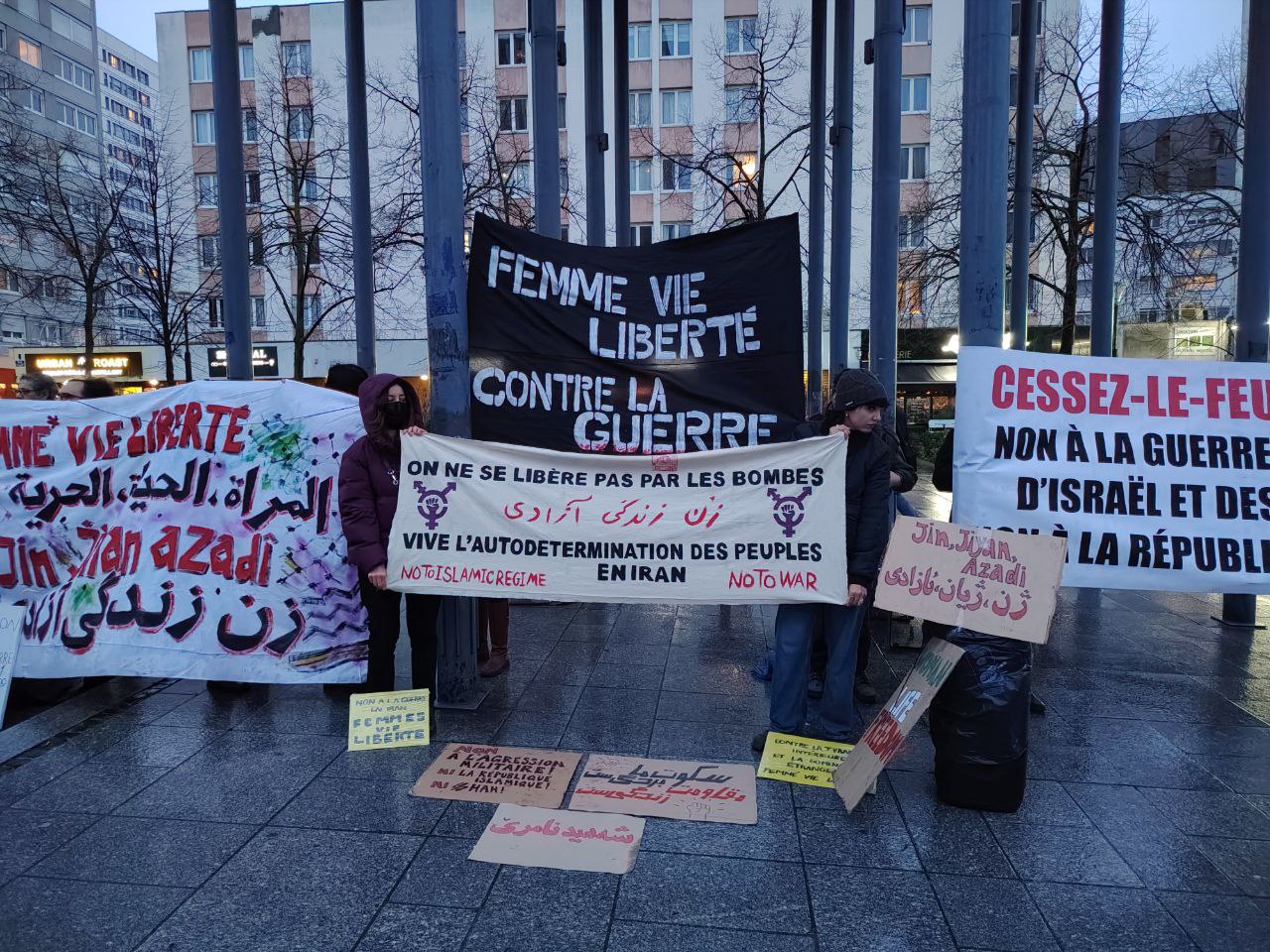
The essay argues that repression and exile weakened the Iranian left’s organizational base, while war and diaspora media amplify monarchist visibility over socially rooted political capacity.
Mohammad-Reza Nikfar proposes a distinction that is both conceptual and practical: in Persian usage, مخالف (mokhālef, dissenter/opponent) is often treated as synonymous with اپوزیسیون (opozīsiyūn, opposition). Nikfar argues that they should not be. “Opposition” is not a prestige label; it implies capacity—the ability to organize, endure, and shape events, rather than merely comment on them. In that sense, the diaspora may contain many مخالفان تبعیدی (mokhālefān-e tab‘īdī, exiled dissenters/opponents) without constituting “the opposition” in any stronger political sense (Nikfar, 2017).
Starting from that distinction, this essay argues that the Iranian left’s post-1979 predicament is best understood as a long history of disembeddedness whose stakes have become sharper in the current wartime conjuncture. Over decades, repression inside Iran destroyed durable left institutions and pushed political activity into exilic arenas oriented less toward organization than toward representation, media visibility, and symbolic leadership. As armed conflict, succession struggles, and foreign talk of leadership change reorder the field, socially embedded actors inside Iran become harder to hear, while more legible exilic figures gain disproportionate visibility (Khosravi, 2018; Malek, 2023; Office of the United Nations High Commissioner for Human Rights [OHCHR], 2026; Reuters, 2026a, 2026b, 2026g; Sadaqat, 2024).
The central question is therefore both historical and conjunctural: why has the diaspora left—despite organizational experience and ideological resources—struggled to turn critique into scalable collective capacity, and what becomes of that problem when wartime conditions reward visibility over organization even more strongly? The monarchist camp enters here as a comparative countercase. Its recent ability to stage mass mobilizations in diaspora settings helps isolate mechanisms that advantage certain political forms under exile—especially class-selective exit, nostalgia-producing media, and leader-centered coordination. These mechanisms do not fully explain the left’s crisis, but they do clarify the terrain on which it has been trying, and often failing, to rebuild capacity outside Iran (Azizi, 2023; Khosravi, 2018; Malek, 2023; Sadaqat, 2024; Shams, 2025).
Institutional Decline: The Iranian Left’s Loss of Social Embeddedness
One correction matters at the outset because it guards against retrospective mythmaking. The Iranian left was not socially marginal immediately after 1979. Moghadam’s analysis of the revolutionary period emphasizes the substantial reach and mobilizing capacity of left organizations before repression and fragmentation deepened. She argues, too, that the early 1980s marked a decisive turning point, when the political field was violently reorganized and the left was pushed out of key arenas of struggle (Moghadam, 1987).
Repression is not merely the backdrop to this story; it is constitutive of it. The consolidation of the Islamic Republic in the early 1980s brought waves of arrests and executions that shattered the institutional continuity required for long-term organization. The 1988 prison massacres intensified that destruction. Amnesty International documents that between July and September 1988 thousands of political prisoners were forcibly disappeared and extrajudicially executed, followed by systematic concealment and intimidation of families (Amnesty International, 2018).
For the purposes of this essay, 1988 matters not only as atrocity but as organizational decapitation. It eliminated cadres, destroyed networks, and severed intergenerational transmission. A left can survive defeat; it struggles to survive the repeated destruction of the human infrastructure through which organizing knowledge and trust are reproduced (Amnesty International, 2018; Moghadam, 1987).
Displacement and Adaptation: Exile’s Shift from Organization to Representation
Exile did not simply relocate Iranian political forces; it changed what kinds of politics were easier to practice. Khosravi’s ethnographic account of Iranians in Sweden warns against treating “the diaspora” as a coherent bloc and instead emphasizes conflict, internal exclusion, and fragmentation along multiple axes, including ideology, class, gender, and migration histories (Khosravi, 2018). Malek similarly stresses persistent fragmentation and the difficulty of turning calls for unity into institutionalized cooperation, especially in the wake of Woman, Life, Freedom (Malek, 2023).
Persian critical debate names a related problem in its own vocabulary. In a widely read intervention, Parviz Sadaqat describes a core issue as “theoretical disorientation” in Iranian left discourse: the inability to formulate a relatively coherent left program capable of praxis under contemporary conditions (Sadaqat, 2024). Whether or not one accepts his diagnosis in full, the text shows that the left’s problem of praxis and organization is being debated directly within Persian critical writing, not merely asserted from outside (Sadaqat, 2024).
Taken together, these sources support a careful claim: in diaspora settings, where durable membership organizations are weak and accountability to lived experience and workplace struggle inside Iran is limited, politics is pulled toward representation—who speaks for “Iran”—as well as media visibility and boundary work around purity and legitimacy. Under such conditions, factional memory can expand while incentives for slow institution-building shrink. Wartime politics intensifies this tendency by further narrowing the channels through which actors inside Iran can speak safely, while rewarding those already legible to foreign states, news media, and diaspora publics (Khosravi, 2018; Malek, 2023; OHCHR, 2026; Reuters, 2026d).
The same structural shift also helps explain a pattern often noted in exilic left milieus: ideological disputes can become unusually intense and durable because disagreements are less often corrected by the discipline of practice—membership routines, workplace organizing, collective risk, and strategic testing on the ground. One early study of Iranian exiles describes left/progressive factions as scattered across Europe and the United States, showing how dispersion and weak organizational anchoring can lead to fragmentation rather than consolidation (Sreberny-Mohammadi & Mohammadi, 1987). More recently, a Radio Zamaneh analysis describes the diaspora as a parallel arena with its own incentives and legitimacy tests—including “ideological inheritance”—that can intensify factional conflict without reorganizing politics inside Iran (Haghighi, 2026).
In this sense, heightened ideological contestation is better understood as a symptom of weak organizational anchoring than as a sufficient explanation in itself. That interpretation sets up the next question: why does the diaspora left persist as an ecosystem of parties and networks while its mobilization capacity remains limited?
Diaspora Dynamics: Constraints on the Left’s Mobilization Capacity
None of this means the diaspora left is absent. It includes longstanding Marxist currents and parties—among them the Worker-Communist Party of Iran and the Left Party of Iran—alongside smaller Marxist-Leninist and Maoist formations and a wider ecosystem of cultural and solidarity initiatives (Azizi, 2023).
But the central issue is mobilization capacity, not mere existence. Azizi notes that diaspora left parties can “sometimes mobilize a few hundred people,” while citing an unusually large leftist gathering in Cologne in April 2023 that brought together “over 1,000” (Azizi, 2023). That empirical baseline matters because it keeps the argument from sliding into impressionism. The diaspora left does mobilize, but usually at the scale of the hundreds, reaching around a thousand only in exceptional moments (Azizi, 2023).
This limitation is more than a failure of will. It reflects a broader structural problem: left mobilization has historically relied on embedded institutions—unions, councils, associations—and those are precisely the institutions repression inside Iran has most aggressively targeted. Exile, meanwhile, has struggled to replace them with membership-based structures capable of scaling beyond already committed milieus. In wartime, that asymmetry grows more consequential, because journalists, states, and transnational audiences quickly seek visible interlocutors, favoring actor-centered brands over slower, risk-bearing organizational forms (Khosravi, 2018; Moghadam, 1987; Reuters, 2026b; Shams, 2025).
Nostalgic Narratives: Media, Class Migration, and Monarchist Coordination in Exile
A major reason Pahlavi-coded politics has recently scaled in diaspora spaces is not simply deep organizational strength, but media infrastructure capable of producing a coherent emotional narrative at high frequency. Discourse analysis of Manoto’s programming identifies a pattern of meaning-making that positively represents the Pahlavi monarchy and links it to a nostalgic past through framing strategies that naturalize specific assumptions and political imaginaries (Soltani & Tafreshi, 2015). Other analyses argue that Manoto helped normalize royalist discourse through polished political-archival content and a steady aesthetic of “lost modernity,” while linking this to regime-change projects that treat Reza Pahlavi as a legible focal figure (Shams, 2025). Parallel analysis describes diaspora monarchist networks as staging a comeback through satellite television and viral content while recasting the Pahlavi dynasty as a “golden age” (Messager, 2025).
Recent analyses argue that while Manoto functions as a cultural-entertainment base for a “Pahlavi golden age” storyline, Iran International has increasingly operated as the hard-news political platform for Pahlavi-linked regime-change currents, especially after 2022, reinforcing Reza Pahlavi’s legibility across diaspora media circuits (Emami, 2026; Messager, 2025; Shams, 2025). That legibility also extends beyond media. Pahlavi’s public visit to Israel in 2023 and his meetings with Volodymyr Zelenskyy in February and March 2026 show how a monarchist figure with name recognition can turn diasporic visibility into diplomatic access. This does not necessarily indicate rootedness inside Iran, but it does show how representational politics rewards actors already intelligible to foreign states, journalists, and lobbying networks (President of Ukraine, 2026; Reuters, 2023; Reuters, 2026f; Reuters, 2026h).
This is where Gramsci’s line on the interregnum is useful, if handled carefully. His well-known formulation—often rendered as “the old is dying and the new cannot be born … in this interregnum a great variety of morbid symptoms appear”—describes a crisis in which the future lacks a legible institutional form. In such a vacuum, nostalgia becomes a political resource. It offers ready-made coherence, symbols, and affective certainty when new organizational forms remain fragile or absent (Gramsci, 1971; The Guardian, 2026).
The class dimension matters here as well. The ability to “exit” Iran has often been socially selective, especially in the case of sustained educational and professional migration, and this can weight diaspora public space toward middle-class and professional horizons. Koo’s chapter on the pursuit of zendegī-ye normal (“normal life”) explicitly situates contemporary overseas migration in relation to upper-middle-class and elite educational migration, while noting that durable residence abroad is most feasible for those with greater resources, even when the desire to leave cuts across classes (Koo, 2023). In Sweden, Behtoui’s study of migrants of Iranian origin, particularly their upward social mobility, supports the broader view that many Iranians in destination countries have high levels of education and professional success (Behtoui, 2022). In the United States, Pew’s 2026 analysis of 2024 ACS data reports very high educational attainment among Iranian Americans (Pew Research Center, 2026).
This does not mean the diaspora is socially uniform, nor that refugees and asylum seekers are absent. It does mean, however, that diaspora political space can be disproportionately shaped by groups for whom “freedom” is often imagined through the idiom of normalcy—everyday social liberties, lifestyle autonomy, and consumer modernity—rather than through the institutional language of class organization. Koo’s “normal life” framework anchors this orientation empirically, while broader monarchist media strategies offer a ready-made story that packages “normal life” as a recoverable national past tied to a dynastic name (Koo, 2023; Soltani & Tafreshi, 2015; Shams, 2025).
The second mechanism is leader-centered coordination. Even when monarchist organizations are not deeply institutionalized, a single symbolic center lowers coordination costs: one name, one flag repertoire, one face for media amplification. Azizi explicitly identifies Pahlavi’s name recognition as a major advantage in diaspora politics, a point echoed in Reuters’s description of him as the best-known anti-regime figure abroad (Azizi, 2023; Reuters, 2026f).
This is visible in mobilization evidence. On February 14, 2026, the Associated Press reported that police estimated about 250,000 participants in Munich at a protest answering a call from Reza Pahlavi, while Die Welt reported a far lower figure—around 15,000—for the same event. The exact number is therefore contested, but the broader pattern remains clear: Pahlavi-coded mobilization can, at certain moments, reach an order of magnitude beyond the hundreds-scale mobilization more typical of diaspora-left events (Associated Press, 2026; Azizi, 2023; Die Welt, 2026).
A third constraint is anti-left stigma within opposition ecosystems. Persian commentary explicitly discusses چپهراسی (chap-harāsī, left-phobia) as a contemporary phenomenon that collapses diverse left traditions into caricature and fuels delegitimation (Radio Zamaneh, 2024). Azizi likewise notes hostility toward leftists within parts of monarchist milieus (Azizi, 2023). Together, these sources help explain how the diaspora left can lose public space even when its organizational critique is coherent, because it faces not only coordination disadvantages but also active symbolic marginalization (Radio Zamaneh, 2024; Azizi, 2023).
Persistent Struggles: The Domestic Left’s Embeddedness Amid Repression
The danger of diaspora-centric analysis is that it mistakes rallies abroad for political strength. The left’s strongest claim to social embeddedness has historically rested on its relation to workplaces, teachers, students, and civic organization inside Iran—precisely the spaces the Islamic Republic has worked hardest to suppress. Human Rights Watch notes that independent unions are not recognized outside state-sanctioned frameworks and documents mounting obstacles to labor rights alongside recurring labor protests (Human Rights Watch, 2022a). It also documents the arrest of at least 38 teachers ahead of May 1, 2022, after calls for nationwide protests by teachers’ associations (Human Rights Watch, 2022b). In the current war, this caution becomes even more important: the louder representational competition abroad becomes, the easier it is to mistake exilic visibility for rooted social capacity inside Iran.
The Haft Tappeh case remains a key empirical anchor because it shows both the possibility of worker-led organization and the state’s response. Human Rights Watch reports on the detention of labor activist Esmail Bakhshi and journalist Sepideh Gholian, including concerns about coercion and repression surrounding torture allegations (Human Rights Watch, 2019).
Recent UN documentation reinforces the broader environment of repression after Woman, Life, Freedom. OHCHR’s press release on the Fact-Finding Mission’s September 2024 update states that Iranian authorities have intensified efforts to suppress the rights of women and girls and to crush remaining initiatives of women’s activism (OHCHR, 2024). The present war intensifies rather than suspends that dynamic. In its March 2026 statement, the Fact-Finding Mission warned that civilians were caught between ongoing armed hostilities and repression that had reached unprecedented levels and might amount to crimes against humanity; Reuters also reported arrests justified through the language of espionage, hostile media, and foreign ties (OHCHR, 2026; Reuters, 2026d). Under such conditions, even relaying voices from inside Iran becomes fraught. Actors abroad need to amplify socially grounded demands, but public identification can also heighten the exposure of labor, feminist, republican, and left actors already vulnerable to imprisonment and retaliatory repression.
Coalition Efforts: The Charter of Minimum Demands as an Example of Internal Coordination
One reason the argument about “organic relation” matters is that we can point to moments when actors inside Iran attempt to build cross-sector coordination in precisely that sense. The 2023 “Charter of the Minimum Demands” is one such document. It presents itself as a joint statement by independent trade unions and civic organizations, linking labor rights, freedom of association, and democratic demands (Campaign to Free Political Prisoners in Iran [CFPPI], 2023).
Even if such texts cannot by themselves generate durable organization under repression, they show that socially embedded coalition work is not merely a diaspora aspiration; it is attempted under extreme risk inside Iran. That contrast matters even more in wartime, when representational competition abroad intensifies just as internally rooted coordination becomes more dangerous and less publicly legible (CFPPI, 2023; OHCHR, 2026; Reuters, 2026d).
War as Conjuncture: Succession and the Intensification of Representational Politics
The war does not introduce a wholly new problem so much as concentrate tendencies already traced in this essay. Once armed conflict and succession became the dominant frame, outside powers and international media looked for legible interlocutors, and representational politics accelerated. Washington has oscillated between denying that regime change is the formal aim and speaking openly about leadership succession, while also rejecting ceasefire efforts. Trump told Reuters that the United States should have a role in choosing Iran’s next leader and named Pahlavi among those “in the mix”; at the same time, Reuters reported that U.S. intelligence assessed the regime was not at immediate risk of collapse (Reuters, 2026a, 2026b, 2026g). The significance of this contradiction is structural. When the future is narrated through succession, external sponsorship, and recognizable personalities, organization on the ground becomes harder to see even as it remains more socially consequential.
The same conjuncture helps explain why Pahlavi’s visibility matters even without demonstrating deep internal rootedness. His 2023 visit to Israel signaled a willingness to align with regional anti-Islamic Republic state actors (Reuters, 2023), and during the present war he has been received by figures such as President Volodymyr Zelenskyy (President of Ukraine, 2026; Reuters, 2026h). None of this proves that he can organize a democratic alternative inside Iran. It does show, however, how wartime politics rewards actors already translatable to foreign governments and news media. Meanwhile, the likely future remains grim: Reuters has reported that Mojtaba Khamenei’s succession points toward harsher domestic controls, while Chancellor Friedrich Merz warned against an Iraqi or Libyan scenario of collapse without democratic reconstruction (Reuters, 2026c, 2026e). War therefore expands the representational field while narrowing the space in which civil, labor, feminist, left, and republican actors inside Iran can speak safely and visibly.
Strategic Reorientation: Prioritizing Relay Over Representation
Nikfar’s recommendation to treat much of the exilic field as مخالفان (mokhālefān, dissenters/opponents) rather than “the opposition” is more than semantic policing; it is analytic discipline. It prevents media visibility from being mistaken for organizational capacity and forces realism about what building durable power would actually require (Nikfar, 2017).
On the evidence, the diaspora left is real, but its typical mobilization scale is modest—hundreds, occasionally around 1,000—while monarchist-coded mobilization can scale dramatically under conditions of nostalgia-producing media, class-selective exit, and leader-centered coordination (Azizi, 2023; Associated Press, 2026).
The deeper explanation is structural. Repression inside Iran blocks organizational work, exile pulls politics toward representation, and media systems can manufacture a coherent nostalgic narrative that aligns with “normal life” imaginaries and makes dynastic leadership unusually legible (Koo, 2023; OHCHR, 2024; Shams, 2025; Soltani & Tafreshi, 2015). War reinforces that structure. It constricts civic space inside Iran, raises the risks borne by labor, feminist, student, and republican actors on the ground, and strengthens the relative position of exilic figures already recognizable to states, journalists, and donors (OHCHR, 2026; Reuters, 2026b, 2026d, 2026h).
The most productive next move for the Iranian left abroad, then, is not to compete on monarchist spectacle or intensify factional differentiation, but to build relay infrastructures that reconnect exilic resources to struggles inside Iran without substituting representation for organization: translating and archiving statements from inside Iran, funding legal defense and detainees’ families through credible channels, amplifying priorities articulated inside Iran, and treating documents like the Charter of Minimum Demands as primary reference points rather than diaspora branding projects. Yet wartime conditions add an essential caution. Relay cannot mean reckless exposure. The task is to widen the presence of socially grounded actors while minimizing the additional risks that public amplification can impose on people already living under militarized repression (CFPPI, 2023; Human Rights Watch, 2022a; OHCHR, 2026).
References
Amnesty International. (2018). Iran: Blood-soaked secrets: Why Iran’s 1988 prison massacres are ongoing crimes against humanity.
Associated Press. (2026, February 15). Supporters of Iran’s exiled crown prince rally for regime change in Munich.
Azizi, A. (2023, October 27). Opposition politics of the Iranian diaspora: Out of many, one—but not just yet. Clingendael.
Behtoui, A. (2022). Upward mobility, despite a stigmatised identity: Immigrants of Iranian origin in Sweden. Nordic Journal of Migration Research, 12(1), 54–71. https://doi.org/10.33134/njmr.419
Campaign to Free Political Prisoners in Iran. (2023, February 16). Charter of the minimum demands of Iran’s independent trade unions and civic organisations.
Die Welt. (2026, February 14). Tausende bei Iran-Demo in München.
Emami, M. (2026, February 26). Reactionary politics in the Iranian diaspora and the crisis of international solidarity. Jadaliyya.
Gramsci, A. (1971). Selections from the prison notebooks (Q. Hoare & G. Nowell Smith, Eds. & Trans.). International Publishers.
Guardian staff. (2026, February 14). “The time of monsters”: Everyone is quoting Gramsci—but what did he actually say? The Guardian.
Haghighi, S. (2026, January 12). Iran’s protest cycles: Exclusion, contention, and the path to anti-discriminatory politics. Radio Zamaneh.
Human Rights Watch. (2019, March 18). Iran should reach out to labor leaders, not prosecute them.
Human Rights Watch. (2022a, April 29). Iran: Labor protests surge.
Human Rights Watch. (2022b, May 5). Iran: Release detained teacher activists.
Khosravi, S. (2018). A fragmented diaspora: Iranians in Sweden. Nordic Journal of Migration Research, 8(2), 73–81. https://doi.org/10.1515/njmr-2018-0013
Koo, G. Y. (2023). The choice for the “Zendegie Normal (Normal Life)”: Changes among Iranian young immigrants. In Social change in the Gulf region (pp. 249–267). Springer. https://doi.org/10.1007/978-981-19-7796-1_15
Malek, A. (2023, June 29). On unity & fragmentation in the Iranian diaspora. Society for Cultural Anthropology (Fieldsights).
Messager, A. (2025, July 28). Iran’s monarchists: Producing nostalgia, courting war. Qantara.de.
Moghadam, V. M. (1987). Socialism or anti-imperialism? The left and revolution in Iran. New Left Review, I(166).
Nikfar, M. R. (2017, June 2). سنجش مفهوم «اپوزیسیون» [Assessing the concept of “opposition”]. Radio Zamaneh.
Office of the United Nations High Commissioner for Human Rights. (2024, September 13). Iran intensifying efforts to repress women and girls on second anniversary of “Woman, Life, Freedom” protests (Press release).
Office of the United Nations High Commissioner for Human Rights. (2026, March 14). Iranian civilians caught between ongoing armed hostilities and repression that has reached unprecedented levels, which may amount to crimes against humanity, UN Fact-Finding Mission says.
Pew Research Center. (2026, March 5). 7 facts about Iranian Americans.
Radio Zamaneh. (2024, April 15). چپهراسی، از کدام چپ؟ [Left-phobia—fear of which left?].
Reuters. (2023, April 16). Son of toppled Iranian shah to visit Israel.
Reuters. (2026a, March 14). Exclusive: Trump rejects efforts to launch Iran ceasefire talks, sources say.
Reuters. (2026b, March 5). Exclusive: Trump tells Reuters US must have a role in choosing Iran’s next leader.
Reuters. (2026c, March 10). Germany’s Merz sees no plan for bringing Iran war to swift end.
Reuters. (2026d, March 10). Iran arrests dozens, including foreign national tied to US and Israel, state media reports.
Reuters. (2026e, March 9). Iran defies Trump, elevates Khamenei’s son Mojtaba as successor.
Reuters. (2026f, January 11). Son of Iran’s toppled shah seeks a role as protests expand.
Reuters. (2026g, March 11). Exclusive: US intelligence says Iran government is not at risk of collapse, say sources.
Reuters. (2026h, February 13). Zelenskiy meets Iranian opposition figure Pahlavi.
Sadaqat, P. (2024, June 7). سرگردانیهای نظری در چپ ایران [Theoretical disorientation in the Iranian left]. نقد اقتصاد سیاسی (PECritique).
Shams, A. (2025, August 6). Our man for Tehran: The U.S.- and Israel-backed campaign positioning Reza Pahlavi, son of the Shah, for regime change in Iran. Boston Review.
Soltani, S. A.-A., & Tafreshi, A.-A. (2015). A discourse analysis of Manoto TV channel programs. New Media Studies, 1(3), 125–164.
Sreberny-Mohammadi, A., & Mohammadi, A. (1987). Post-revolutionary Iranian exiles: A study in impotence. Third World Quarterly, 9(1), 108–129.The President of Ukraine. (2026, March 13). Volodymyr Zelenskyy met with the exiled Crown Prince of Iran.