

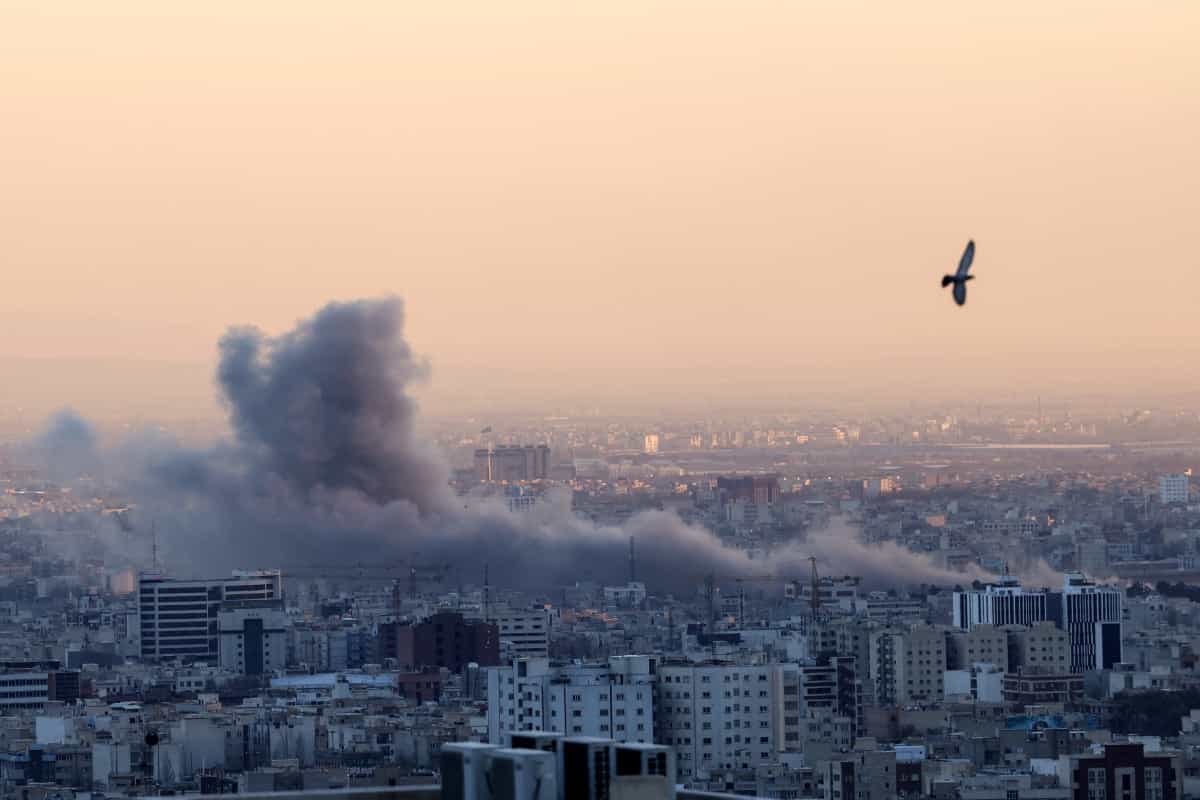
U.S. and Israeli pressure seeks leverage without owning the aftermath, while Tehran shuts down talks and bets on “non-surrender”—pushing the crisis toward a long, geo-economic war of attrition.
When the U.S. Secretary of Defense, in the first official justification, explicitly says the mission is not “nation-building” and that no “democracy-building” is supposed to come out of it—and even adds that this is not “Iraq” and will not be “endless”—it has at least one benefit: it strips away any ideological cover. The political meaning is simple: the United States does not consider itself responsible for designing Iran’s political future; its mission is to shift the balance of power, not to build the postwar order. This is precisely where the dream of “exported regime change” hits the wall of reality: the war has come to break something and impose rules, not to engineer freedom.
On the other side, Netanyahu places two propositions side by side that, read separately, can mislead—but together they reveal the war’s logic. On the one hand, he says the operation may take time, but it will not last “years” and will not become a long war; on the other hand, he tosses the ball of “government change” into Iran’s domestic court and says it is Iranians’ job to finish off the regime. The analytical translation of this duality is clear: maximum external pressure, minimum responsibility for the next order—pressure without commitment: maximum coercion from the outside, minimal ownership of what comes after—no occupation, no reconstruction, no political transition. In other words, the balance in the field is meant to change, not that anyone is meant to accept responsibility for building tomorrow.
But the other side of this deadlock is Tehran, which is not shortening the horizon of the crisis. Ali Larijani has stated bluntly that Iran will not negotiate with Trump and does not see the solution in talking to him. Abbas Araghchi, emphasizing that in the previous war they believed Iran would surrender within days but it did not, has said he sees no difference this time and has repeated the narrative of “non-surrender.” At the military level, official language does not speak of a rapid end; reports from IRGC positions suggest operations will continue “without pause” until the enemy is decisively defeated. This set of positions shows that the engine of attrition is not running only from Tel Aviv and Washington; Tehran is also an active agent and refuses to lower the crisis’s time ceiling. In such conditions, the campaign shifts from a limited operation toward an attritional confrontation that both sides define as a battle of wills, not a one-off strike.
When War Becomes a Price Tag
If Tehran accepts no political exit—no real negotiation, no practical ceasefire, no credible mediation—and the other side keeps the horizon of “change/collapse” open as a threat, the path ahead is neither a lightning victory nor a clear ceasefire. What appears more likely is a multi-layered war of attrition that simultaneously pressures both the “body of war” and the “psyche of governance”: waves of bombardment to weaken command, air defense, missile capability, and governability nodes; and in response, missile/drone/asymmetric strikes to make the continuation of war costly—not only with military aims, but with the aim of manipulating “risk” in energy and shipping.
Today, war is above all defined by “price.” Based on official statements and reports, QatarEnergy has announced that following attacks on the Ras Laffan and Mesaieed facilities—Qatar’s main LNG and energy export hubs—it halted production in some units. In plain terms, the company and its customers began warning that some shipments could be delayed or reduced if the disruption continues. This shows that the crisis has moved from the level of news to the level of contracts: the risk of war enters the legal text of obligations—meaning war is not only missiles; it is a contract clause.
The same logic explains market jumps: the shock of war has pushed oil sharply upward and jolted gas markets. Today, markets have priced scenarios before politicians—not out of moral analysis, but because shipping, insurance, and supply security have been materially threatened. When chokepoints and routes become unsafe, “war” turns into a number: premiums rise, freight rates rise, and energy is traded with a risk premium.
From this moment on, the geography of war is not only Tehran, bases, and air defenses; the geography of war is flights and maritime routes. According to an official U.S. State Department announcement, an order has been issued to evacuate non-essential personnel from several countries in the region, and at the same time reputable media have reported practical disruptions in regional flights.
Inside Iran, too, the equation is more complex than being solved by the death or removal of a single figure. The power structure is a network of armed, security, economic, and appointed institutions; removing one head does not necessarily produce “collapse,” but it creates a ruthless test: can the network reproduce decision authority or not? If the command chain functions without interruption, the short-term result leans more toward “emergency consolidation”; if economic/energy/banking/logistics disruptions become persistent, the cost of governance rises and competition over decision authority sharpens—and then the external war spills into an internal war of interpretation and authority.
Scenario 1: Multi-Layered Attrition
Here there will be neither rapid collapse nor a clear agreement; war becomes “gradual rotting.” Wave strikes continue, insurance and transport and energy operate with risk premiums, trade turns cautious, capital retreats, and governing becomes more expensive. This scenario is the most realistic because it aligns with both sides’ logic: the attacker needs to erode different capacities to impose will (without occupation), and the defender needs to impose costs to avoid surrender (without being able to “end” the war). The central danger to this scenario is a “major incident”: a miscalculation at sea/in the air/at an energy chokepoint that suddenly turns manageable attrition into an uncontrollable escalation.
Scenario 2: Forced Pause
If the energy shock and rising insurance and freight costs reach a point where allies and markets apply real political pressure, a pause emerges: not an official peace, not a grand deal, but a lowering of operational tempo or an undeclared practical ceasefire. This scenario typically activates when “war” starts to exact a “global tax”: when its costs do not remain on the two sides but spill into supply chains, inflation, and energy security. But this pause is fragile, because the fundamental issue is not resolved; it is only managed—and one incident can break it again.
Scenario 3: Threshold Jump
The worst path activates when one side concludes attrition is not enough and must escalate: a major strike on energy chokepoints/ports/sea lanes, or an action that produces heavy casualties and political consequences and forces the other side into a major response. Signs of approaching this threshold are usually a shift in official tone toward “total defeat,” movement from pinpoint attacks to paralyzing infrastructure strikes, and repeated energy spikes. This is the point where a “manageable campaign” slides toward a broader regional war.
In this framework, the transfer of responses into the domains of energy, shipping, and contracts shows that war has moved from the battlefield to the geo-economy. The near future will be determined not by slogans but by a ratio: the ratio of destructive capacity to tolerance capacity—and also the ratio between the will to continue and the cost each side can absorb. Until the threshold of a jump is broken, the more likely picture is neither immediate collapse nor decisive victory, but a period of tense attrition: a war that unfolds in the sky, in markets, and in the decision-making structures on both sides of the crisis.