

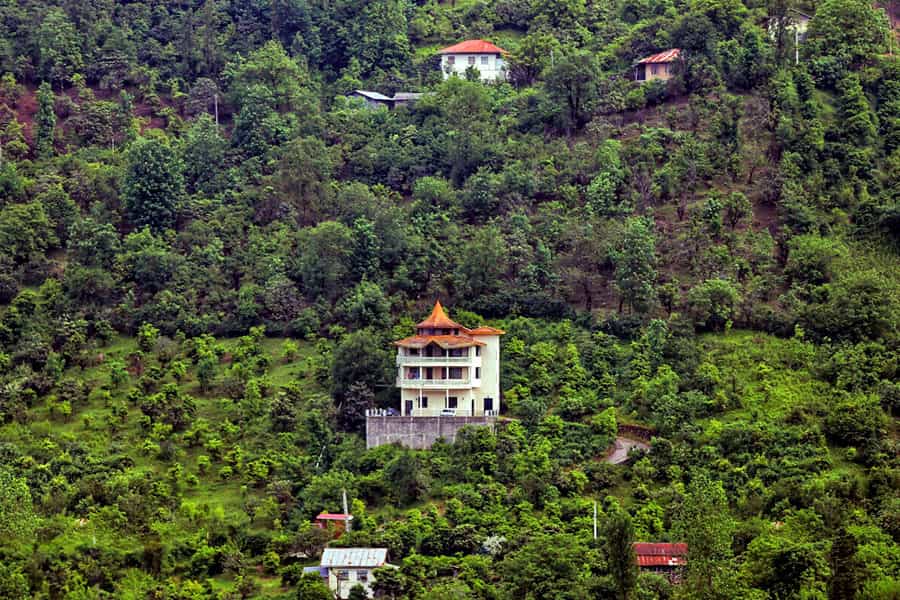
Mazandaran officials approved a deal swapping waste services for land reclassification, pulling 60+ hectares of rice paddies into village limits for villas, sidestepping legal safeguards and fueling “forest grabbing”.
Mazandaran sits on Iran’s lush Caspian coast, a sharp contrast to the country’s arid interior. Its emerald rice paddies and the ancient Hyrcanian forests (a UNESCO-listed ecosystem) make it Iran’s green belt and a magnet for tourism, second homes, and speculative real estate. Villages are governed by tarh-e hadi (local master plans) that set boundaries and land-use rules meant to protect farmland and forests. In recent years, however, agricultural and forest lands have been illegally seized and repurposed for housing. That is the backdrop to this week’s controversy: a waste-management deal that doubles as a fast track to redraw village limits and turn fertile paddies—and, increasingly, forest edges—into profitable villa plots.
Mazandaran Province is now facing a fresh land-grab scandal. Under a new deal tied to “waste management,” more than 60 hectares of rice paddies are set to be reclassified for villa construction—with provincial officials’ sign-off.
Abadgostar Mehregan, a private waste-management company, has struck a deal with the Mazandaran Provincial Waste Management Organization that critics call illegal. Under a signed and already-implemented memorandum of understanding, the company would manage waste for several towns in Mazandaran Province in exchange for rezoning and annexing over 60 hectares of paddy and agricultural land to village boundaries to enable villa building.
This arrangement has been advanced with the approval and signatures of the province’s highest judicial and executive authorities, including the governor and the chief justice of Mazandaran.
According to a report by Shargh Newspaper on Wednesday, October 22, 2025 (30 Mehr 1404), officials justified the environmentally risky deal as a way to “resolve the waste crisis” and manage a “population influx.” Notably, they linked the latter to the “12-day Iran–Israel war” and the return of large numbers of people—rationales the report says were used to legitimize the measure.
Minutes dated Saturday, September 6, 2025 (15 Shahrivar 1404), signed by Mehdi Younesi, governor of Mazandaran; Abbas Pouryani, head of the Mazandaran provincial judiciary; and other senior officials, state:
“…in order to resolve the critical waste situation in Mazandaran, and given the growth of migration to the province and its direct impact on waste, the need for housing has intensified—most evidently after the 12-day war with the Zionist regime and the return of a large number of compatriots—which pushed the province toward a critical state; with the continued rise in migration, both the waste crisis and the provision of housing are worsening.”
Rezoning in exchange for waste services
Abadgostar Mehregan signed a deal in May 2025 (Ordibehesht 1404), later approved in September 2025 (Shahrivar 1404), to run waste services for several towns in Mazandaran Province. The company also pledges to build the waste facilities and hand them over to the municipalities free of charge. In return, more than 60 hectares of the company’s farmland near four villages will be brought within the villages’ official borders and reclassified from agricultural to residential use. This reclassification is carried out with approval from the relevant municipalities, via a revision of the local village plan (tarh-e hadi). The company will pay statutory fees equal to 60% of the “value added” created by converting the land from farmland to housing.
The plan has drawn sharp criticism from environmental experts. One specialist, speaking to Shargh on condition of anonymity, said that at a meeting held in September 2025 at the Mazandaran Provincial Waste Management Organization, officials tried to justify adding a very large number of people—described as “migrants” or “second-home residents”—to four villages. This “population quota,” the expert explained, is tied directly to pulling more than 60 hectares of company farmland inside village limits, reclassifying it for housing, and then selling those new plots to incoming residents. The resulting population increase, they warned, would exceed what the villages’ approved plans allow.
Ambiguities and violations
According to Shargh, the deal bypasses the legal process and the bodies that are supposed to oversee any change in agricultural land use. In Iran’s northern provinces, rezoning paddy fields is banned by a Cabinet resolution; any exception must be approved by the Commission established under Note 1 of Article 1 of the Law on the Preservation of Agricultural Land Use. Despite that, the governor of Mazandaran and senior judicial officials—who are not members of this commission and have no authority to change land use—signed off on minutes issued by the Provincial Waste Management Organization.
A second problem is the fee pathway. As one expert told Shargh:
“A major illegality in this resolution is that Abadgostar Mehregan is supposed to pay fees into the account of the Mazandaran Provincial Waste Management Organization. By law, the governor cannot divert revenues from village master plans or rural development plans to discretionary uses; the money collected from implementing these plans must be deposited into the state treasury. On this point, the governor’s office has clearly violated the law.”
Track record of the contracting company’s management
Questions also surround the background of Abadgostar Mehregan’s director. Mohsen Ravandmand, the company’s manager, was convicted in 2011 (1390) of “acquiring property through illegal means” and received a prison sentence, along with an order to repay large sums to Bank Sepah and Bank Melli. Reports also indicate that a new case related to the company’s alleged violations is currently before the Mazandaran provincial prosecutor’s office.
Taken together, the report argues, senior provincial officials are using the “waste crisis” and migration as pretexts for land grabbing disguised as development—illegally converting more than 60 hectares of fertile northern rice paddies into villas and housing. The governor has defended the approach, saying government funds are insufficient to solve the waste problem and that “alternative financing” is necessary. Legal monitors and experts counter that this so-called alternative is flatly unlawful.
Sale of forest lands
On Tuesday, September 30, 2025 (8 Mehr 1404), environmental activists in Mazandaran exposed an attempt by the Mostazafan Foundation of the Islamic Revolution to sell one of the largest forest-and-lowland tracts in the Kelarabad–Abbasabad area.
The Foundation, which operates directly under Ali Khamenei, had already taken control of more than 980 hectares of the ancient, 50-million-year-old Hyrcanian forests in the Yalbandan section. Before the attempted sale, hundreds of old-growth trees were felled and the land was converted into private orchards to get around protections for national and forest lands.
The asking price announced for these deforested areas was 1,960 billion tomans—about USD 18 million using late-September 2025 open-market rates (≈110,000 tomans per USD)—with sweetened terms of only 10% down and the rest payable over two years.
“Forest grabbing” in the north
Across northern Iran—including Mazandaran—a network of “forest grabbers” exploits woodlands illegally: cutting trees for timber and converting forest land into farms or housing in defiance of environmental rules. The Hyrcanian forests are a prime example; about 53% of this ancient ecosystem lies in Mazandaran. Parts have been cleared for villas and residential projects, often with official backing or willful neglect, generating large profits for those involved. Beyond the ecological loss, these cases point to entrenched corruption and the abuse of political and economic power.