

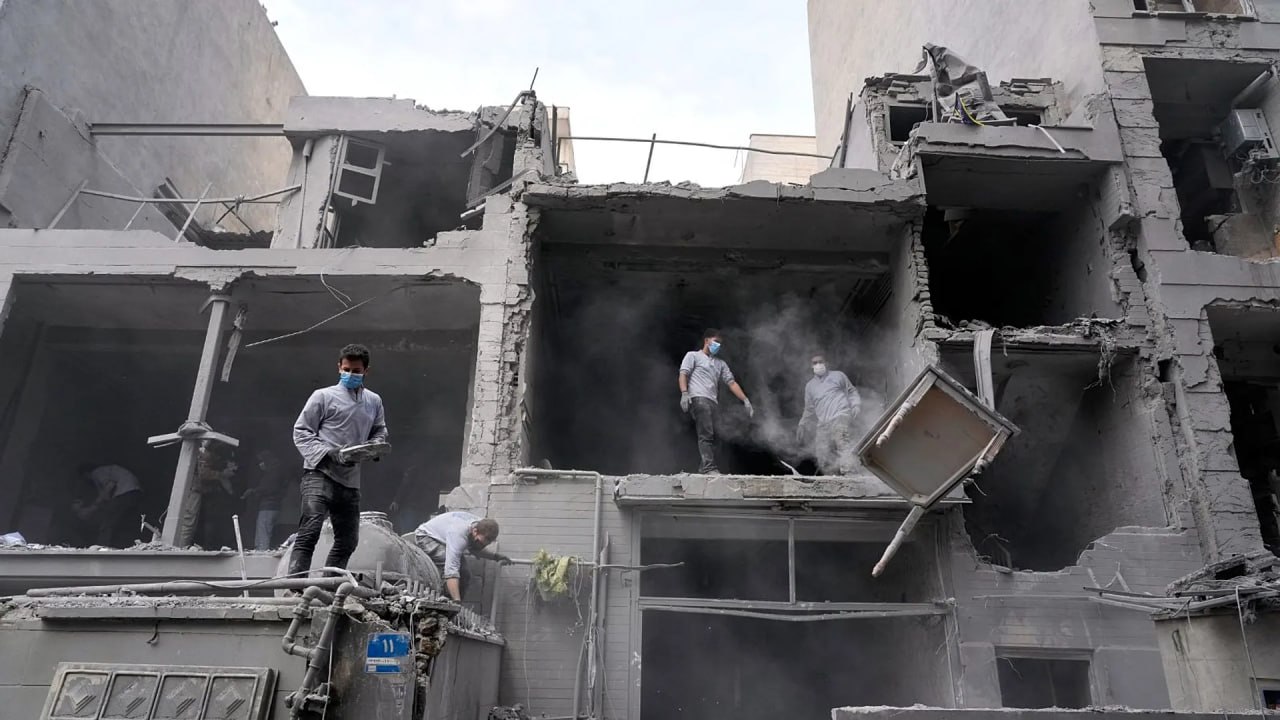
The war has deepened Iran’s housing emergency: soaring rents, stalled construction, failed state schemes, and millions pushed into residential insecurity.
In the fragile ceasefire after the war, Iran’s housing crisis has entered a new phase. Rising construction costs, stalled projects, soaring rents, and the failure of state-backed housing schemes have left millions of tenants facing insecurity, displacement, and the threat of homelessness. This report shows how war, inflation, and the rentier structure of the housing market have transformed one of life’s most basic needs into a widespread social crisis.
In the temporary ceasefire after the war, what becomes immediately visible alongside the ruins is the depth of the economic crisis. People’s purchasing power is collapsing so rapidly that even the government’s electronic food coupons — meant to help households cover basic expenses — have fallen behind inflation and rising prices. Officials have now openly acknowledged that the value of a one-million-toman coupon, about $5.70, has fallen to around 600,000 tomans, about $3.40. In other words, even the same coupon from two months ago no longer buys much.
When economists measure the value of a country’s currency, they usually look to exchange rates and gold prices. In Iran, however, the cost of housing and shelter imposes itself on both microeconomic and macroeconomic indicators. According to the director-general of the Housing Economics Office, around 31 percent of Iranians are tenants, while the rest are homeowners; another 8 percent live in institutional housing. In Tehran, however, 51 percent of residents are tenants. At the same time, Tehran has recorded the highest levels of poverty among households living in rental housing.
According to Donya-e Eqtesad in 2025, the largest number of people experiencing housing poverty live in Tehran Province. This poverty has reached such a level that even subsidized housing is now beyond the reach of a large part of the population. In recent years, the housing situation had already tightened around tenants’ throats like a fist. The recent war has intensified that pressure. Rising prices for construction materials, factory closures during the war, and sanctions have all made the housing crisis harsher than before. This report looks at the government’s National Housing scheme, as well as the rise in rents in Tehran and other major cities.
Tenants Without Shelter: War and the Housing Economy
According to findings and accounts from people active in the sector, housing prices fell by around 10 percent after the 12-day war in the summer of 2025. But this decline was caused by stagnation in a housing market that had already been frozen for years and was further deepened by the war. With the start of the second phase of war, and alongside the blow dealt to the entire economy, the housing economy came under severe pressure.
In some areas, large clusters of homes near bombed sites were destroyed. Many other homes became unsafe after shockwaves from explosions damaged buildings. Civil construction projects stopped. Construction costs rose. Shortages of materials worsened. Employers became unable to pay wages that had visibly increased under inflationary pressure. The construction workforce also shrank, partly because workers left Tehran for safer towns and partly because long-term unemployment pushed people into other jobs. Uncertainty about the future made investment in housing riskier, while the psychological behavior of people under war conditions also changed. Together, these factors made housing transactions more cautious on one side and, on the other, pushed unreal prices onto households who still needed a place to live.
During the war, the government passed a temporary measure extending leases by two months for tenants whose contracts had expired. Landlords were not allowed to raise rents or evict tenants during that period. But once the two months ended, this measure had no meaningful effect on the confusion facing tenants and people who had lost their homes. The war had already pushed housing costs upward, to a degree that even officials could no longer deny.
Mostafa Taheri, a member of parliament’s Industries and Mines Committee, said in an audio interview with Tabnak on May 4, 2026: “Everywhere else in the world, when there is war, housing becomes cheaper. How is it that in Iran housing becomes more expensive? External factors play a role in rising prices.”
But these “external factors” are obvious enough that it is strange for a member of the Industries Committee not to name them. For years, housing, land, and construction have been controlled by powerful real-estate and “construction mafias” — rent-seeking networks that have long dominated land and housing markets. They decide which areas will suddenly see land and housing prices rise, increasing the value of their own assets. Even remote villages and desert regions have not been spared this destructive policy and the vast rents built around it. These networks have turned housing into an investment commodity — and in Tehran, several other large cities, and the northern provinces, even into a luxury commodity.
It is under these conditions that, more than a month after the ceasefire, domestic media are reporting a jump in rents. Renting has pushed millions of Iranian households to the edge of economic incapacity and collective psychological collapse. There are no precise figures for the total number of tenants, but even approximate statistics point to a very large tenant population, especially in major cities.
Is the rise in rents caused by a shortage of supply and an increase in demand — meaning that there are fewer rental units than actual demand requires? The problem of empty homes shows that this is not simply a matter of too few units.
The direct effects of the war are now visible. Attacks on industrial infrastructure, including steel and petrochemical factories, have reduced the supply of construction materials and raised their prices, directly increasing housing costs. At the same time, the housing market is shaped by inflation across the whole economy. During the so-called “ceasefire”, what paralyzes the economy most is not war itself, but the open-ended waiting for war either to end or begin again.
In the Iranian economy, this waiting means the retreat of capital. Hamidreza Asefi, a former diplomat, argues that “the most important battlefield” today may not be the skies over the region, but the minds of investors, governments, financial markets, and public opinion. In this model, time itself becomes an instrument of power: every day that no agreement is signed, while hope for one remains alive, Iran’s economy remains suspended. Capital retreats, major decisions are postponed, markets become more volatile, and the cost of uncertainty gradually accumulates.
The spread of rooftop living, stairwell dwellings, and rented containers is no longer rumor or exaggeration. It is the visible edge of a homelessness crisis. These non-standard and degrading forms of shelter are the tip of an iceberg that has been slowly rising and is now so obvious that officials can no longer ignore it, even though they lack either the capacity or the will to improve the situation.
For ordinary people, the annual rise in rent is so tangible that they can measure their own impoverishment by the rent they pay. In major cities, rent’s share of household income rose from between 25 and 40 percent in the 2000s to between 50 and 70 percent in 2025. No new figures have yet been published for the current year. But by placing together the continuing surge in housing costs, shortages of materials, and construction stoppages caused by the recent war, one can easily foresee the scale of the coming homelessness crisis.
National Housing: Homeownership or the Exposure of Poverty?
The National Housing scheme, launched in 2019 as a continuation of earlier state housing programs, was supposed to help low-income groups become homeowners by building state-supported apartments at subsidized rates on the outskirts of major cities. The project led to the construction of satellite towns around Tehran and other major cities, with minimal urban infrastructure. Yet even these units have now moved beyond the reach of many households without homes.
The immediate reason is the rise in production costs, part of which is linked to damage to steel and petrochemical industries. This has increased the price of state-built housing and appears, at least for now, to have pushed subsidized housing construction off the practical agenda, even as official news agencies continue to report that National Housing projects are ongoing.
The secretary-general of the mass builders’ association told the state news agency ISNA:
“Construction industry actors had predicted from the middle of last year, following currency tensions, that housing prices would face upward fluctuations, because construction inputs and production costs had already risen. From the second half of last year until before the war in February–March 2026, property prices were rising. With the war, the housing market entered a pause. But as soon as the ceasefire was announced, asking prices rose immediately, and in Tehran they almost reached the long-term average of $1,200 per square meter. Production costs have risen, partly because of damage to steel and petrochemical industries. Now, in very few cities can one find apartments for less than 30 million tomans per square meter, about $170. The production cost of structurally built buildings, excluding land prices, is now above 35 million tomans per square meter, about $200.”
The reality is that many of those who need subsidized housing cannot even afford the entry costs for these schemes, and have therefore been left out. Around 810,000 households recognized as eligible joined the list of applicants after making an initial payment of 40 million tomans, about $230. In the years after 2019, the number of applicants rose slightly. But after that, not only did the number stop growing, some applicants withdrew their requests altogether.
Those who remain cannot afford the usual monthly installments. In many cases, the monthly installment is equal to the household’s entire income. This is despite the fact that all eligible applicants are tenants who are already paying rent for their current shelter.
Around 35 percent of these units have remained stuck at the “contract with the bank” stage, without any financing injected into the projects. As a result, the banking system has been able to provide loans to only around 45 percent of ownership-based subsidized housing projects built on 99-year leasehold land. Yet in February–March 2026, deputy officials at the Ministry of Roads and Urban Development told IRNA that “no subsidized housing construction project in the country has faced problems because of the Ramadan War, and no stoppage has occurred in the projects.”
What is visible in practice, however, is not homeownership, but the fact that even finding a place to rent has become a major problem for tenants.
Rent controls and imposed pricing have never worked in the rental market. For example, although the government had announced a 25 percent rent increase ceiling over the past four years, rents in practice rose by 50 percent. Market behavior cannot be controlled by orders from above; landlords set the prices. According to figures provided by the director-general of the Housing Economics Office, the average monthly rent per square meter for residential units in Tehran has reached around 440,000 tomans, about $2.50. In other words, renting a 100-square-meter apartment without counting the deposit costs 44 million tomans per month, about $250.
Fading Hopes of Life
Unemployment, widespread layoffs in manufacturing sectors and companies, unstable income, and the absence of a clear future in the current neither-war-nor-peace situation have pushed many people toward informal work. Moving to satellite cities around Tehran such as Parand and Pardis had for years offered low-income groups some hope of lower rents. Now even that no longer works. Rents in these cities have also risen sharply.
Under these conditions, and while official data from the Statistical Center of Iran show that point-to-point inflation reached 73.5 percent in March–April 2026, housing security is fading even further.
Face-to-face conversations about new rent levels are so discouraging that the possibility of renting a reasonable apartment feels more distant than ever. One real estate agent says: “For example, a 48-square-meter apartment in Tehran used to require a one-billion-toman deposit, about $5,700 — which was already an absurd and staggering figure. Now, in just this past month, that has become a 1.5-billion-toman deposit, about $8,600.”
This is while government employees’ incomes have risen by around 20 percent, and even that increase has not yet been applied to workers. Most landlords now prefer to increase the deposit for their units. Previously, the tendency had been to raise monthly rent, which seemed logical under rising inflation. But the new preference for larger deposits reveals something else: there is little hope in the financial future. In other words, landlords prefer to receive cash now rather than rely on monthly rent payments when no one knows what the situation will be in one or two months, or whether tenants will still be able to pay.
At the same time, some homeowners whose properties are near high-risk urban areas have decided to leave their homes and rent somewhere else, either in another part of the city or in other towns. If their homes were not damaged in the war, they are now considering renting them out.
A young woman who has owned an apartment for years on Pastur Street in Tehran says she can no longer live there alone. Fear of war, and of renewed missile attacks and bombings, had already forced her to move to another town before the war. Now she is thinking of renting out the apartment rather than selling it, in order to cover part of her living expenses. In the current situation she has also become unemployed, and her former clients have disappeared. Staying in Tehran, waiting for her buying-and-selling work to recover, is no longer financially viable.
She says she can return and live with her family again. But her life will certainly change. She will no longer have the financial and social independence she once had, and she will also become a burden on her family.
After the war and amid this severe economic crisis, there are many families whose lives will not return to what they were before. It is as if life now understands only the law of survival — and nothing else.