

Mojtaba Khamenei’s conflicting signals on revenge and negotiation expose tensions among hardliners, pragmatists, and the institution of velayat-e faqih.
Is Mojtaba Khamenei moving toward a deeper confrontation with the United States, or will the logic of the regime’s interests ultimately prevail over slogans of revenge? As tensions between Tehran and Washington intensify, the Islamic Republic’s new leader has issued contradictory messages, reviving debate over the balance of power among hardliners, pragmatists, and the institution of velayat-e faqih (the rule by the supreme jurist). In conversations with several sociologists and analysts, Radio Zamaneh examines Mojtaba Khamenei’s first leadership test and the prospects for decision-making in the Islamic Republic.
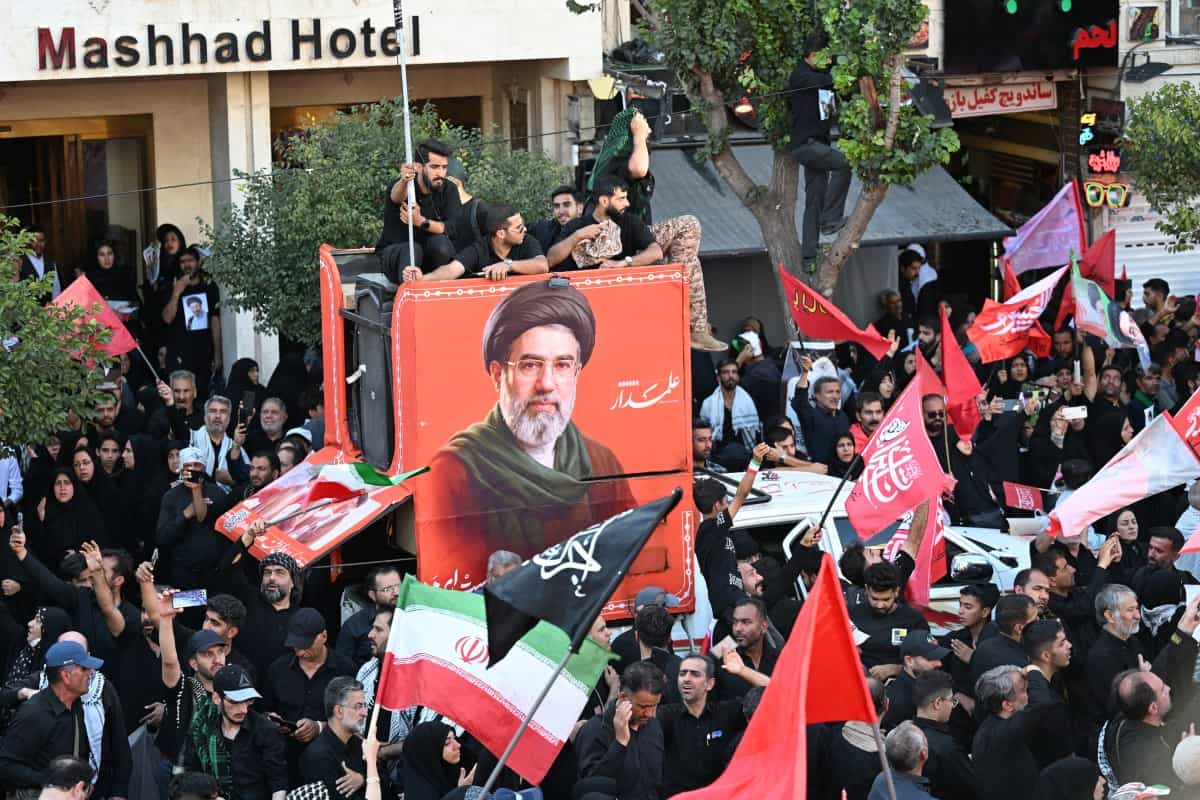
After U.S. President Donald Trump and Iranian President Masoud Pezeshkian signed the Islamabad Memorandum of Understanding on June 17, 2026, it appeared that pragmatists had gained the upper hand in the internal struggle between the pragmatic and ideological wings of the Islamic Republic’s ruling establishment, and that Iran was emerging from the flames of war. Yet during the funeral and burial ceremonies for Ali Khamenei, the Islamic Republic’s leader who was killed in the war, the system’s more hardline supporters beat the drums of vengeance and retaliation so loudly that the political atmosphere changed completely.
Eulogists, speakers, and marchers at Khamenei’s funeral and burial repeatedly called for Donald Trump’s assassination. This shifted the balance against pragmatists such as Pezeshkian, Mohammad Bagher Ghalibaf, and Abbas Araghchi, while negotiations with the United States were portrayed as a “betrayal of the martyred leader’s blood.”
On the evening of July 10, Ali Khomeini, a grandson of the Islamic Republic’s founder, said in a speech at the Shrine of Fatima Masumeh in Qom:
“Negotiation does not mean peace with the United States. Negotiation is itself one of the fields of battle. Anyone who sends a message of friendship to the United States has a vile and impure mouth.”
One day later, on July 11, Mojtaba Khamenei issued a message marking Ali Khamenei’s funeral and burial. Addressing his father, he wrote:
“We pledge to take revenge for your pure blood and for the blood of all the martyrs of these two wars from the dishonorable criminal killers. This revenge is the demand of our nation and must certainly be carried out. These criminals—whose identities are known from the highest to the lowest ranks—will carry their dream of a peaceful death in bed to the grave.”
In a previous message in late June, discussing his acceptance of the memorandum, he had written:
“In principle, I held a different view. However, because the esteemed president, in his capacity as chair of the Supreme National Security Council, gave me a commitment on behalf of himself and the other members to safeguard the rights of the Iranian nation and the Resistance Front, and explicitly accepted responsibility for it, I authorized the agreement.”
In his latest message, however, he threatened U.S. and Israeli political and military officials with assassination, making it considerably harder for Pezeshkian and Ghalibaf to turn the signed memorandum into a final agreement.
Beyond the threatening content of Mojtaba Khamenei’s message, the Islamic Republic’s attack on three commercial vessels in the Strait of Hormuz on July 7—even before Ali Khamenei’s burial—triggered U.S. strikes on military targets in southern Iran on July 9, the day of the burial. Those strikes began a series of heavy U.S. air attacks in recent days against Iran’s coasts and southern regions, from Chabahar to Bushehr and Khuzestan.
This new situation, nearly one month after the Islamabad memorandum was signed, has sharply reduced the prospects of an agreement between Iran and the United States—an agreement that, under the memorandum, was supposed to be reached within 30 days.
The escalation between the Islamic Republic and the United States—despite the Islamabad memorandum having been approved by 11 of the 12 members present at the meeting convened to accept or reject it—demonstrates how difficult it is for Mojtaba Khamenei to move beyond his father’s political legacy.
Some political observers may nevertheless believe that the atmosphere created in mid-July was largely a product of Ali Khamenei’s funeral and burial. To occupy the position of leader in practice, rather than remain in underground hiding like Osama bin Laden or Abu Bakr al-Baghdadi, Mojtaba Khamenei needs an agreement with the United States.
Yet the ideological character of the Islamic Republic, together with the expectations of its fervently loyalist base, has long obstructed any normalization of relations with the United States. Mass expectations often become chains around political leaders’ hands and feet, limiting their freedom to make decisions. Mojtaba Khamenei’s oscillation between the Supreme National Security Council’s preference for negotiation and the street-level loyalists’ appetite for war reflects his lack of room for maneuver: he leads an anti-American government but is expected to move beyond anti-Americanism.
The Institution of Velayat-e Faqih Will Not Bear the Cost of a “Tactical Retreat”
Ali Afshari, an analyst of Iranian politics, told Radio Zamaneh that the opposition between hardliners and moderates in the Islamic Republic’s current ruling establishment should not be overstated:
“the hardliner–moderate binary is not deeply rooted in the Islamic Republic. It is relevant, but only as a secondary factor, not in fundamental decisions. The Islamic Republic’s decision-making structure is essentially concentrated around one focal point: the institution of velayat-e faqih. This institution rests on a totalitarian movement with an ideology of Shiite-centered Islamic fundamentalism. That movement elevated Mr. Khomeini to leadership before the revolution; from his leadership emerged the institution of velayat-e faqih; and under the first Khamenei, that institution expanded organizationally and institutionally.”
According to Afshari, this institutionalization is the main foundation of hardline positions. Yet it serves the institution’s interests not to state this openly, but to guide these forms of extremism partly from behind the scenes. At certain moments, the requirements of governance also force it to exercise tactical expediency.
Afshari argues that the social base supporting velayat-e faqih cannot understand this tactical calculation. The Islamic Republic ultimately gives the regime’s interests priority over Ashura-inspired conduct centered on defending its ideological values. He continued:
“That is why we see a cycle of ‘strategic belligerence’ and ‘tactical expediency.’ At certain points it prevents the supreme leader from openly adopting positions identical to those of the hardliners, but the system’s decisions ultimately align with them. When the system is forced to strike a bargain or make some form of tactical retreat before the ‘Great Satan,’ neither the leader nor the institution of velayat-e faqih must pay the political cost. Conditions are therefore arranged so that forces portrayed as Western-influenced or revisionist carry out the tactical retreat.”
“Institutional Decision-Making” Allows the Supreme Leader to Evade Responsibility
Elaborating on how the institution of velayat-e faqih avoids responsibility and on the function the Islamic Republic’s hardline supporters perform for it, Afshari added:
“From the perspective of velayat-e faqih, neither the JCPOA nor the Islamabad memorandum conforms to the ideals and values of the Islamic Revolution. They must be presented as one-off events imposed on the system’s leadership, which it accepted only for reasons of expediency. More recently, officials say that ‘institutional decision-making’ is taking place within the Supreme National Security Council. This opens a route for the supreme leader to avoid accountability and responsibility for the system’s decisions. In my view, Mojtaba Khamenei’s approach to the Islamabad memorandum has so far mirrored Ali Khamenei’s approach to the JCPOA.”
Afshari believes that hardline mobilization is intended to prevent the political climate from moving toward normalization between Iran and the United States and to preserve the fundamentally confrontational orientation of foreign policy. But the hardliners have not obstructed the system’s decision-making process. The system signed the memorandum, and most of its signatories also support military confrontation in the Strait of Hormuz under current conditions. Hardliners also increase pressure on revisionists, a function that helps the institution of velayat-e faqih balance forces within the power structure.
From Mojtaba’s Emphasis on “Revenge” to Mostafa’s Call for “Patience”
Unlike Ali Afshari, Taghi Azad Armaki, a sociology professor at the University of Tehran, does not regard Mojtaba Khamenei’s emphasis on revenge as definitive proof that he has moved closer to the hardliners and away from the policies favored by the Islamic Republic’s moderates. He told Radio Zamaneh:
“Mr. Mojtaba Khamenei lost his father, his wife, and other relatives in the Israeli and U.S. attack, so a radical reaction from him should be expected. I understand the call for revenge in his latest message primarily as a verbal reaction to the injustice inflicted on his family. I do not see him as having been taken over by the hardliners, because hardliners are not especially numerous in Iran and most clerics do not sympathize with their positions. They are trying to place Mojtaba Khamenei under the control of the Paydari Front. The new leader’s sharp message was also a reaction to the previous leader’s funeral—particularly because state media exaggerated the scale of that funeral. Anyone cut off from society cannot understand its realities. Overall, such a harsh message was natural, but it does not mean that the Islamic Republic’s new leader has come under hardline control.”
Three days after Mojtaba Khamenei’s message, on July 14, his elder brother Mostafa addressed a gathering of government supporters at Tehran’s Grand Mosalla. Speaking about Ali Khamenei’s killing and the proper response, he said: “When confronting this immense calamity, the question of ‘patience’ arises, as the Quran emphasizes.” He then added:
“Patience in its true sense means enduring this immense calamity in a way that allows us to continue on our path firmly and correctly until we reach the final goal. Patience is therefore in no way incompatible with taking revenge and confronting the evildoers of the world who participated in these great crimes.”
Although the elder son’s remarks appeared contradictory, his central message was probably the emphasis on “patience.” His likely aim in urging those demanding vengeance for Ali Khamenei to remain patient was to calm the inflamed political atmosphere among the system’s most committed supporters—an atmosphere that had led them to insult Pezeshkian and Araghchi at Khamenei’s funeral.
Azad Armaki described Mostafa Khamenei’s remarks at his father’s memorial in Tehran and his potential political role under present conditions:
“I believe Mostafa Khamenei’s role in Iranian politics is more decisive than Mojtaba’s. Ayatollah Khamenei entrusted his shrouding and burial ceremonies to his elder son Mostafa, and, as we saw, Mostafa also led the funeral prayer for his father at the shrine of Imam Reza. Moreover, at his father’s memorial, Mostafa Khamenei did not echo the radicals and instead spoke moderately. Overall, I think society is moving toward moderation rather than revenge. Should Mostafa and Mojtaba fail to reach an understanding, we may eventually see an internal split within the Khamenei family—a radical–moderate division. Yet I do not believe Mojtaba Khamenei will submit to the Paydari Front’s demands, because the conditions that pushed the Islamic Republic toward negotiations with the United States remain in place.”
The Former Model of Velayat-e Faqih Cannot Continue
Radio Zamaneh also spoke with a sociologist close to the principlist, or conservative, camp. Asked whether, given the events of 2025–26, Mojtaba Khamenei would “remain alive long enough to lead the system in a normal manner,” the sociologist replied:
“I do not want to answer how great the current leader’s chances of survival are. But I do not think velayat-e faqih can continue in the form seen under the Islamic Republic’s second leader. We have entered the Islamic Republic’s third period, and this third republic lacks political cohesion. The supreme leader no longer has the same degree of social support, and the clergy no longer view the institution as they once did.”
The sociologist said that many prominent supporters of the system’s second leader were killed in the recent war. Most of society is also no longer like it was in the late 1980s, when it was prepared to accept the form of supreme leadership practiced over the past 37 years. Iranian society is tired of “ideological leadership.” Today, the state must meet people’s basic material needs; the situation is completely different from previous decades.
Hardliners Ultimately Submit to the Hard Core of Power
Hamid Asefi, an Iranian political analyst who was arrested in March 2026, five days after the U.S.-Israeli attack on the Islamic Republic began, broadly agrees with Ali Afshari and Taghi Azad Armaki. Although Mojtaba Khamenei repeated the funeral crowd’s calls for revenge in his latest message, Asefi believes he will ultimately distance himself from the hardliners if the regime’s interests require it. He told Radio Zamaneh:
“In the Islamic Republic, the principle of ‘expediency’ can veto anything. When the system’s foundations are endangered, expediency sets ideology and every other matter of prestige aside. The Islamic Republic is a regime with multiple voices. One voice favors negotiation, and it was heard through the Supreme National Security Council. Most council members approved negotiations with the United States, and Mr. Mojtaba Khamenei accepted the decision. But the leader must retain the hardline current that opposes negotiation because, first, it serves as a force for attacking rivals and is useful in factional score-settling; and second, it mobilizes supporters and takes control of the political stage. In major decisions, however, hardline currents have no real standing. When the hard core of the system decides on negotiation, an understanding, or anything else the hardliners dislike, they may complain, but in practice they are defeated.”
Asefi considers the Supreme National Security Council one of the hard core of power’s most important arms; the Office of the Supreme Leader is the other. This core has the final word, and its attention is currently directed toward negotiations. Asefi says it remains unclear why revenge became so prominent at the funeral of the Islamic Republic’s second leader and why negotiations then turned into military clashes. Nevertheless, he believes both sides appear to have preferred a military confrontation before the next round of negotiations, hoping it would improve their bargaining positions.