

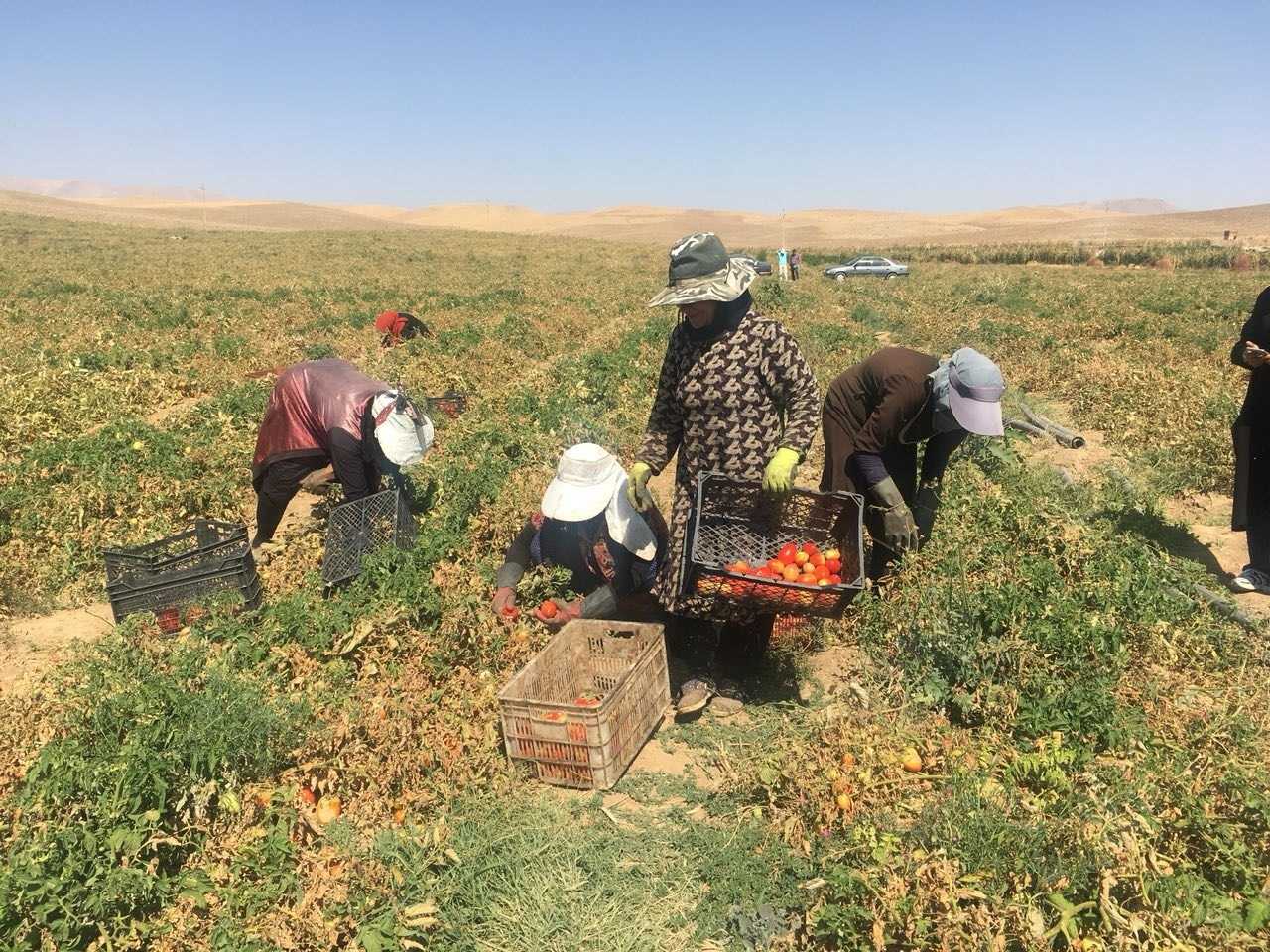
Women seasonal agricultural workers in Kurdistan in Iran are paid less than men, then return home to a second shift of unpaid domestic labor.
Women agricultural workers in Kurdistan in Iran begin their day before sunrise; they earn less than men, and when their work in the fields ends, their second shift of unpaid labor at home begins. Through the lives of women seasonal workers, this report narrates the intersection of exploitation in the labor market and gendered oppression within the family. What follows is a field report from Kurdistan of Iran.
Agriculture, particularly in Kurdistan in Iran, depends on the labor of women workers, especially during planting and harvest seasons. Men also work in this sector, but the story of their labor is different. Men are paid more, are not expected to take on domestic work after returning from outside employment, and are treated as more suitable for physically demanding and better-paid tasks. This creates an intersection of workplace exploitation, domestic exploitation, and oppression for women who work seasonally in agriculture. In this report, we examine the situation of women agricultural workers in Kurdistan in Iran through a specific case study.
Work Crews
They must be ready by 5:30 or 6:00 in the morning. On street corners in cities and villages, from Sanandaj to Marivan, from Saqqez and Baneh to the plains of Qorveh and Dehgolan, from Sarvabad to large and small villages, these days are full of women waiting early in the morning to go to work. They usually gather either at a fixed meeting point or in small groups in their neighborhoods, waiting for the minibus shuttle to arrive. They wear special clothing for agricultural work. They cover their heads and hands to prepare for a day of labor under the hot sun. Some also bring their young children with them because they have no one to look after them.
Their work in Ordibehesht and Khordad (April–June) is mostly picking strawberries and tomatoes. In other seasons, they do different kinds of work.
Who Are These Seasonal Women Workers?
In terms of background, these women workers often share similar conditions. Their most basic common feature is that they belong to the lower classes of society — classes that are no longer limited to working-class families. Low-ranking employees, retirees, teachers, and even families of ordinary military personnel are now among the households sending women’s labor outside the home. Married women and divorced women also make up a significant share of this group. After divorce, they usually become responsible for raising their children, and sometimes they take their children with them to the workplace.
Their ages vary widely: among them are teenage girls as young as 13, women in their sixties, and even older women. The urgent need for money brings them all together. For a long time now, the economic model of the nuclear family has no longer worked for these households: the model in which the man of the family is the so-called “breadwinner,” provides for the costs of his wife and children, and, in return, probably expects their obedience. This model has been disrupted because many men from working-class families now work as day laborers in agriculture alongside their wives and daughters — especially older men who have no insurance or pension and have lost the physical capacity to do harder jobs.
It should be recalled that Kurdistan province, alongside Ilam and Kermanshah, experienced the heaviest inflation last year: inflation above 100 percent. This additional pressure naturally forces all members of low-income families to work more.
The Difference Between Men’s and Women’s Labor Power
Many men also work in this same sector, but the number of women is much higher. Men whose economic activity falls under the category of “seasonal workers” in Kurdistan in Iran usually sell their labor power in other areas, including cutting grass, gardening, or doing similar agricultural work in Kurdistan in Iraq, but for higher wages. Some also take other family members with them and work as a family for about a month in the plains of Shahrazur in Kurdistan in Iraq. Men have the possibility of earning higher wages in the neighboring region, about 25,000 Iraqi dinars per day, equivalent to around three million tomans.
Men’s labor power sells for more in the spring seasonal labor market. For example, a man receives two to three million tomans for one day of grass-cutting, while women receive only 800,000 tomans for one day of strawberry picking in the Iranian year 1405 (2026–2027). In other words, with three days’ wages, a woman worker can buy only one five-kilogram tub of solid cooking oil.
Higher-paid work is usually not available to women workers. The issue is not simply that they lack sufficient physical strength, because many women do help with this kind of work whenever they have time. The issue is, above all, the heavy additional responsibilities imposed on them by the existing social order: caring for and raising children, cleaning, cooking, and providing comfort for their husbands.
The Intersection of Oppression and Exploitation
The wage gap between women and men has roots in social factors far more than in any natural or biological difference. For women workers, this situation marks the point where gendered oppression at home intersects with exploitation in the workplace. By gendered oppression in the home, we do not mean only the harsh and common forms of treatment directed at women within the family, but rather the persistence of old patterns that assign women and men their places within a social hierarchy — even when the material foundations of that pattern have collapsed.
In reality, poverty and economic pressure have shaken the foundations of this model, because men from the lower classes are no longer reliable sources for meeting the family’s financial needs, and working women have been forced into the labor market. Yet despite women working side by side with men, still almost no one expects a man to change a child’s diaper. That task is still treated as something self-evident and natural for women. If the order and cleanliness of the home is disrupted, the finger of blame is still pointed at the woman of the house.
These women who work on agricultural land, once their work shift ends, must rush back home so that the next round of their unpaid labor can begin: housekeeping and cooking.