

A diary from war-struck Tehran, where bombs, checkpoints, grief, and ordinary acts of care fold into the struggle to keep living.
This is an account of daily life in war-struck Tehran: nights in which the sounds of bombs, sirens, and checkpoints merge with family conversations, anxiety, mourning, and the effort to go on living. Through small, human details — from Mash Esmail, the neighborhood street sweeper, to crowded bookstores and homes collapsing under rubble — this report offers a portrait of a society suspended between fear, anger, exhaustion, and the stubborn attempt to keep hope and solidarity alive.
March 22, 2026 — Day 23 of the War
I no longer know how many nights in a row I have woken to the sound of a violent explosion. I am dazed, disoriented. I listen carefully. The sounds come from far away. R is lying face down on the floor. My head aches. I close my eyes against the headache.
I wake early in the morning. Before anything else, I want to exercise, but I cannot. Instead, I sit down to read Women in Contemporary Iranian History, a collection of long essays on women’s presence in education, higher education, associations, parties, and political life. This section is about women’s associations and parties during Mossadegh’s premiership.
A few days ago, R told me: if you had managed to win your rightful demands today, you would be reading Hegel now instead of the history of the Constitutional Revolution and the Qajar period. I both understand and do not understand what he means. I understand because years of struggle over compulsory hijab and similar issues have consumed so much of our energy, and rightly drawn so much of our attention, that at times we forget ourselves. Unconsciously, I think of the One Million Signatures Campaign: all that effort, going door to door to collect signatures, the arrests of women’s rights activists, their isolation, their migration — read: exile — and the dust of despair settling over us.
That night we are invited to R’s sister’s house. A friend calls and jokes: “I’m going to take my axe and go to the forest to bring back firewood.” I ask, “What now?” She says, “Don’t you know? Trump has given a 48-hour ultimatum. He said if they don’t open the strait, he’ll hit all the power plants.”
My breath catches. Absolute darkness. Total disconnection from everyone and everything. Paralysis in the full sense of the word. I think of the huge towers around us. If electricity goes out across Iran, one of the smallest consequences will be that the mostly elderly residents of these towers will not be able to move; they will be trapped inside their homes. Our situation will become something like Blindness. Restless and irritated, I look for a new distraction in order to deny the situation. In addition to Fidibo, I download Taaghche and buy Losing to the Body. Yesterday I also installed Navar, an audiobook app. I calculate that to preserve some rhythm, I need to read for one hour on Fidibo, half an hour on Taaghche, listen to half an hour on Navar, and review ten pages of The Social History of Women in Qajar Iran. To be honest, I am not upset at all about not going to work. The only thing I miss is my students. If I could regulate my food and exercise, I would actually like this arrangement.
I turn the dishes upside down, looking for one R’s sister might like. In the end, we buy a large stew dish with green flowers and a gold rim.
At N’s house, R’s sister, every conversation circles around Iran, Israel, and the United States. N and her husband are constantly quarrelling. It amazes me how this life continues without breaking.
Z is R’s other sister. When I say that many people in Dezful ululated while bombs were falling on them, she sighs and says sadly: “Damn the situation they have created for us.”
N, however, believes that because of our hatred for the Islamic Republic, we no longer see reality. By “we,” she mostly means her husband, A. A says: “Thousands of precious lives have been lost. You yourself still go to sleep crying every night, three years after your child died. How can you not think of these families?”
I do not know why it slips out of my mouth, but I say: “They attacked people who had begun Nowruz beside grieving families.” A says, “Exactly,” and continues: “This homeland means nothing to me without my compatriots. Soil without them means nothing to me. I call this place my country because of them. If someone is going to turn them into mourners, I don’t want to be here.”
I think of N’s silence, of the lump in her throat after A mentioned the death of their teenage daughter. Their daughter died three years ago. I was at R’s house. It was one of the most horrifying moments of my life. At three in the morning, R’s father called and said the girl had gone into cardiac arrest. That was it. I remember perfectly how R lost his breath, bent over, and sobbed uncontrollably. I remember that cursed morning: N sitting on the sofa, rocking herself back and forth, unable to breathe, tearing at her collar. Since then, N’s hair has turned completely white. Just like R’s hair and beard.
N has made almond stew, one of the most delicious dishes I have ever eaten. Despite her sharp disagreements with all of us, N is endlessly kind. She turns to me and says: “I made almond stew because of you. At first I was going to make sour cherry rice.” I shower her with affection.
After dinner, we all sit together. Satellite TV is showing Iran’s attack on residential complexes in Israel. Human life, caught between these two wars, has no value. But when Israel condemns the attack and constantly speaks of the value of its citizens’ lives, I become furious — as though our lives are not worth a grain of barley.
N says, “Ever since I heard they might hit the power plants, I’ve been thinking I should cut my hair.” R’s mother tells me, “Go take a shower quickly.” I say, “There’s no point. If the water and electricity are cut, I’ll probably have to shave my head.” Kh says, “In that case, we’ll all have to shave our heads.”
In my mind, I see women and men with shaved heads, groping their way through the darkness, having lost hope that good days will ever come.
March 24, 2026 — Day 25 of the War
“Madam, my workplace is in Bagh-e Sepahsalar. I have to go back and forth along this route five or six times a day, and every time there are several checkpoints where they search my car from top to bottom. Once, one of them opened the trunk and I told him: ‘Brother, search properly.’ He said, ‘What?’ I said, ‘Search properly, brother. Search thoroughly. Maybe you’ll find something.’ He said, ‘Are you making fun of us?’ I said, ‘No, honestly, you set up the checkpoints and turned us into the ones being checked. All of you search me several times every day. Have you found anything yet?’”
This is what the Snapp driver tells me as he takes me from N’s house back to ours. He says all this as we pass the checkpoint on Shariati Street. For as long as I can remember, there was always a nighttime checkpoint before Sar-Moallem. But N had said that in recent days, after they hit the Haft-e Tir checkpoint, it had been removed. Now we see it has been set up again.
We pass through empty, silent, dark streets. The driver says: “When they hit Ferdowsi and Meydan-e Shohada, I was nearby. They were gathering up hands and feet.”
That morning, on my way to N’s house, one of my students, H, had called. She said that the day after the Zarafshan explosion, she had gone to her workplace, only 200 meters from the destruction, and saw bodies being pulled out from under the rubble.
Ever since I read The Unwomanly Face of War, whenever anyone mentions severed limbs, I think of the Russian woman soldier who said she used to spend long hours standing over a cauldron in which the hands and feet of those killed in the war were boiling.
As we enter Chamran, the Snapp driver says: “I don’t know whether this is a divine test we’re going through or divine punishment. So many people were killed during the January uprising. Now so many more are being killed.”
In the opposite lane, I see cars moving in a line, carrying Iranian flags and images of the Ayatollah and Mojtaba Khamenei, chanting “God is great” and “Haydar.” I think about the word punishment, and my heart sinks. I tell the driver: “Whatever its name is, this was not and has never been what we deserved.”
I remember well how much people did for one another during the 12-day war. They invited each other into their homes. They welcomed even strangers in different cities. Anyone with a car would ask around to see if someone was going in the same direction and take them along. A Telegram group was created for exactly this purpose, so people could travel together. Our dear neighboring country Turkey was surprised that people had not rushed toward its borders. Of course, there were some who exploited the situation — like certain taxi drivers on the Tehran–Karaj route who demanded up to 15 million tomans per passenger. But they were few.
I know well that despite the polarization of society, we are good people. We have always been tolerant. These days, we are simply desperate, and our endurance has run out.
The driver smells his wrists and says: “Now madam, in the middle of all this, look at how carefree I am. The other day I went to Tajrish to walk around a little. I went into a perfume shop. They had two perfumes for five or six million tomans each. One of them was Ali Daei’s perfume. The seller sprayed both on my wrists. I told him, if the smell lasts until tomorrow, I’ll come back and buy it.” Then he smells his wrist again and says: “This Ali Daei perfume really smells amazing.”
In the midst of days filled with fear, horror, and anxiety, life throws itself against the walls and struggles so that we do not abandon it. They are right: the force of life is far stronger than we imagine.
March 25, 2026 — Day 26 of the War
The sound of the explosion falls onto my shoes, onto the loose tiles of the parking garage floor. I press my fingers to my temples and swallow my tears. Since last night, I have not been able to get the face of Mash Esmail, the elderly street sweeper of our neighborhood, out of my mind.
We could hear the scratch of his broom between explosions. As if we had all been listening for it, we suddenly got up and went to the balcony. The blackness of the night had shifted in the alley. My mother, my brother, and I called him together: “Mash Esmail!”
He was right below our balcony. He stopped working and looked up. My mother said: “The noise has become too much. Do you want to come up here until things calm down, then go?” His smile appeared under the building’s single light. He looked tired and faint. He said: “No, madam, there’s not much left. I’m almost done.”
My mother asked: “Where is your home?” Her voice passed through the shriek of the bombs and reached him. “Pakdasht,” he said. My mother put some cash from the mantelpiece into my pocket, went to the kitchen, took a bag, opened the fridge, filled it with fruit, handed it to me, and said: “Run, take this to Mash Esmail.”
He took the fruit and money with his calloused hands. I said: “Forgive us, Mash Esmail. I wish we could do more.” Then, before my tears could spill onto my cheeks, I ran back upstairs.
I want to vomit up these days of feeling unwell, the fact that I have not taken my medication since the war began, the insomnia clawing at the edges of my life — all under the pretext of Mash Esmail’s sweeping. But there is no time. N sends a message saying she has suddenly been seized by severe anxiety. For days she has been deep-cleaning the house, gathering all the furniture in the middle of the living room. I guess she went into the study and saw her cats’ bow ties and her mother’s wedding candlestick, and something broke open inside her.
N lost one of her cats two years ago and the other during the 12-day war. The first did not survive illness; the second disappeared in Rasht. Cancer took her mother in 2014, and her father died two years later.
We speak on the phone. Whenever N feels this bad, we talk until she is better. She takes an anti-anxiety pill. I keep telling her I can come over, but she resists. After a few minutes, she says: “Don’t be scared, but I think I’m having an attack.” N has a history of panic attacks. Since the war began, they have intensified and become more frequent. I tell her I am coming. She says it is dangerous and that she will worry about me. I insist. I do not know what else to do. The sound of airstrikes does not stop.
She puts alprazolam under her tongue. I imagine her curled up on the chair next to the fridge, beside the window that opens outward, where the neighbor’s nightingale can also be heard. I worry she will stand up, try to walk, her legs will give way, and her knees will be wounded again, as they were a few days ago.
She hangs up and messages that she is better. From exhaustion, I fall asleep for fifteen minutes. I have no strength to get up and cook lunch. I call N again. She had lied; she is not better. I get dressed to leave, but she says our mutual friend M has called, was nearby, and is now on her way over. I feel relieved.
Outside, a light rain is falling. Since morning I have been telling R that we should go to Shahr-e Ketab, the bookstore chain, and he promised the afternoon. This has made me angry and restless. In the middle of my anger, I think that tonight I must definitely cook and set aside a portion for Mash Esmail too.
R comes in the afternoon. We set out. Shahr-e Ketab is very crowded. F had said that since the war began, so many books have been ordered from the provinces that they were astonished. I look at the geraniums behind the windows, fresh and blooming again.
Before anything else, I go to the women’s studies shelf, hoping it might have changed, that this small shelf might look better. But no. I remember well how, a few years ago on International Women’s Day, I argued with the manager of Shahr-e Ketab: so many books have been published on women, and yet you have put four cheap, superficial books here. The manager told me to give him a list and he would order them. I brought him a list of more than 500 titles. Nothing changed.
I look for Cooking in the Safavid Period, edited by Iraj Afshar, and I find it very unlikely they will have it. The explosions begin again. The salesman — with a long mustache, thinning hair, a protruding belly, and kind eyes — ignores the sounds and finds the book for me. He also insists that I buy the rest of Iraj Afshar’s works. It is tempting, but I resist. I wait in the checkout line for twenty minutes.
I cannot believe people have become so restless that they are rushing to bookstores.
R and I walk toward the streets and houses near us that have been hit. I think to myself: I wish I could do something. I wish I could shelter all the homeless people of my city in our house.
March 26, 2026 — Day 27 of the War
A friend’s house has been destroyed in the bombing. Another friend lost her home during the 12-day war. She used to take photos of her house at night and post them as stories. The last photo of her home showed a living room in the half-light of string lamps, leaning toward gray sofas decorated with a Turkmen-patterned throw. The next photo, posted at noon, showed everything so crushed together that no matter how hard I tried, I could not recall the image from the previous night. Even now, remembering that moment fills my eyes with tears.
I am not well. Last night, after 27 days, I finally took my sleeping pill, but it made no difference. Not only did I not sleep, I woke with dizziness and a terrible headache. I resist. I resist the heaviness of depression that has slowly crept in and caught the hem of my dress. I go out to buy bread. Unlike most early mornings, the bakery is empty. There is only one other person in line.
I left the house irritated and angry. I can no longer bear my father, his illness, and his ways. In the morning he had woken up, gone to the kitchen, taken a flatbread in his teeth, and started chewing on it. I watched him in disbelief. I asked, “Why aren’t you eating bread and cheese?” He said, “I couldn’t find the cheese.” With a sharp, angry movement, I opened the fridge, took the cheese from the nearest possible place to him, handed it over, then turned to the freezer, took out bread, and slammed it onto the table.
I am tired. Very tired. Tired of giving him his medicine every day, only for him to ask dozens of times whether he has taken it. A few days before the war, his leg pain began, and all of us entered a strange cycle. He refused to let us call an ambulance. He could not take even a single step. My brother helped him to the bathroom with great difficulty. One day, when my brother was not there, by the time I tried to lift his 90-kilogram body, it was too late. The moaning became so severe that we ignored his protests and called an ambulance.
But by then the war had begun. The ambulance service would not waste its time on a patient whose condition was not considered an emergency. A private ambulance would cost five million tomans just to reach the hospital, and the hospital itself would charge 50 to 60 million.
On the fourth day of the war, we forced my father into a wheelchair and went to Akhtar Hospital. But there was no specialist to write him an MRI order. We called the doctor. He told us to come to NAJA Hospital on Valiasr Street. As soon as we entered the hospital, a nearby area was hit. A code was announced in the hospital, meaning everyone had to evacuate to protect their lives. A friend of mine is a nurse at Sina Hospital. She says evacuation is only allowed for NAJA Hospital staff. In other hospitals, unless the hospital itself is hit, staff are not allowed to leave. I remembered what R had said: when they struck the police station near the hospital by his home, the guards stood at the door and directed everyone inside.
After the staff left, we struggled to find a doctor and forced him to prescribe painkillers for my father. Then we made our way home with even greater difficulty.
Remembering those days irritates me, and the fact that I cannot get my own work done irritates me even more. At noon we are invited to R’s mother’s house for lunch. R comes to pick me up, and we go for a walk in the park. As I walk, my heart sinks. Everything we have is tied to fear: an ordinary walk, even the dragging sound of the garbage bins our building caretaker moves around every night. The sound resembles an airplane rising into the sky, and it makes everyone’s ears sharpen.
R’s mother has made okra stew for lunch. After lunch, we talk about the previous night, about the nightly spectacle that begins around eleven: people shouting “God is great” and “Death to America” through loudspeakers in squares, streets, and alleys, as though their only purpose is to produce fear. R’s mother says: “I barely sleep. Every night, first the shouting of this crowd keeps me awake, then the bombs.”
The conversation turns to war crimes. H, R’s brother, says: “So far, several thousand Iranian civilians have been killed in Iran, while Israel has only lost 20 or 30 people.” R says: “We all agree on war crimes. Any attack on civilian centers is a war crime.” H adds, in a particular tone: “The killing of the children of Minab too.” He says it as if we had said we wanted to ignore that massacre.
One discussion leads to another, and we end up talking about checkpoints. Kh, R’s other sister, says: “I feel sorry for the kids at these checkpoints. Many of them are teenagers and they have put guns in their hands.” Z says something worth thinking about: “As long as they are holding guns, we are not equal. First they have to put down their weapons. Then we can say: now come and talk. For the sake of those kids too, everything has to change fundamentally.”
When we leave, R’s dear mother, wearing a light-colored scarf over her small body and a dark dress, gives me Nowruz money. It has been a long time since I received an Eid gift. I kiss her face and thank her.
At eight in the evening, the attacks begin. The fighter jets fly so close to the ground that you feel they might come inside at any moment. Then enormous explosions are heard from near and far. My mother is at my grandmother’s house. She calls anxiously and asks, “Are you all right?” I say yes. She says they hit near my uncle’s house, and his teeth locked from fear. At four in the morning, the huge sounds of explosions mix with thunder and lightning, and I think: even the pills no longer make any difference.
March 28, 2026 — Day 29 of the War
The plate is white, covered with black lines running from the center to the edges. I buy it with several small bowls, and we head to the home of Z.K. and Sh. I feel somewhat calmer because recently their area has been hit much less. Damn it, I want to visit my friends once without dread.
Z.K. is as she always is. Only her straight hair has grown a little longer. As usual, she is wearing a white blouse and black trousers. Sh, however, has grown a thin Clark Gable mustache and looks completely different.
Almost as soon as we sit down, we start talking about the number of people killed in recent days. Z.K. jokes bitterly: “A good Iranian is a dead Iranian.” When I mention areas where many people have been killed, she tilts her head toward her shoulder, mocks a familiar voice, and says: “No, darling, these are precise strikes. They don’t kill civilians.”
I say: “I have no issue with those inside Iran who are pro-war. I’m not angry with them. But those who join demonstrations abroad with Israeli and American flags — I neither understand them nor want to understand them.”
Z.K. runs a hand through her hair. Her eyes narrow slightly. She says: “Before the internet was cut, I posted a story on Instagram. I wrote that those outside the country should not beat the drums of war for us. Within a few days, I was attacked so viciously it was unbelievable.” They called her regime-affiliated, corrupt, a whitewasher of blood, an accomplice of the system. She had a severe nervous breakdown and cried for several days. Remembering it brings a frown to her face. Ash from her hand-rolled cigarette falls onto her blouse. She rubs her neck.
The Iran University of Science and Technology has also been hit. The university is ruined. Ruin has entered the cities of Iran like termites. Tehran is worse than everywhere else, while the northern cities, indifferent and distant from the war, continue living amid crowds from other cities.
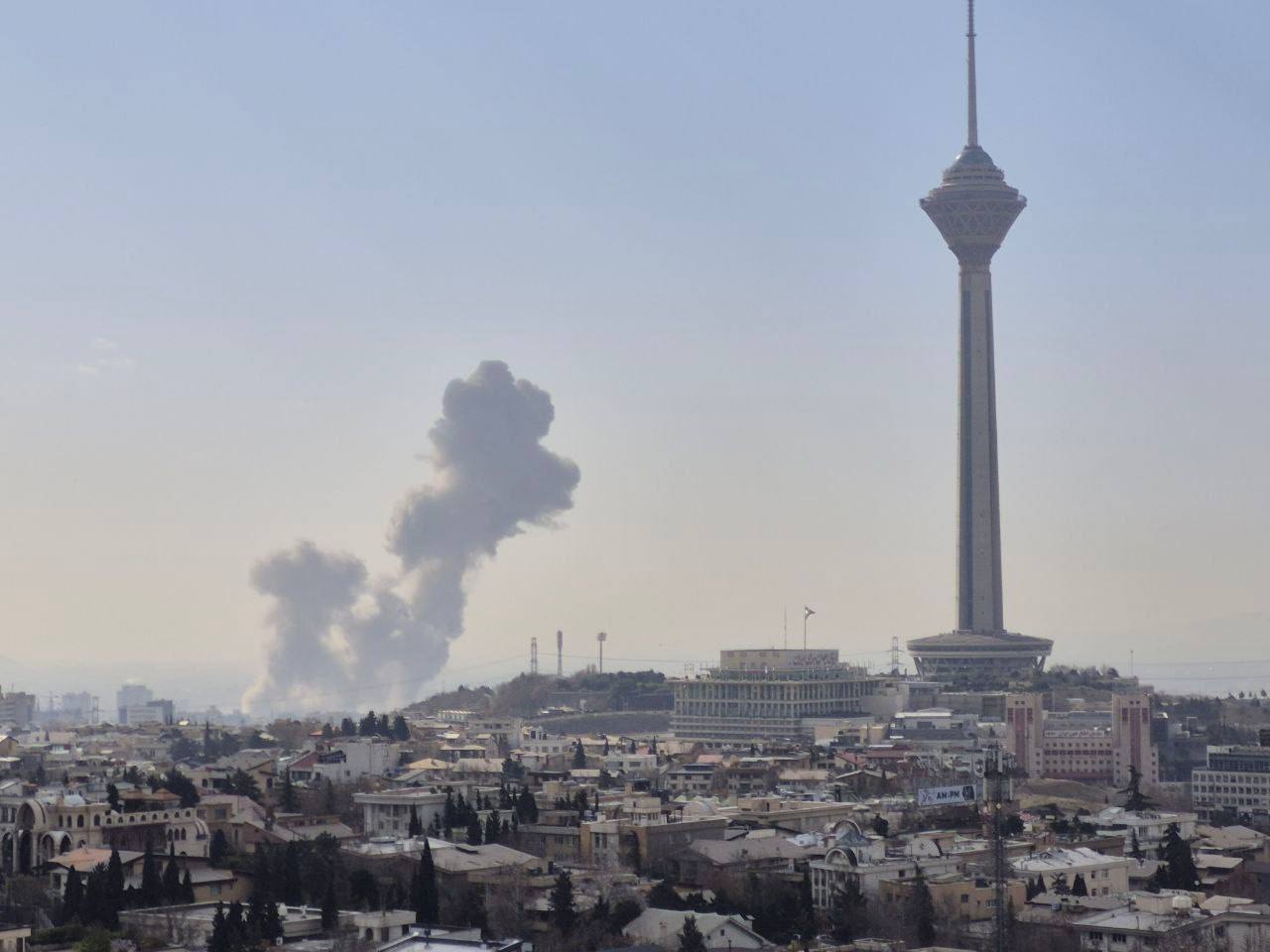
R shows Z.K. a photo he took at noon from the rooftop: smoke rising from an explosion. Then he shows her a photo from the second day of the war. We had gone together to buy my mother’s medicine from the pharmacy. Only a few minutes after we left, the area nearby was hit. I remember raising my head and watching the fighter jets move through the sky. We were near a hospital. I began crying then — not because I was afraid for my own life. R had left the house because of me, and if anything happened to him, it would be my fault. We were at the hospital entrance. R said: “Don’t worry, they won’t hit here.” The next day we heard they had hit beside the hospital.
Z.K. leans eagerly toward R’s phone and says: “What smoke.” She says things have been so quiet where she is that she asks friends to send her photos and videos. From this, I understand that Z.K. has also installed Bale, the domestic messaging app. She says she spoke with a friend in Boston, who told her how shocked local Democrats — people who have always stood with Palestine — were to see Israeli and American flags in Iranian demonstrations. They asked in disbelief: “Do you really support Israel?” Her friend answered, with vicarious shame: “Not all of us. These people are very right-wing.”
As we are talking, the doorbell rings. A is the others’ friend. He arrives excitedly and says he had been on his way to a film shoot when the strike happened. He followed the smoke and the crowd and reached Mobina Alley — I think that was its name — on Hoveyzeh Street. He says the scene was apocalyptic. A has a short beard and wears a silver ring that could easily cause misunderstandings. He is dressed in black too, and perhaps, as he says, that is why the Basijis did not bother him and let him move forward.
He saw an elderly woman and man, covered head to toe in dust, wounded and distraught, crying and beating their heads. They shouted: “Our whole life is gone.” The only sentence that came to A’s mind was: “Thank God you are alive.” The old woman suddenly snapped: “I wish I had died. My home and my life are gone.”
At that moment, people began arguing with the security forces, telling them: “All this disaster is your fault.” Suddenly, a woman with heavy makeup, ripped jeans, and large breasts visible through her shirt began shouting at the people. She said: “Actually, all of this is your fault. You went onto your rooftops and kept shouting ‘Long live the Shah’ and ‘Death to the Leader.’” She began insulting the displaced people.
A says the security forces stood there stunned, unsure whether to be happy or upset that a woman with that appearance and language was defending them. He adds that apart from this incident, the security forces seemed extremely anxious. It felt as though something beyond the destruction of homes had happened in that area.
As the glasses are filled, the conversation turns to checkpoints. At any moment, one of them may be targeted, and a crowd of people may be blown up with them.
A says again: “A few days ago we were passing a checkpoint. I stopped and said I wanted to speak to their commander. A young man came forward and said he was the commander. I pointed to Zh — I assume she is a little girl close to him, though I do not ask — who was in the car, and said: ‘Sir, do you see that child in the car? If they hit you, that child will be harmed too. Who will be responsible?’ The young commander answered respectfully: ‘I understand. But we have found many things at these checkpoints. Besides, they hit us with micro-drones that have intelligent eyes. They usually make sure to strike when the place is emptier.’”
I feel sickened by this situation. For the thousandth time, I feel nauseated by all these contradictions. Why should we not worry about their lives? A says: “Many times, when I pass through checkpoints, I wonder whether they played a role in the January killings. Imagining them on those nights destroys every feeling of pity I have.”
I ask Z.K. about her new work. She is a strange artist. With pieces of fabric she sews together, she creates extraordinary, colorful tableaux. She sits calmly, stitching, while the tips of her fingers turn red with blood. She sucks the redness away and continues.
Z.K. shows me a photo of a three-and-a-half-meter Garden of Eden, all its pieces sewn together with delicate lines. R and I stare in astonishment at the fabric work. Through all the difficult days — difficult for all of us — Z.K. has been making a Garden of Eden and taking refuge in it.
The smell of saffron rice cake fills the house. Among the men, a tense argument about Mossadegh begins. A says Mossadegh made mistakes in the nationalization of oil. Sh says bluntly: “Who the hell are you to say that?” We all laugh. R says: “In general, I have a problem with seeing everything through history. What difference does it make for today whether we know Mossadegh made mistakes or not?”
As R speaks, Sh takes out a photo and shows it to everyone. It is him, around two years old, standing beside his young parents and his middle-aged grandparents, none of whom are alive anymore. They are standing beside a Nowruz ceremonial table, with a large photo of Mossadegh on it and candles burning beside the photo.
We all sit around the table for dinner when the sound of an explosion shakes the windows. I half-rise. For a while, silence fills the room.
At one in the morning, we set off. In the middle of the night, my mother and R’s mother had called anxiously, saying they were hitting the area, and we had reassured them not to worry, that we were fine. Now, leaving our safe place again, I become anxious.
As we pass Mohseni Square, we see that the boulevard has been blocked and a checkpoint set up. I look at each of them, one by one. I do not know whether this will be their last shift, or whether they will endure.