

Iran’s farms are running on water they no longer have. Official statistics paint a picture of growth, but in wheat fields and fruit-producing regions farmers are protesting late payments, rising costs, and drying wells. Behind the crisis lies more than scarcity: it is a system that shifts risks onto small farmers while profits flow elsewhere.…
A fragmented sector
While the 2025 Agricultural Census by the Statistical Center of Iran highlights a rise in farm operators and an expansion of cultivated land, the reality on the ground tells a different story. Across wheat-growing plains and fruit-producing regions, farmers are protesting water shortages, power cuts, rising costs, and delayed government payments. The problem is not simply “water scarcity.” It is a deeper structural contradiction between the actual stock of resources and the way value is produced and distributed along the food chain.
Most of Iran’s agriculture is in individual hands: more than 3.8 million farm units are owned by individuals, while fewer than 10,000 belong to companies and institutions. Among producers, about 3.2 million are literate and nearly 950,000 are not. The average age is 50, with fewer young people entering the sector than older farmers leaving it.
This fragmented ownership means weak bargaining power. Small family farms carry the costs of inputs and the risks of climate change alone, while on the market side they face powerful chains of middlemen, factories, and importers. As a result, producers capture too little of the final value of their product, farm capital steadily erodes, and smallholders quietly leave the land.
Literacy, skills, and succession
Nearly one million producers are illiterate. This slows the adoption of essential technologies such as smart irrigation and water meters and leaves farmers more dependent on middlemen. Without basic training, water-saving policies remain only words on paper.
The aging of the workforce deepens the problem. With an average age of 50 and few young people entering the field, local knowledge is disappearing and physical labour is harder to replace. This leaves domestic production more vulnerable to price and climate shocks, directly threatening food security.
When small producers can no longer bear the risk, two things follow: Domestic production becomes unstable, and the price of bread and protein rises during droughts or currency crises; land is either abandoned or turned over to high-water, high-profit crops that clash with limited water resources. Both outcomes undermine food and water security.
Land, water, labour: three mirrors of the crisis
The 2025 census reports more than 4.29 million producers nationwide. Total farmed area has reached 17.38 million hectares, a 5.5% increase since 2014: 89% cropland, 11% orchards or groves. Of cropland, 62% is rain-fed and 38% irrigated; 80% grows annual crops and 20% is fallow. Wheat dominates at 8.3 million hectares, up 29% since 2014, two-thirds of it rain-fed and dependent on rainfall and climate variability.
Meanwhile, prices keep climbing. In traditional farming, gardening, and livestock, producer prices have jumped by 32.9% over the past year, pushing the index to 1,585.5. The costs of seeds, fertilizer, fuel, labour, and transport are rising faster than guaranteed purchase prices. When payments are delayed and farm access to markets and liquidity is weak, many farmers lose the incentive to continue and drop out.
Imports and energy costs add to the strain. Under current currency and tariff policies, imported inputs raise production costs. Price controls and monopolies in the supply chain reduce the share that farmers receive from the final value of their products. This erodes farm assets and weakens the ability of rural labour to sustain itself.
Water: the choke point
Iran’s challenge is not only that water is scarce. The deeper problem is that the country is using more water than it can naturally renew. This creates what experts call water debt: the gap between what has been promised in allocations and projects, and the amount of renewable water that actually exists. Instead of reducing this debt, the government often turns to supply-side projects such as new dams or inter-basin transfers (conflicts over moving water from one region to another). These projects may look like solutions, but in practice they are like taking out new loans to pay old ones. They provide short-term relief, while in the long run they deepen the crisis and increase its social and environmental costs.
The figures are stark. Each year, about 15 billion cubic meters of water are pumped beyond safe limits from legal and illegal wells. In Tehran, 25 to 30 percent of the water supply is lost through the distribution network. Evaporative coolers consume another 600 million to 1 billion cubic meters every summer. Without better management of demand and repairs to the network, simply adding more supply will only increase the water debt.
Land subsidence, driven by falling groundwater, has become a hidden but costly crisis. Satellite data shows 56,000 square kilometers of land at risk, with nearly 3,000 square kilometers sinking by more than 10 centimeters each year. The damage already affects airports, railways, historic sites, and basic infrastructure.
The contradiction is obvious. Most cropland and wheat fields rely on unpredictable rainfall, yet water debt continues to grow. Unless real water reserves guide planning, every new hectare of water-hungry crops and every new transfer project will only increase the risk.
Farmers’ protests
Over the past two years, farmers have raised their voices. It started at harvest: they delivered wheat but payments came late. By August–September 2025, officials claimed 87–94% of payments were made, but delays remained. Rising daily costs for seeds, fertilizer, fuel, and labour, combined with late payments, left farmers unable to pay debts or plan the next season.
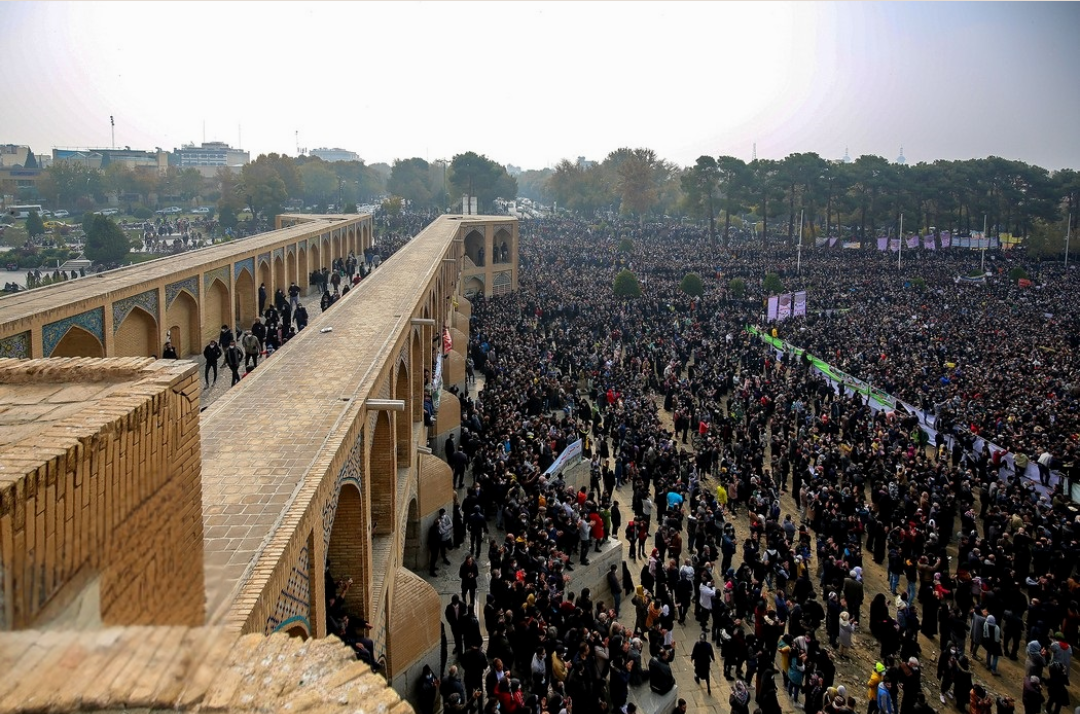
In recent weeks, protests have spread across provinces. In Kermanshah, farmers gathered outside the governor’s office to denounce “empty promises” and unpaid wheat deliveries. In Khuzestan, growers say that four months after delivery they are still owed billions of tomans, though the law requires payment within 48 hours. The delays disrupt summer and autumn planting and leave farms short of cash.
Water and electricity have been just as unstable. From south to north, repeated blackouts and disputes over inter-basin transfers have fuelled demonstrations, first seen in Khuzestan in 2021–2023, then spreading to central and northern provinces. Farmers say projects that were meant to add water have instead shifted the risks of quantity and quality of water onto local communities.
Rising prices, debt, and market volatility complete the picture: protests are no longer one-off demands but tarckling structural issues. Farmers argue that profits from projects flow to destination cities, while the costs stay at the source: wetlands dry, plains sink, and jobs disappear. Risk has been shifted from the state, contractors, and urban consumers to the smallest producers. Unless that flow reverses, every season will bring a new round of protest.
The costly gamble of rain-fed wheat
Since 2014, wheat fields have expanded by 29 percent, mostly through rain-fed farming. On paper this suggests self-sufficiency, but in practice it makes production highly dependent on rainfall. Each climate shock forces the government to choose between shortages at home and more imports, which officials already admit are needed to keep reserves. Unless cropping patterns match the real water capacity of each basin, even on-time government purchases cannot solve the problem. A single dry year or heat wave can drive small farmers into bankruptcy and push the state to provide emergency support.
At the national level, Iran’s food balance is fragile. In 2023, the country imported 25 million tons of agricultural and food products because domestic production could not meet demand. This left a shortfall of about 16 million tons. More than 80 percent of livestock and poultry feed depends on imports, and self-sufficiency in oilseeds is only around 18 percent. This heavy reliance on a few foreign suppliers means that any geopolitical or logistical shock quickly translates into higher prices for bread and protein at home.
The bottom line: relying on rain-fed wheat plus heavy dependence on imported inputs leaves households vulnerable to two risks at once: shortages in local production and disruptions in imports.
Why technology is not enough
On paper, progress looks impressive: since 2014, greenhouse acreage has grown by more than 160%, beekeeping by 56%, fisheries by 24%, and over 509,000 farms now use pressurized irrigation. But these advances have not delivered real stability.
The reasons are straightforward. Pressurized irrigation systems lose efficiency without proper filters, reliable electricity, and regular servicing. Small farmers who cannot afford maintenance often return to older, water-intensive methods. The investment is made, but without upkeep it does not last.
Since the 1990s, dam and water transfer projects have built networks of contractors and consultants who profit from inflated costs, often linked to corruption. The Gotvand Dam is the clearest example: costs exploded, downstream water quality declined, debts grew, and public trust collapsed. When projects are judged by completion instead of real water balance, the crisis is not solved—it only moves somewhere else.
The deeper issue is groundwater governance. Without transparent permits, smart meters, basin-level monitoring, and actual reductions in pumping, no technology can halt subsidence. In some plains, scientists warn, conditions are approaching irreversibility.
Energy subsidies add to the problem. Cheap electricity and fuel for pumping encourage overuse and undermine efficiency. If extra pumping carries no real cost, irrigation upgrades alone cannot fix the problem.
Technology is necessary but not sufficient. Until water governance changes, project rents give way to real accounting, maintenance is guaranteed, and energy pricing supports conservation, growth charts will not translate into sustainability.
What is to be done
To secure both water and bread, four steps need to follow one another, each building on the last.
1. Decide at the basin level, with local participation.
Water management should move from closed offices to local watershed councils. These councils must have the power to stop projects that damage aquifers. Pumping limits should be enforced with meters, and extra pumping should be costly. Water rights should only move within the same basin to protect livelihoods. High-risk wells should be closed with fair compensation. Cities and industries must recycle water, and products should carry labels showing how much water they consume. No dam or transfer should go ahead without independent review.
2. Protect small farmers’ livelihoods.
Once fair water rules are in place, smallholders must be supported to survive under them. This means on-time payments at fair prices, simple drought insurance, and low-interest loans to guide them toward crops suited to local water. These protections can be funded by taxing water rents and export duties on water-hungry crops, while exempting small farms. Without this shield, new water rules will only drive farmers off the land.
3. Match crops to real water.
With livelihoods safer, cropping patterns must be based on two simple questions: How much renewable water is available? And how much value does each cubic meter of water produce? Dry areas should shift to resilient rain-fed farming with tougher seeds, crop rotation, and conservation tillage. Small processing units near farms can stabilize incomes. Rivers and wetlands must always receive their share to stay alive.
4. Share technology fairly.
Change will only last if tools are available to all. Irrigation systems and greenhouses should be owned through cooperatives, backed by maintenance funds and local extension services. Energy prices should reward efficiency: the less water a farmer uses, the less they pay. Village-level solar and wind power can also help reduce pumping costs.
Signs of success would include less over-pumping and land subsidence, on-time payments, wider drought insurance, and real access to loans and technology for smallholders.
If water remains, bread remains
From census tables to street protests, the message is the same: Iranian agriculture depends on fragile water. The problem is not only scarcity but also the unequal distribution of power and risk in the food chain. The way forward is to make water real and bread secure—together.
The four steps outlined above are not a wish list. They are about shifting risks and rewards: moving away from project rents and cheap energy toward real water accounting and fairness in production. If over-pumping decreases, land subsidence slows, payments arrive on time, drought insurance works, and small farmers gain real access to credit and technology, then the path is right. If not, each new project will only spark new protests.
The choice is decisive: continue with project-first policies that sink both land and public trust, or move to basin-based governance that returns water to villages and cities alike. If water remains, bread remains.