

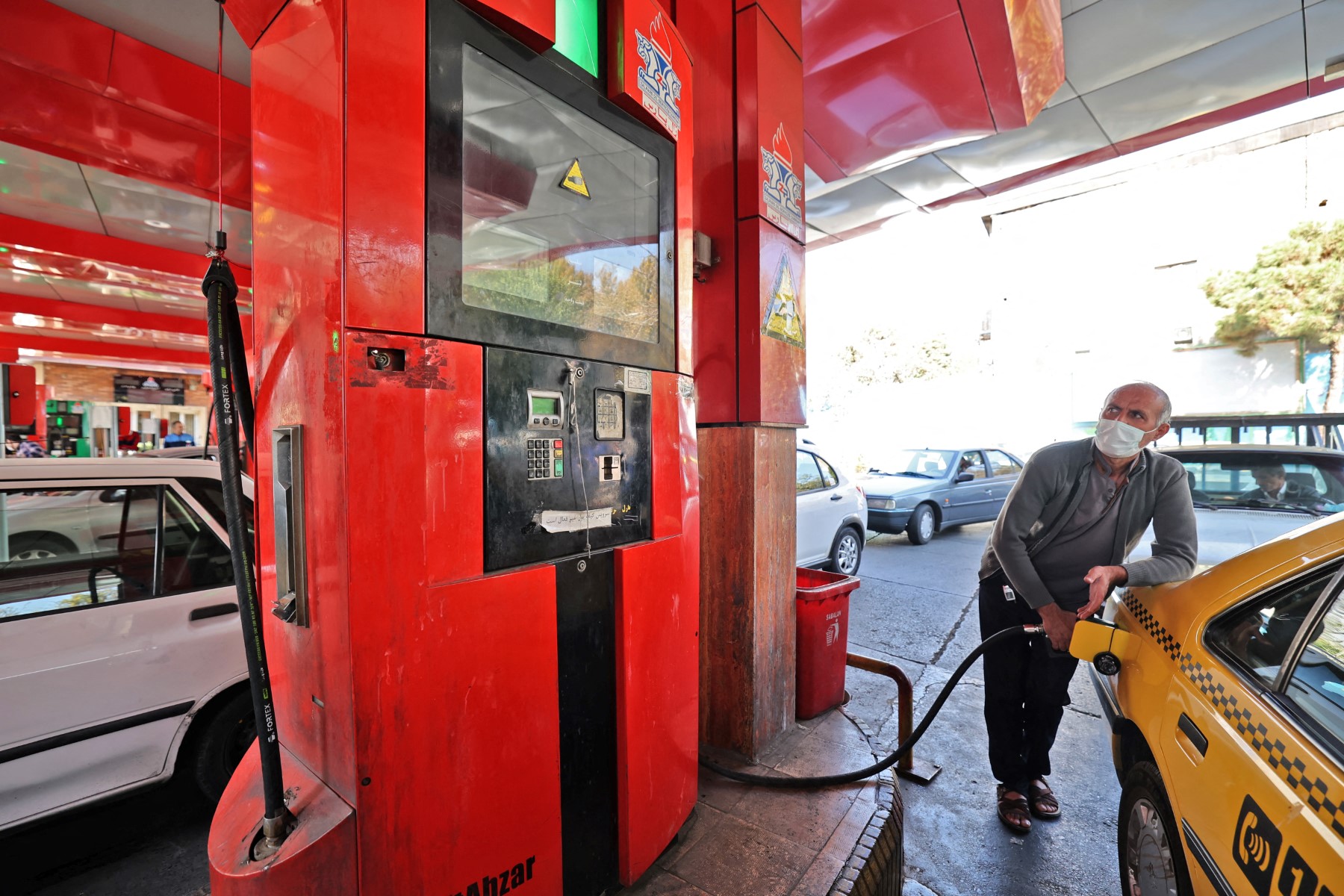
Seven years after the bloody November 2019 protests, gasoline is once again at the centre of a potentially explosive social crisis, as war, inflation and falling purchasing power constrain the government’s options.
Seven years after the bloody protests of November 2019, the government is once again confronting an issue it has avoided touching for years: the price of gasoline and the way it is distributed. Declining production capacity under wartime conditions, the high cost of imports, and fuel smuggling have pushed the government to consider new plans. But in an economy already gripped by inflation, poverty and declining purchasing power, these measures could have consequences reaching far beyond fuel management.
Gasoline and its price are among the basic requirements of social reproduction in Iran. Shortages, rising prices or scarcity can seriously disrupt the everyday cycle of life. Under current conditions, however, gasoline has taken on an explicitly political dimension: it has become a point of confrontation and a test of strength between state institutions and society.
The Heavy Shadow of November 2019
The social protests of November 2019, triggered by a threefold increase in gasoline prices, were suppressed through a state massacre. The price of gasoline remained fixed at 3,000 tomans per litre. For the seven years since then, gasoline has been the one commodity in Iran’s economy whose official price has remained unchanged.
It is not that government officials have not wanted to raise the price. Rather, the scale of anger and protest unleashed in November 2019 forced them, from that point onward, to leave gasoline prices alone—even as inflation reduced its real value to little more than the price of a bottle of mineral water.
Since then, one cost-of-living crisis has followed another, eroding purchasing power to the point that society has little capacity left to absorb another increase in fuel prices. No government has been willing to assume the risk of changing the price again.
The Hard Point of Decision
Now, however, under wartime conditions, the government of Masoud Pezeshkian has been forced to revisit the issue. Imported gasoline costs the state around 90,000 tomans per litre. The gap between the current subsidised price and the unsubsidised price of gasoline is enormous. Even if it wanted to, the government could not raise the price anywhere near that level. Yet, in the cabinet’s own words: “We cannot continue like this either.”
The government has put forward three options for cautiously changing the way gasoline is priced and distributed.
The first would cap nationwide distribution at 121 million litres per day. Once that amount had been sold, no more gasoline would be available until the following day.
Under the second plan, 121 million litres would again be distributed each day, but once that quota was exhausted, additional gasoline would be sold at an unsubsidised price.
The third option would allocate 30 litres of subsidised gasoline per month to every national ID number. Those without a car could sell their allocation on the open market.
At the initial stage, all three proposals have the same objective: to prevent nationwide gasoline consumption from exceeding 121 million litres per day. Wartime conditions and damage to refineries have effectively eliminated the possibility of increasing domestic production. Importing gasoline also presents numerous difficulties and, at current prices, makes little economic sense for the government. Yet none of the proposed alternatives is capable of resolving the crisis.
Alternative Plans That Deepen the Crisis
One of the government’s principal reasons for reducing vehicle fuel quotas has been to curb smuggling. Even before the current proposals, access to unsubsidised gasoline at filling stations in border provinces had been restricted to five hours a day, and only from the fifteenth day of each month onward. After waiting for hours in long queues, each vehicle can obtain only 15 litres using the filling station’s fuel card. Even this measure has failed to stop gasoline smuggling.
One reason lies in the pervasive corruption throughout the country’s administrative system. Fuel-station owners themselves are among the main actors involved in smuggling fuel and selling station allocations on the black market. By paying kickbacks to those above them, station owners use various schemes, with virtually no oversight, to sell a large share of the fuel they are supposed to distribute to smuggling networks at other prices.
This corruption extends to the highest levels of fuel management. In other words, it is a network of thieves paying one another off while robbing an entire country.
The current proposals are therefore also destined to fail unless the existing system is replaced by transparent, corruption-free management. Whichever plan is implemented, long gasoline queues are likely to appear quickly. A multi-tiered gasoline market would add yet another class of middlemen to Iran’s economy. Much like currency dealers and the crowded informal markets for buying and selling foreign exchange, an open market for buying and selling gasoline would emerge in plain sight: complete chaos.
A Social Crisis
In a society where everyday life has become structurally dependent on motorised transport, social reproduction is inseparable from access to fuel. What Iran is confronting today is therefore not merely a choice between different techniques of fuel management. This is not simply a technical or administrative problem. It is a social crisis directly connected to the broader crisis engulfing society as a whole.
Any increase in gasoline prices would send another severe inflationary shock through the prices of virtually every good and service people rely on. Society has little capacity to absorb yet another wave of rising prices.
The constant comparisons in state media between gasoline prices in Iran and international prices are misleading. If everything in Iran is supposed to be priced at global levels, then workers’ wages, employees’ salaries and household incomes should also be brought closer to global standards.
While the minimum wage for workers has been set at 22 million tomans, the poverty line for an average family has risen above 50 million tomans—a gap of more than twofold.
The gasoline issue is inseparable from Iran’s other social crises, including stagflation, wartime conditions and profound social inequalities. Any reckless intervention in gasoline prices or distribution could therefore trigger consequences far beyond the fuel market, deepening an already acute social crisis.