

Iranians fleeing repression, war, and internet shutdowns find precarious survival in Armenia, where delivery work offers cash but no protection or future.
The 40-day U.S.-Israeli war on Iran that began on February 28, deepening economic crises, structural blockages in communication, including restrictions and internet shutdowns, as well as the continuation of political repression and violent events, have placed Iranian society in a complex state of instability and uncertainty. Under these conditions, parts of society have turned to migration in search of a way to “survive,” not merely to improve their quality of life.
Yet unlike in previous decades, when destinations such as Europe and the United States occupied the imagination of many Iranian migrants, economic limitations, difficulties in obtaining visas, and the narrowing of legal migration routes have made these options practically unreachable for large sections of the population. As a result, recent months have seen a significant increase in the movement of Iranians toward neighbouring countries, especially Turkey and Armenia, countries that are easier to enter and do not require complex and costly procedures.
In this context, Armenia has become one of the focal points of this new wave because of its geographical proximity, relatively lower costs compared to some other destinations, and visa-free entry for Iranians. But the central question is this: does Armenia have the capacity to absorb and integrate this population, or will this process itself produce a new form of crisis?
Neither Refugees nor Tourists, Neither Workers nor Students
The residency status of Iranians who have come to Armenia after Dey 1404 (December 2025–January 2026) and the 40-day war is caught in a strange impasse. In fact, we may need a new name for this form of migration: a migration carried out under the title of tourism. Yet most of these people are looking for internet access, work, and activities that can help them get by. This kind of migration therefore leads to unstable jobs that offer no guarantee of even relative stability in life. For this reason, we are dealing with victims whose survival has been threatened by successive crises and who have now been pushed into conditions where they make a living almost in hiding.
They are victims because they fit into none of the ordinary legal or migration categories. Their lives are hidden, and within this precarious existence they are searching for a way to survive. Being a victim in such a situation has deeply surreal and frightening consequences: the inability to find work to cover basic needs, the endangerment of their lives, and the growing disposability of their existence. Conventional legal and state structures do not represent them either. They have therefore become a population without representation, whose lives are in their most fragile state. What follows attempts, through conversations with these individuals, to narrate the causes and background of this displacement.
For example, one person who migrated from Iran says:
“After witnessing Dey 1404 (December 2025–January 2026), I could no longer live in Iran. I came to Armenia without knowing what fate awaited me here.”
Another person says:
“Housing here is terrifyingly expensive. I can only rent one bed in a room with 20 people. Now I can’t go back to Iran either.”
Several people we encountered said they had formally converted to Christianity, not out of belief, but in the hope of receiving financial assistance from churches. They had done so only because they hoped it might offer them a way to survive.
The Background: Flight, Not Migration
According to observations, many people came to Armenia after the repression of the January 2026 protests, while another group of Iranians came after the 40-day war. There is a significant difference between these two groups. The first group came mainly because of widespread repression, despair, and the deep wound inflicted by the state, and in order to save their lives. Their existence has become as fragile as possible, as if they are suspended and trapped between the foundations of the Islamic Republic’s repression and border laws. For them, there is no glimmer of hope. This is why this group primarily tries to save their lives from suspension through asylum applications. But seeking asylum in Armenia itself produces other crises that affect their lives.
A much larger population migrated to Armenia during and after the war. Alongside the economic crisis and the exhaustion caused by political repression, one of the main reasons was the internet shutdown. For this reason, internet access became one of the main drivers of migration. According to reports, millions of people lost their jobs because of internet outages, at one of the darkest economic moments in Iran. The question now is whether this group can continue their previous online activities and work from Armenia. This migrant population faces deep difficulties in the processes of working and finding housing. Their previous online activities are no longer enough to cover costs, and the suspended nature of their migration status creates serious limits on their ability to work.
The second group is fundamentally unstable: they do not know how long these conditions will continue. For this reason, applying for work residency feels out of reach. What we encountered among Iranians in Armenia was therefore a fragile, exhausted, and hopeless picture. Ultimately, these conditions have produced a new employment situation that carries many forms of insecurity.
The Jobs of Displaced Iranians in Armenia
A large number of Iranians who came after December 2025–January 2026, carrying a deep wound, as well as those who came during the war, mostly lack the official documents that would allow them to find reliable jobs. In practice, they have no formal employment. They are unemployed or work in undeclared jobs. This situation turns even the most basic necessities of life, such as shelter, into a crisis.
In one case, we met someone who arrived at a hostel during the war with two suitcases. He did not even have enough money to rent a place in the hostel. To secure a bed in a room with 20 people, he had to work several days a week as a cleaner and helper in the hostel, exhausting work performed only in exchange for a bed to sleep in.
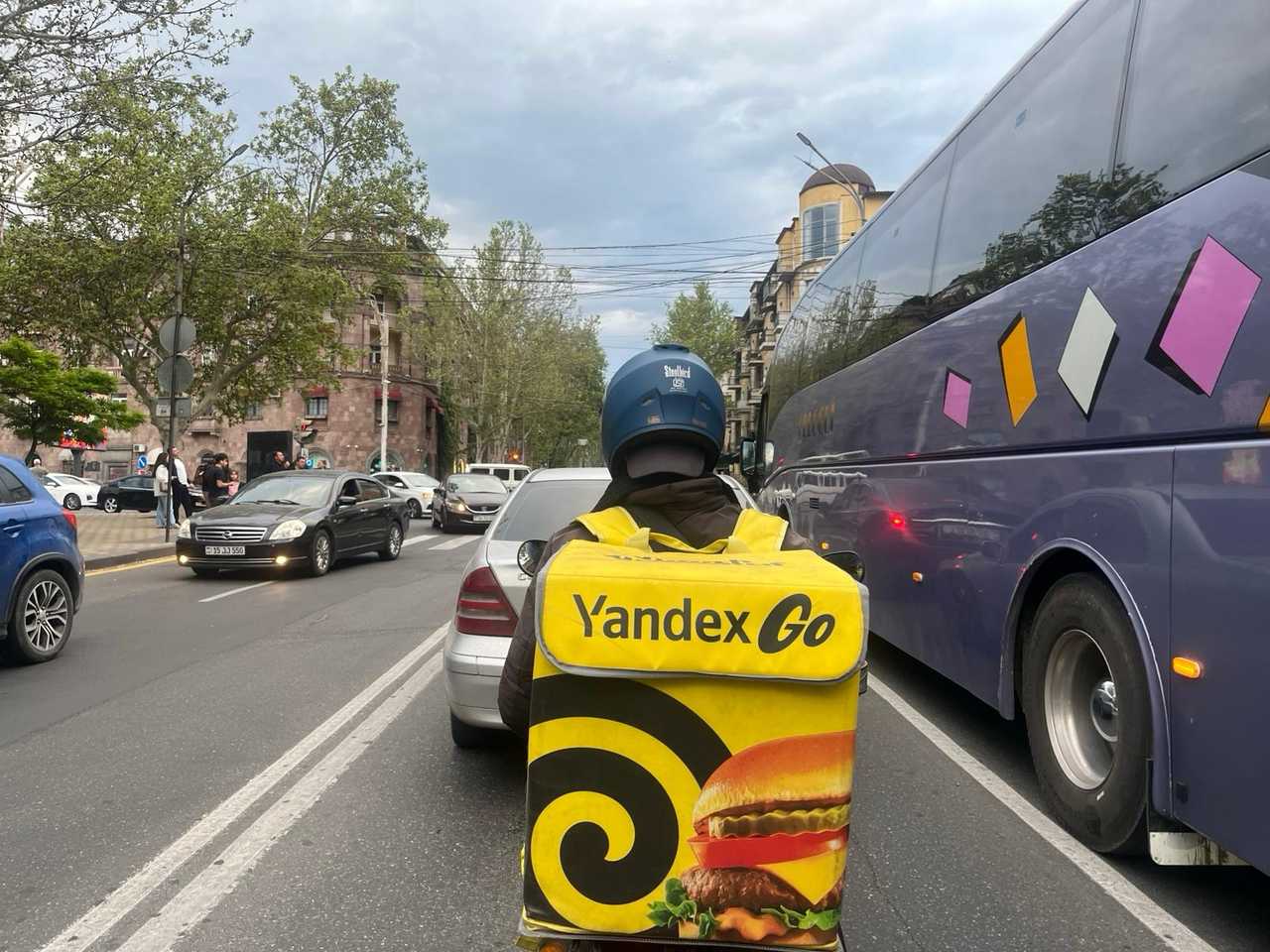
On the other hand, many Iranians displaced by war, political repression, and economic crisis are working as motorcycle couriers on Yandex, the Russian tech platform widely used for delivery and transport services. It is the only job that does not require work residency, and where there is at least some confidence that they will be paid. But this job provides no insurance and no reliable means of securing a livelihood. There is no job security, and couriers must wait for orders at all hours of the day in order to earn a little money to survive. As is clear, this job involves risks to life and safety for which no institution and no company take responsibility. For example, if couriers have an accident while driving on roads and routes, all costs fall on them. If the police become involved, there is also the risk of police scrutiny and possible deportation.
We spoke with people working in this field, and the general outcome of those conversations was a sense of hopelessness about the future:
“Working for Yandex is very hard. Your life is in your hands, and there is no security in it. However much you work, maybe you can only cover the small costs of daily life. Renting the motorcycle, repairs, all of that is on you. It makes the work even harder.”
Another person says:
“After January and the war, the number of Iranians working for Yandex became so high that working on this platform is no longer profitable for anyone. Before, there were 30 orders for each person, and you could make money from that. But now imagine that those 30 orders have dropped to seven or nine.”
In the meantime, one person recounts a bitter experience among Iranians looking for work:
“I know technical work. On the first day I came here from Iran, I was looking for construction work, and eventually I found a place. I worked for a month, and the person did not pay me, and I lost the job. This did not happen only to me. It is a bitter thing that happens to everyone. We do not have work permits, so our rights and wages are easily stolen. Maybe the only solution is working as a delivery courier for Yandex. At least you know your money is paid in cash. With all its problems and limitations, it is the only way out.”
Armenia: A New Geography of Survival
What is taking shape in Armenia is not simply a classic migration wave, but a new geography of survival, a place between flight, waiting, and the attempt to minimally rebuild life.
The Iranians caught in this situation fit into none of the recognized legal categories and benefit from no structural protections. They live in a kind of “suspended existence,” in which every everyday decision, from work to where to sleep, becomes a matter of survival.
If this trend continues, the main question will no longer be how these people came to Armenia. It will be what fate awaits a population that can neither return nor stay.