A tribute to the Iranian artist whose work turned revolution, exile, and women’s defiance into a universal language of memory.
Marjane Satrapi, creator of the landmark Persepolis, died on 4 June 2026. She died “of grief” a little over a year after the death of her husband. But can one die of grief? In Persian, there is a word for such a death, at once colloquial and brutally precise: deq — a wasting away from grief. A word for that moment when mourning crosses the boundary of the psyche, settles in the body, slowly dries up the desire to live, and cuts short a life before it has reached its natural end. In contemporary medicine, people speak of “broken-heart syndrome,” or Takotsubo cardiomyopathy. This is a note on that condition, and in mourning Satrapi’s death.
The news of the death of Marjane Satrapi, creator of the landmark Persepolis and one of the tireless voices of the “Woman, Life, Freedom” movement in recent years, shocked Iranian and French society alike. She left the world at fifty-six, at an age when one can usually still write, endure, create, become angry, and bear witness. Those close to her have said that Satrapi died “of grief” a little over a year after the death of her husband, Mattias Ripa; a phrase that must be understood with medical caution, but also taken seriously in all its human weight.
This is a life cut short: not only in the sense of dying young, but in the sense of a possibility being cut off. When Houshang Golshiri spoke of “premature death in contemporary Iranian prose,” he was not thinking only of the number of years writers lived. For him, the issue was incompletion: the interruption of a path, the extinguishing of a possibility that could still have continued. Satrapi’s death is of this kind too: the cutting of a branch that still bore fruit.
Broken-Heart Syndrome
But can one die of grief?
Deq is an experience people understood and named before physicians did: if grief remains without shelter, it can pass through the psyche and reach the body. Sorrow does not remain only in thought. It breaks sleep, takes away appetite, wears down the body, lowers immunity, puts pressure on the heart, and slowly dries up the will to go on. Deq is a silent retreat: the slow death of the desire to live.
In contemporary medicine, people speak of Takotsubo cardiomyopathy, often called broken-heart syndrome: a heart condition that can occur after severe emotional or physical shock and whose symptoms may resemble a heart attack. This syndrome does not explain the full meaning of deq, because deq is not always a sudden event and cannot always be reduced to a cardiac episode. But Takotsubo clarifies one thing: a broken heart is not only a metaphor. The body can translate emotional shock into the language of muscle, pressure, shortness of breath, and cardiac disorder.
Severe and prolonged grief, meanwhile, is not merely psychological sorrow. Medical and psychiatric research has shown that the loss of a spouse or a close loved one can increase the risk of death, heart disease, depression, sleep disorders, and the erosion of general health. New classifications also speak of “prolonged grief disorder”: a condition in which grief departs from its ordinary path and becomes a permanent preoccupation of mind and body with loss. So “dying of grief” should not be taken as a simple medical diagnosis, but neither should it be dismissed as poetic fantasy. Grief can destroy the body when it becomes tied to loneliness, depression, insomnia, loss of appetite, exhaustion, and the abandonment of self-care.
The death of the beloved, if the love has been deep, is the collapse of the architecture of the world. The person who dies takes part of time away with them. The past becomes ownerless, the future without a sign, the house without meaning, and the days without direction. When that presence leaves, the body must learn to be alone again. Some bodies do not learn. Or cannot. Or no longer want to.
Deq, Melancholia, and Mourning
Deq is not the same as mourning or melancholia, but it is related to both. Mourning, even when devastating, is still a form of relation to loss. The person knows whom they have lost, what has collapsed, which place in the world has become empty. In mourning, the object of loss is clear. The dead person is absent, but their absence has a name. The pain is not diffuse and indeterminate; it is tied to someone, a memory, a house, a voice, a body, or a lost future. For this reason, mourning, if it has the possibility of expression and companionship, can, over time, prepare the ground for a stronger return to life.
Melancholia is different. In “Mourning and Melancholia,” Freud states the main distinction in this way: in mourning, the world becomes poor and empty; in melancholia, the ego itself becomes poor and empty. In mourning, the loss is outside me, even if it breaks me. In melancholia, the loss is transferred into me. The person does not only lose the beloved or the lost object; they become one with it, and then turn anger, blame, and destruction back against themselves. For this reason, melancholia is not only sadness. It is a collapse in the relation to the self. The person does not say only that the world has become meaningless; it is as if they themselves are no longer worthy of living, desiring, or continuing.
Deq lies between these two, but it is neither exactly mourning nor merely melancholia. Deq names the moment when mourning exceeds the body’s capacity to bear it and melancholia comes close to biological erosion. Deq is not mourning, because in it, loss devours the possibility of life. Nor is it melancholia, because it is not necessarily expressed in the language of guilt, self-reproach, or the psychoanalytic structure of anger returning to the ego. Deq is the precise name for the moment when loss retreats from the level of meaning and settles materially in the body. In deq, the question is not that the world has become meaningless; deq is indifferent to meaning. It deals with appetite, sleep, voice, skin, heart, movement, memory, and desire.
In this sense, deq is the failure of the possibility of mourning. It is the point at which loss is not symbolized, does not find a place in language, no collective body is formed to carry it, and the body is forced to endure it alone, in a form that has not been given a name. Mourning, when it has a social possibility, can create a distance between the dead and the living; a painful distance, but a necessary one. Deq begins when this distance is not created. The dead do not leave the world; they remain alive in the body. Not as memory in the ordinary sense, but as an erosive pressure.
Deq and the Politics of Care
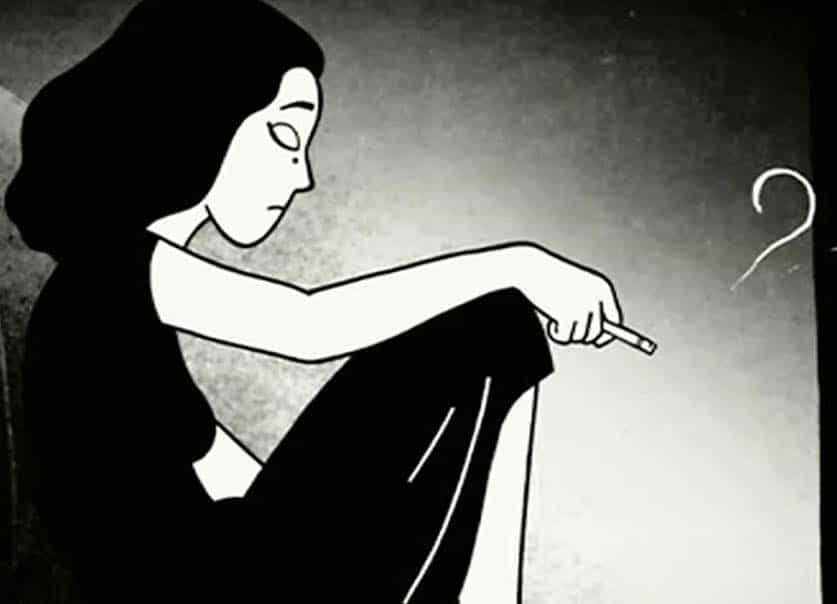
Marjane Satrapi was an artist of the defeats and wounds that followed the 1979 Revolution. Persepolis was not only the story of a girl’s childhood in post-revolutionary Iran. It was a narrative of history entering the home, the school, the woman’s body, the girl’s hair, family fear, the grandmother’s laughter, exile, and language. She was able to make an Iranian experience global without making it harmless or decorative. This is why her death weighs heavily on Iranians. She was one of the few figures able to build a bridge between Iran and the world, between image and politics, between exile and memory, between childhood and historical violence. Her death is one of those deaths after which you feel that something has gone missing from public language.
Marjane Satrapi’s death brings us back once again to this harsh truth: human beings do not have an infinite capacity to endure.
We understand deq well, because our contemporary history is piled high with grief. Exile causes deq. Prison causes deq. Execution causes deq. The defeat of revolution causes deq. Repeated news of death causes deq. But we also understand well how deq can be pushed back through a politics of mourning. Bereaved mothers, families of prisoners, survivors of war, migrants with no return, and generations constantly forced to live with loss all know that grief is not only a feeling. Grief is matter. It has weight. It sits on the shoulders, settles in the chest, and ages the body before its time. And yet they have made from grief a politics of life.
To understand deq, we also have to think about the politics of care. “It is easy to praise a flower, to pick it, and to forget that the vase must be watered.”
Death from grief should not be beautified, nor should it be treated as a code name for romantic fidelity. Deq is less a celebration of love than a sign of the failure of the possibility of mourning: the inability to symbolize loss, to share it socially, and to transform grief into a force for continuing. Today’s world has made mourning more private and has increasingly abandoned the bereaved person to the room, medication, short messages, and loneliness.
Marjane Satrapi has gone, prematurely and shockingly. But one word in the news of her death was heavier than the news itself: grief. She died “of grief.” May her memory be honored.