

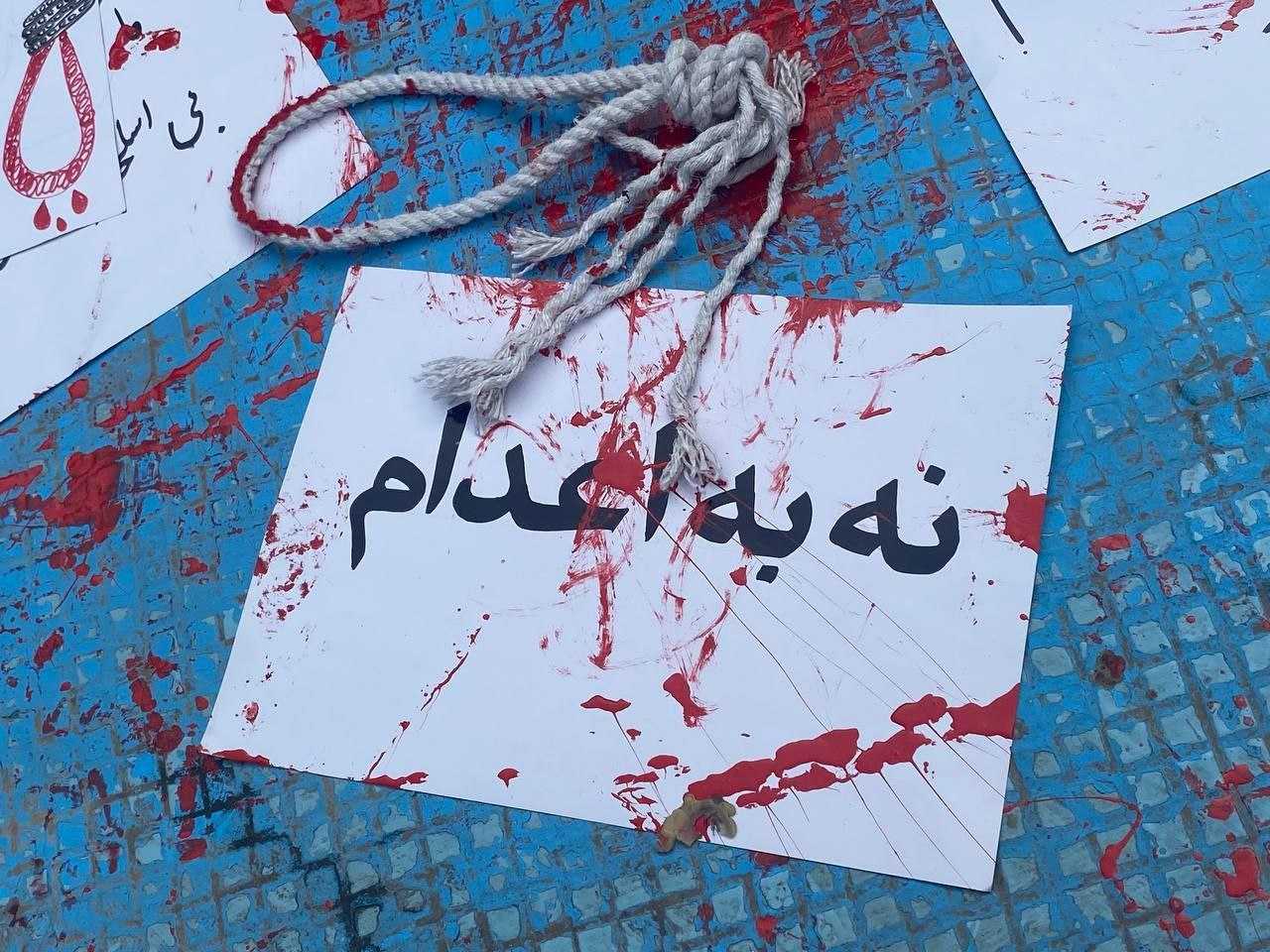
At least 11 people were executed this week in Iran, including young protesters, political prisoners, two brothers, and a disabled worker.
In the past week, the Islamic Republic executed at least 11 prisoners whose cases had been reported by human rights organizations and state media: Peyman Mohammadi, Mohammadreza Mohammadi, Abbas Rahimi-Azar, Mehdi Badfar, Mehdi Rasouli, Mohammadreza Miri, Ebrahim Dolatabadi-Nejad, Mehrab Abdollazadeh, Naser Bakerzadeh, Yaghoub Karimpour, and Sasan Azadvar Jonaghani.
Seven of these executions were linked to political, security, espionage, or protest-related cases. Four others were carried out under Iran’s system of retaliatory punishment for murder, known as qisas, a legal-Islamic framework that rights groups have long criticized for ignoring the complexity of cases, the circumstances of the accused, and the standards of fair trial.
In the shadow of war, the Islamic Republic is using the language of “security” to accelerate executions and settle accounts with those arrested during uprisings. The state that failed to protect society from war, inflation, unemployment, and infrastructural collapse is now trying to restore its damaged authority through the gallows. The targets are not only political prisoners accused of espionage or armed action; they are also young protesters, workers, ethnic and religious minorities, and people caught in a judicial system where forced confessions, denial of legal counsel, and secretive executions have become recurring features.
Some of those executed were barely adults when they were arrested. One was a 21-year-old athlete. Others were 21, 25, or 26. Several had said their confessions were extracted under torture. Families were kept in the dark, bodies were handed over after execution, and burials took place under heavy security. In case after case, the judiciary presented the execution as the end of a legal process; human rights sources described it as the continuation of repression by other means.
Four Prisoners Executed in Isfahan: A Disabled Worker, Two Brothers, and Another Prisoner
On Sunday, May 3, 2026, four prisoners were executed in Dastgerd Prison in Isfahan. They were identified by Iran Human Rights as Peyman Mohammadi, 37, Mohammadreza Mohammadi, 41, Abbas Rahimi-Azar, 29, and Mehdi Badfar, 33. All four had been sentenced to death in separate murder cases under qisas.
Mehdi Badfar was from Chabahar and worked as a farmer. He had been arrested about five years earlier on a murder charge. According to the report, he had a physical disability and had previously lost three fingers on his left hand in a workplace accident.
Among those executed were also two brothers, Peyman and Mohammadreza Mohammadi. According to an informed source, they had been arrested about four years earlier on charges of killing a man named Fakhr al-Din and were later sentenced to death.
Abbas Rahimi-Azar, from Isfahan, had been arrested nearly three years earlier in a murder case described as involving so-called “honor” motives.
By the time the report was published, official domestic sources and state-affiliated media had not announced or confirmed the executions.
These four executions once again expose one of the central problems of Iran’s death-penalty system: the absence of meaningful distinctions between different degrees and circumstances of “intentional murder.” In practice, a single sentence—qisas—can be issued without sufficient consideration of motive, context, self-defense, coercion, or the possibility that the killing took place under circumstances falling short of premeditated murder.
According to Iran Human Rights’ annual figures, at least 747 people were executed in Iran in 2025 on murder charges, the highest number of qisas executions recorded since 2010. The figure was at least 419 in 2024, 282 in 2023, 288 in 2022, and 183 in 2021.
Three More Prisoners from the January Uprising Executed in Mashhad
The judiciary also announced the execution of Mehdi Rasouli, Mohammadreza Miri, and Ebrahim Dolatabadi-Nejad, three prisoners arrested in connection with the January 2026 uprising in Mashhad. Their cases, like previous protest-related executions, remain marked by serious ambiguities.
According to the judiciary, the sentences were carried out after legal proceedings and confirmation by the Supreme Court. In its official statement, the judiciary accused the three men of involvement in violence during the protests. Mehdi Rasouli and Mohammadreza Miri were accused of links to foreign intelligence agencies and involvement in the killing of a government force. Ebrahim Dolatabadi-Nejad was described as one of the people involved in directing protests in the Tabarsi district of Mashhad.
The judiciary also listed accusations such as acting against national security, damaging public property, participating in violent clashes, and using knives and Molotov cocktails. As in many protest cases, the state’s account relied on what it called the defendants’ “confessions,” along with security reports, images, and statements attributed to the accused.
Human rights sources reported that Mehdi Rasouli, 25, and Mohammadreza Miri, 21, were executed at dawn on Sunday, May 3, in Vakilabad Prison in Mashhad. Their families had reportedly not been informed in advance of the execution time, and their bodies were handed over to them later that morning.
According to these reports, one of the defendants had previously denied the charges and said his confession had been extracted under pressure. This claim has not been independently verified, but it fits a broader pattern in protest-related cases in which defendants say televised or written confessions were obtained under torture, threat, or coercion. Families had also reportedly been encouraged to remain silent.
In the case of Ebrahim Dolatabadi-Nejad, the judiciary accused him of leading part of the protests, inciting demonstrators, and playing a role in violent clashes. It also referred to his previous criminal record. Yet no independent details have been published about the proceedings against him.
The executions form part of a wider wave of death sentences against those arrested in connection with the January 2026 uprising, which began in Tehran and quickly spread to other cities, including Mashhad. The protests were met with widespread repression. Thousands of people were killed, wounded, or arrested.
Mehrab Abdollazadeh, Arrested During Woman, Life, Freedom, Executed in Urmia
On the same day, Sunday, May 3, the judiciary announced the execution of Mehrab Abdollazadeh, a Kurdish political prisoner held in Urmia Central Prison. Mehrab was born in 1997 and was 29 years old. He had been arrested in October 2022 during the Woman, Life, Freedom uprising.
The judiciary’s Mizan news agency said he had been sentenced to death on the charge of “corruption on earth” in connection with the killing of Abbas Fatemiyeh in Urmia. State media described Fatemiyeh as a “popular volunteer force,” while earlier reports had identified him as a member of the Basij paramilitary force.
Mehrab Abdollazadeh had previously sent a message from Urmia Central Prison saying that the confessions attributed to him were false and had been extracted through torture and threats: “From the first day of my arrest, they forced confessions out of me through torture and threats, all of which were lies.”
He was arrested on October 22, 2022, at the barbershop where he worked, by agents of the Intelligence Organization of the Islamic Revolutionary Guard Corps. After his arrest, he was held for 38 days in that security-military agency’s detention facility. Human rights sources say he was subjected to severe physical and psychological torture to force him to confess to participating in protests and taking part in the killing of a Basij member.
According to available information, video footage from the scene of the killing, which was in the possession of security agencies, did not show Mehrab Abdollazadeh at the scene. He consistently denied involvement throughout interrogation and trial. Sources close to the case say that the arrest of his girlfriend and threats to arrest other family members were among the tools used to pressure him into forced confession.
During his initial detention, Abdollazadeh was reportedly denied family visits and access to a lawyer. His family, despite repeated inquiries, had no information about his condition or place of detention. In interrogation and court sessions, he had asked for the location data of his mobile phone to be examined in order to prove that he was not present at the site of the killing. The request was ignored. His death sentence was issued in September 2024 and communicated to him a month later.
His execution shows how the state continues to use the courts to punish the Woman, Life, Freedom generation long after the peak of the street protests. The uprising may no longer occupy the streets in the same visible form, but its detainees are still being killed in prisons.
Secret Executions in Urmia: Naser Bakerzadeh and Yaghoub Karimpour
On Saturday, May 2, the judiciary confirmed the executions of Naser Bakerzadeh and Yaghoub Karimpour in Urmia Central Prison. Both had been sentenced to death in political cases involving accusations related to “espionage for Israel.”
Human rights organizations reported that the executions were carried out secretly at dawn. Mizan later confirmed them. The executions took place after Naser Bakerzadeh, Yaghoub Karimpour, and Mehrab Abdollazadeh had been removed from their wards on Thursday, April 30, under heavy security measures and transferred to unknown locations. From that moment, concerns grew that their executions were imminent.
Naser Bakerzadeh, a 26-year-old political prisoner from Urmia, had been sentenced to death by Branch 2 of the Urmia Revolutionary Court on charges of “espionage for Israel.” His sentence was confirmed by Branch 39 of the Supreme Court and officially communicated to him on April 25. Published reports say he was severely tortured during detention at the al-Mahdi detention center and that the confessions attributed to him were extracted under pressure.
Amir Raisian, a lawyer, had previously said that Branch 39 of the Supreme Court confirmed the third death sentence issued by the Urmia Revolutionary Court despite twice having overturned earlier versions of the ruling and without resolving the previous legal defects. Human rights sources said the speed and opacity of the proceedings intensified concerns about violations of Bakerzadeh’s right to a fair trial.
Yaghoub Karimpour, the other executed prisoner, had a degree in public law. He was from Miandoab, a Turkic citizen, and a follower of the Yarsan faith. He was arrested by the Ministry of Intelligence during the 12-day war between Iran and Israel. Branch 1 of the Urmia Revolutionary Court sentenced him to death on the charge of “corruption on earth” through “espionage for Israel.” His sentence had been confirmed the previous month by Branch 9 of the Supreme Court.
According to Hengaw, security forces also arrested his wife, Saboura Lotfi, to pressure him.
The two prisoners had been removed from their wards on Thursday under pretexts such as “transfer to forensic medicine” and “meeting officials responsible for sentence enforcement.” They were then taken to solitary confinement or unknown locations. Families who went to the prison and the Urmia courthouse to seek information received no clear answer.
The presence of prison guard units in political and public wards—something usually seen before executions—had already raised alarm. Rights organizations warned that the transfer of the prisoners signalled imminent executions and called for serious international reaction to the new wave of political executions in Iran.
Sasan Azadvar Jonaghani: A 21-Year-Old Athlete Executed in Isfahan
At dawn on Thursday, April 30, the Islamic Republic executed Sasan Azadvar Jonaghani, a 21-year-old athlete and one of those arrested during the January 2026 uprising. He was executed in Dastgerd Prison in Isfahan.
Sasan, from Isfahan, had been arrested during the nationwide protests and sentenced to death by Branch 1 of the Isfahan Revolutionary Court on the charge of “enmity against God.” The sentence was later confirmed by the Supreme Court.
According to published reports, he was arrested on January 1, 2026, and tried in February or March. Judicial authorities accused him of participating in street clashes, attacking security forces, damaging public property, and propaganda activity against the state.
In addition to the death sentence, he had received other prison terms in a separate case: 15 months for “propaganda against the system,” seven years for “inciting or provoking people to war and killing one another with the aim of disrupting national security” through encouraging unrest in public and online spaces, and 25 months for “insulting the Supreme Leader.”
Human rights sources said his trial was marked by serious ambiguities, including lack of effective access to an independent lawyer and prolonged detention in solitary confinement.
His family was summoned to the prison for a final visit days before the execution. His burial was held under heavy security, and only a limited number of relatives were allowed to attend.
The execution of a 21-year-old athlete arrested in the January uprising captures the brutality of the state’s postwar strategy. The judiciary turns protest into “security crime,” youth into “enemy,” and political anger into a capital offense. The message is meant not only for the family of Sasan Azadvar, but for all those who took to the streets: the state remembers, waits, and retaliates.
The Gallows as Postwar Governance
The latest executions cannot be separated from the broader political context. Since the start of attacks by the United States and Israel on February 28, the United Nations High Commissioner for Human Rights has said that at least nine people have been executed in connection with the January 2026 protests, 10 others on accusations of membership in opposition groups, and two on espionage charges. In the same period, more than 4,000 people have reportedly been arrested on national-security grounds.
This is the architecture of postwar repression: executions, mass arrests, forced confessions, and the conversion of social protest into national-security threat. The Islamic Republic is using the aftermath of war not only to silence dissent, but to rewrite the meaning of dissent itself. Protesters become not only “rioters,” but “terrorists” as well; political prisoners become “spies”; trials become ceremonies of punishment whose outcome is often determined before they begin.
The execution of young protesters such as Sasan Azadvar, Mohammadreza Miri, Mehdi Rasouli, and Mehrab Abdollazadeh shows that the state’s revenge is generational. It is aimed at those who entered political life through the streets, through revolt, through the experience of seeing the state kill and lie and then demand obedience.
The qisas executions in Isfahan, meanwhile, show another side of the same machinery: a penal system that kills poor and marginalized prisoners with little public visibility, often without official announcement, and within a legal framework that reduces complex social violence to a single answer: death.
Together, these executions reveal a state that governs through fear at the very moment when its own failures have become impossible to hide. War has deepened poverty. Inflation has emptied tables. Factories have been damaged. Jobs have disappeared. The national currency is under pressure. Yet instead of accountability, the state offers punishment; instead of justice, it offers the scaffold.
For the Islamic Republic, the postwar moment has become an opportunity: to intimidate society, to discipline the memory of uprisings, and to take revenge on protesters under the cover of national security. For the families of those executed, however, the war has not ended. Its legacy continues in prison corridors, in unannounced dawn executions, in bodies returned after death, and in graves surrounded by security forces.