

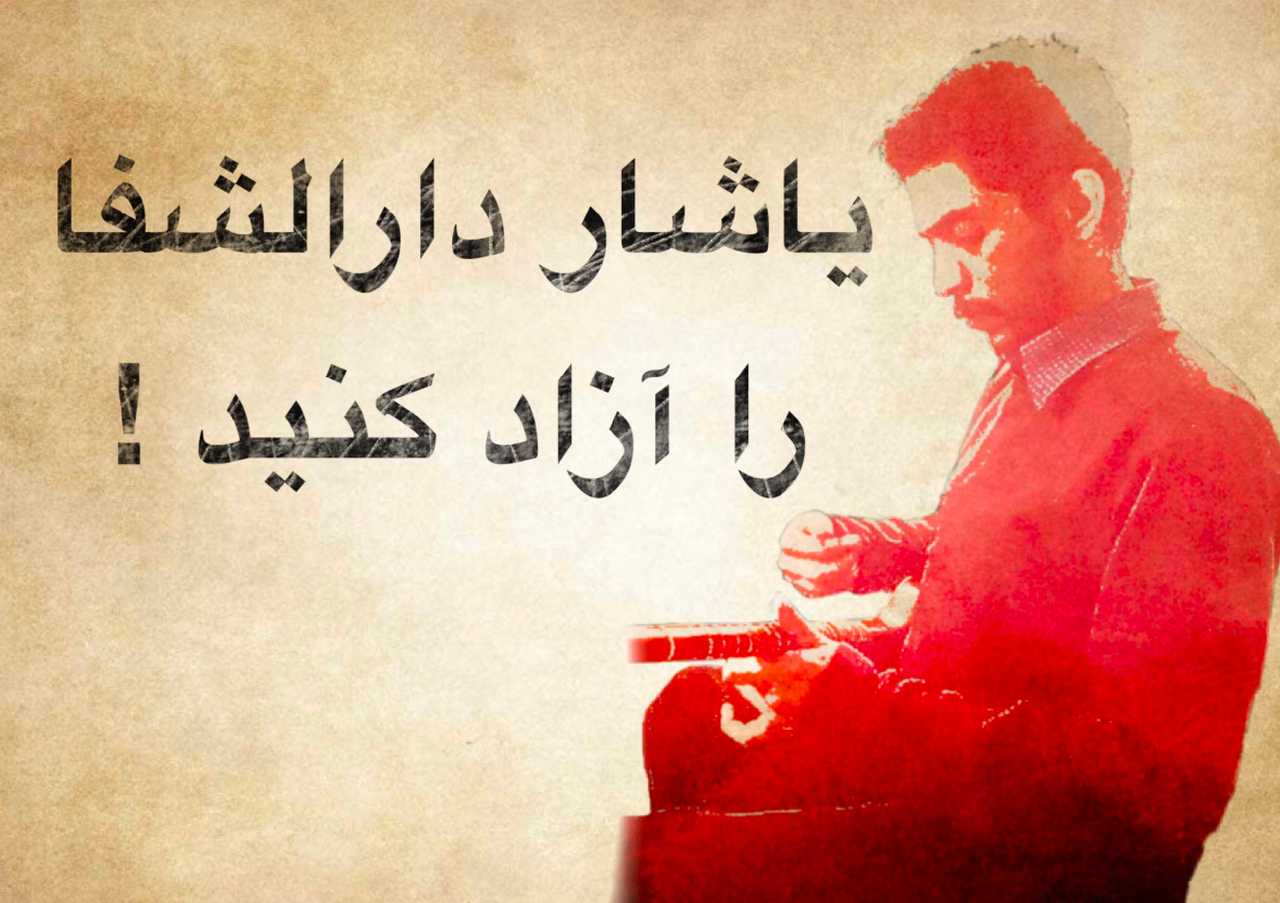
Nearly thirty days after his arrest, Darolshafa’s family still does not know where he is being held or what charges he faces.
Yashar Darolshafa is a member of the management council of the Education Center of the Iranian Sociological Association and an engaged and committed social researcher in Iran. He has been arrested several times. For nearly thirty days, his family has had no information about him.
Neither the place of detention nor the charges against Darolshafa are known. Nearly thirty days after his arrest, security and judicial bodies have not responded to his family’s inquiries.
Security forces arrested Darolshafa violently at his home on June 3, 2026, without announcing any charges. At the same time, they confiscated his electronic devices and some of his personal belongings.
According to information received by Zamaneh, Darolshafa has had only two brief phone calls with his family since his arrest. Despite repeated follow-ups by his relatives, the judiciary has so far not announced either the reason for his arrest or the place where he is being held.
This is not the first time security institutions have arrested this social sciences researcher and former student activist. The last time, in February 2023, he was released from prison after serving part of a 10-month prison sentence. That sentence, which began in August 2022, was enforced while Darolshafa had already suffered psychological and physical harm as a result of previous arrests and imprisonments.
He was arrested after the 2009 protests and sentenced to five years in prison. During Darolshafa’s imprisonment, a large number of sociologists and sociology lecturers at Iranian universities wrote a letter calling for his release as one of the country’s “elite students.” In the 2010s, he defended his master’s thesis while under a prison sentence.
When Darolshafa was arrested in November 2019, his leg became infected in prison. After his release, he said: “I could see that my leg was turning dark, and the smell of the infection bothered me.” After his release, the infected leg was operated on twice.
Several years ago, the medical commission of the National Conscription Organization, which assesses the health of those subject to compulsory military service, reviewed Darolshafa’s file and confirmed the illness that made him exempt from compulsory service. Nevertheless, Iran’s Legal Medicine Organization, whose opinions can determine whether a prisoner is medically fit to serve a sentence, reviewed his medical file and opposed issuing a ruling that he was unfit to endure punishment.
According to information received by Zamaneh, he needs treatment for both physical and psychological conditions. There are concerns that, in detention, he may be denied access to medication and that his treatment may be interrupted.
An Engaged and Committed Social Researcher
Darolshafa was admitted with a top ranking to the doctoral program in Health and Social Welfare at the University of Social Welfare and Rehabilitation Sciences. In his dissertation, titled “Class Struggle and Workers’ Welfare: Measuring the Impact of Iranian Industrial Workers’ Struggles on Their Welfare Conditions, from after the Revolution to 2020–2021,” he examined “workers’ self-activity” in order to study “the class formation of workers and their welfare conditions” over 42 years of rule by the Islamic Republic.
His doctoral dissertation should be understood as a continuation of his master’s thesis in the social sciences. In his master’s thesis, titled “A Critique of the Ideology of Iran’s Post-Revolution Five-Year Development Plans, with an Emphasis on Social Welfare Parameters,” Darolshafa examined the impact of the state’s economic policies from 1989 to 2009.
Comparing development plans across the presidencies of Akbar Hashemi Rafsanjani, Mohammad Khatami, and Mahmoud Ahmadinejad, he wrote: “Technocratism, reformism, and demagoguery are, for us, three apparently different native formations, but identical in content: their ultimate goal is to deepen capitalist relations, shrink the scope of social welfare, and crush every form of social resistance to these unequal relations.”
On June 7, 2026, the Scientific Association of Sociology at the University of Tehran protested the arrest of “the member of the management council of the Education Center of the Iranian Sociological Association,” writing:
“Yashar Darolshafa is one of the few graduates of social sciences in Iran who, despite all pressures, has for years seriously pursued his commitments as a researcher, lecturer, and student activist. His work focuses on the suffering of the subaltern and the poor, especially workers and the history of the labor movement. In this respect, few people resemble him: hardworking, focused, and active in both theory and practice.”
Referring to Darolshafa’s two student theses, the association also listed “membership in student associations and teaching social thought to workers and teachers” as another part of his record. It added: “We all remember Yashar Darolshafa’s positions in recent months: clear and well-argued positions condemning domestic repression, rejecting monarchism, opposing war, and drawing a line against left currents that align themselves with the Islamic Republic and its regional allies in the name of ‘resistance’ against the West. The arrest of Yashar Darolshafa means nothing other than an attempt to silence independent voices.”
The board of directors of the Iranian Sociological Association also reacted to the arrest of the member of its Education Council’s board. In a statement expressing concern over Darolshafa’s arrest, the association called on the responsible institutions to provide “transparent information” about him “within the framework of the country’s laws and regulations” and to act to “ensure his legal rights.”
In his other research and articles, Darolshafa pursued the same field of inquiry with reliance on, and command of, Marxist studies. In an analytical chronology of strikes and protests, he examined the struggles of Iranian workers from 1906 onward. In another study, he turned to the works of Marx in Persian. In addition, numerous articles by him have been published in recent years, revealing the depth of his concern for the poor and workers, as well as for the devastating effects of prescribed policies of economic liberalization.
Darolshafa studied industrial management as an undergraduate. Alongside his studies, he was also significantly active in the arts, especially music and theater. Perhaps his best-known artistic work is his performance of Bijan Mofid’s play The City of Tales in Evin Prison.
Authorities must immediately disclose Darolshafa’s place of detention and the charges against him, ensure his access to medication, medical treatment, and legal counsel, and respect his basic legal rights.