

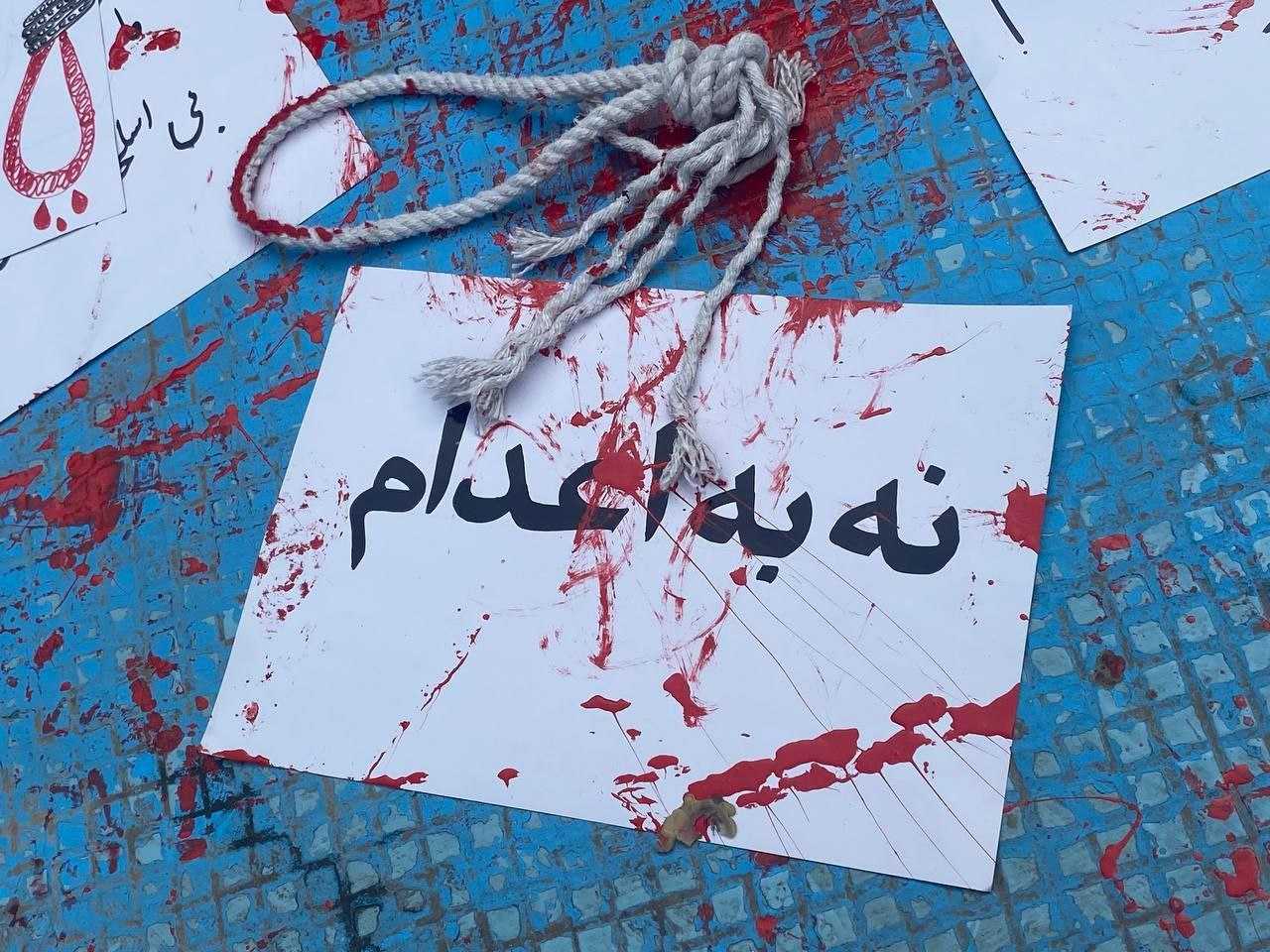
The campaign expands to 59 prisons as 1,500 Ghezel Hesar death-row prisoners strike amid at least 20 executions and new sentences against protesters.
In its 130th week, the “No to Executions” campaign expanded to 59 prisons after prisoners in Neyshabur joined the initiative. [explain this campaign: on each Tuesday they go on strike, and now it is more than … prisons who are active in this campaign]. At the same time, more than 1,500 death-row prisoners in Unit 2 of Ghezel Hesar Prison entered the second week of their strike and sit-in. The protests continued during a week in which at least 20 prisoners were executed across Iran, including four people linked to the “Woman, Life, Freedom” uprising and the January 2026 protests. Alongside these executions, courts continued to issue death sentences and lengthy prison terms against other protesters, showing that capital punishment remains one of the state’s principal tools of political repression and control over poor and marginalized prisoners.
On Tuesday, July 21, 2026, the “No to Executions on Tuesdays” campaign marked its 130th consecutive week and expanded to 59 prisons after a group of prisoners in Neyshabur Prison announced that they had joined.
Meanwhile, the strike and sit-in by prisoners in Unit 2 of Ghezel Hesar Prison, which began on Monday, July 13, entered its second week. The campaign’s statement put the number of participants at more than 1,500 death-row prisoners. According to the Human Rights Activists News Agency, on Monday, July 20, prisoners refused their food rations for the eighth consecutive day and staged a sit-in in the ward hall. The protest began after six prisoners sentenced to death in drug-related cases were transferred to solitary confinement. Videos published from inside the prison show the prisoners’ gathering and handwritten signs reading “No to Executions.”
The convergence of the large-scale Ghezel Hesar strike with the campaign’s 130th week has taken the protest against capital punishment beyond the framework of a weekly hunger strike. The campaign began with Tuesday strikes in January 2024. Prisoners in women’s and men’s wards across the country—from Evin and Ghezel Hesar to Zahedan, Rasht, Urmia, Sanandaj, Sheiban Prison in Ahvaz, and Adelabad Prison in Shiraz—have since declared their participation. Neyshabur’s addition brought the number of participating prisons to 59.
This week’s statement said that at least 280 people have been executed in Iran since the start of the current Persian year on March 21, 2026.
Hengaw alone recorded at least 26 executions in April, 80 in May, and 109 in June—a total of 215 executions over those three months.
Because many executions remain concealed and organizations use different data-collection methods, these figures should be understood as minimum estimates rather than final totals.
Four Protest-Related Executions Among at Least 20 Carried Out
The campaign statement focuses on the executions of four prisoners connected to protests: Aref Khoshkar, who was arrested during the “Woman, Life, Freedom” uprising, and Mohammad Amini Dehaghani, Erfan Esfandiari, and Gol-Mohammad Mohammadi, who were arrested during the January 2026 protests. A review of published reports, however, indicates that the total number of verifiable executions carried out between July 14 and July 19 was considerably higher.
During those six days, at least 20 prisoners were executed in prisons in Tabriz, Ghezel Hesar, Isfahan, Sari, Shushtar, Khorramabad, and Yasuj. Four people were executed in Tabriz on July 14; 11 were executed on July 15 in Ghezel Hesar, Isfahan, Sari, Shushtar, and Khorramabad; one person was executed in Khorramabad on July 16 and another on July 17; one woman was executed in Yasuj on July 18; and two people were executed in Isfahan on July 19. At least half of the 20 had been sentenced to death on drug-related charges. Many of these executions were not announced by the judiciary or state media.
Aref Khoshkar was executed at dawn on Wednesday, July 15, alongside four other prisoners in Ghezel Hesar. He had been arrested in November 2022 during protests in Tehran’s Fallah neighborhood. A Revolutionary Court sentenced him to death for “waging war against God through carrying and using a weapon” and for the killing of a member of the Basij paramilitary force. His lawyer had previously said that there were no surveillance cameras at the scene of the killing and that the evidence was insufficient to establish Khoshkar’s role in the case. Before the sentence was carried out, his family’s efforts to obtain a reprieve and negotiate with the victim’s family were unsuccessful.
Mohammad Amini Dehaghani was executed in Isfahan on the same day. The judiciary accused him of setting fire to the Dehaghan governor’s office and police station and damaging public property during protests on January 9, 2026. The official report did not specify where the execution took place, and no independent information has been published about the length of the proceedings, his access to a lawyer of his choosing, or the evidence used to sentence him.
Four days later, the judiciary announced the executions of Erfan Esfandiari and Gol-Mohammad Mohammadi, an Afghan national, in the case known as the “Alikhani Square” case. The official account held them responsible for killing four police officers during protests in Isfahan on January 8. The case documents, the method used to establish each defendant’s individual role, and the details of their defense have not been made public. Nor has any transparent information been released about their access to lawyers of their choosing or their ability to mount an effective defense.
The “Alikhani Square” case did not end with these two executions. Human-rights reports indicate that 59 people have been tried in connection with the case and that 12 have received death sentences. Following the executions of Esfandiari and Mohammadi, 10 others remain at risk of execution. The judiciary has said only that “a number” of defendants were sentenced to death and has not explained the exact number of sentences or how each defendant’s charges were considered separately.
New Sentences Against Protesters and an Expanding Range of Punishments
During the same week in which four protesters were executed, reports emerged of several other severe sentences being issued or upheld. On July 20, Iran Human Rights reported that Mojtaba Dehbandi, 23, and Kianoush Hamzehei Kazerouni, 27, had been sentenced to death by Branch One of the Shiraz Revolutionary Court. The announced charges included “waging war against God” by setting fire to public buildings and “acting against national security” by sheltering protesters. An informed source said that the two men had taken injured protesters into their shops for treatment and were identified by security forces through surveillance-camera footage. The initial verdict had been issued more than two months earlier, but its details became public this week.
Hengaw also reported on July 20 that Mehdi Nazer and Mahnaz Chardoli, two other detainees from the January protests, had been sentenced to death. In addition to the death sentence, Mahnaz Chardoli received 10 years in prison, while Atefeh Nazer, Mehdi Nazer’s sister, was sentenced to 10 years. All three were arrested on January 11 and, according to the report, are being held in Evin Prison. Their families have also been pressured not to publicize the sentences.
In Tonekabon, Sina Sotoudeh, a 31-year-old resident of Ramsar and father of a five-year-old child, was sentenced to eight years in prison for “acting against national security” and summoned to begin serving the sentence. He was arrested on January 10 and released on temporary bail about two and a half months later. Citing an informed source, Hengaw reported that Sotoudeh was tortured in detention, sustaining injuries to his teeth, hands, feet, ribs, and genitals. Judicial authorities have not investigated or responded to these allegations.
The Tehran Province Court of Appeals has also upheld a 10-year prison sentence against Parya Dadgar-Safa; four years are suspended and six are enforceable. Ribwar Marabi, another defendant in the same case, received a similar sentence, and both files have been sent to the sentence-enforcement unit of the Evin Prosecutor’s Office. In Bojnurd, Hamzeh Ahmadi Taraghi was sentenced in two cases to a total of five years and seven months in prison, 148 lashes, and one year of internal exile in Zahak. According to the Human Rights Activists News Agency, he was denied access to a lawyer of his choosing despite having a hearing impairment.
The events of this week connect two apparently separate trajectories. On one side, political and protest-related cases proceed through death sentences, lengthy imprisonment, flogging, and exile. On the other, the routine carrying out of executions—especially against prisoners convicted of drug offenses and murder—continues, often without any official announcement. The Ghezel Hesar prisoners’ strike has emerged precisely where these two trajectories meet: political prisoners, January protesters, and poor and marginalized prisoners sentenced in drug cases all confront the same machinery of execution.
The campaign’s continuation over 130 weeks has served a clear purpose: it places executions carried out across scattered prisons, cities, and cases within a single frame, allowing prisoners to speak about a policy that the authorities largely seek to reduce to a collection of isolated and unrelated cases.
Campaign Statement: Neyshabur Joins in Week 130 as More Than 1,500 Ghezel Hesar Death-Row Prisoners Strike
The “No to Executions on Tuesdays” campaign condemns the growing number of executions in Iran and honors the memory of all executed prisoners, particularly those who sacrificed their lives for freedom and in the struggle against autocratic rule.
Over the past week, the ruling dictatorship once again took the lives of four political prisoners through a medieval form of execution: Aref Khoshkar in Ghezel Hesar Prison, and Mohammad Amini Dehaghani, Erfan Esfandiari, and Gol-Mohammad Mohammadi in Isfahan Prison.
Like many other political prisoners sentenced to death, these four oppressed prisoners were tried and executed in unfair proceedings. May they rest in peace, and may their memory be honored.
According to reliable figures, at least 280 prisoners have been executed since March 21, 2026.
In opposition to these inhuman executions, more than 1,500 prisoners in Unit 2 of Ghezel Hesar Prison have been protesting and striking for more than a week, demanding the abolition of the death penalty.
All prisoners in this ward are on death row, primarily on drug-related charges. It is clear to everyone that senior state officials and commanders of the Islamic Revolutionary Guard Corps are responsible for importing and producing narcotics in Iran. To conceal this evident betrayal, they send people who have been trapped by drugs because of poverty and deprivation to the gallows every day.
The prisoners of Ghezel Hesar and the “No to Executions on Tuesdays” campaign have now risen and resisted capital punishment in Iran for 130 consecutive weeks.
A group of prisoners in Neyshabur Prison has also announced in a statement that it is joining the campaign. Accordingly, on Tuesday, July 21, 2026, in its 130th week, the “No to Executions on Tuesdays” campaign is holding hunger strikes in the following 59 prisons:
Evin Prison (women’s and men’s wards); Ghezel Hesar Prison (Units 2, 3, and 4); Karaj Central Prison; Fardis Prison in Karaj; Greater Tehran Prison; Qarchak Prison; Khorin Prison in Varamin; Choubindar Prison in Qazvin; Ahar Prison; Arak Prison; Langaroud Prison in Qom; Khorramabad Prison; Borujerd Prison; Yasuj Prison; Asadabad Prison in Isfahan; Dastgerd Prison in Isfahan; Sheiban Prison in Ahvaz; Sepidar Prison in Ahvaz (women’s and men’s wards); Nezam Prison in Shiraz; Adelabad Prison in Shiraz (women’s and men’s wards); Firuzabad Prison in Fars; Dehdasht Prison; Zahedan Prison (women’s and men’s wards); Borazjan Prison; Ramhormoz Prison; Behbahan Prison; Bam Prison; Yazd Prison (women’s and men’s wards); Kahnuj Prison; Tabas Prison; Birjand Central Prison; Mashhad Prison; Gorgan Prison; Sabzevar Prison; Gonbad-e Kavus Prison; Qaemshahr Prison; Rasht Prison (men’s and women’s wards); Rudsar Prison; Haviq Prison in Talesh; Ezbaram Prison in Lahijan; Dizel Abad Prison in Kermanshah; Ardabil Prison; Tabriz Prison; Urmia Prison; Salmas Prison; Khoy Prison; Naqadeh Prison; Miandoab Prison; Mahabad Prison; Bukan Prison; Saqqez Prison; Baneh Prison; Marivan Prison; Sanandaj Prison; Kamyaran Prison; Ilam Prison; Kerman Prison; Borujen Prison; and Neyshabur Prison.
Week 130 — July 21, 2026
“No to Executions on Tuesdays” Campaign