

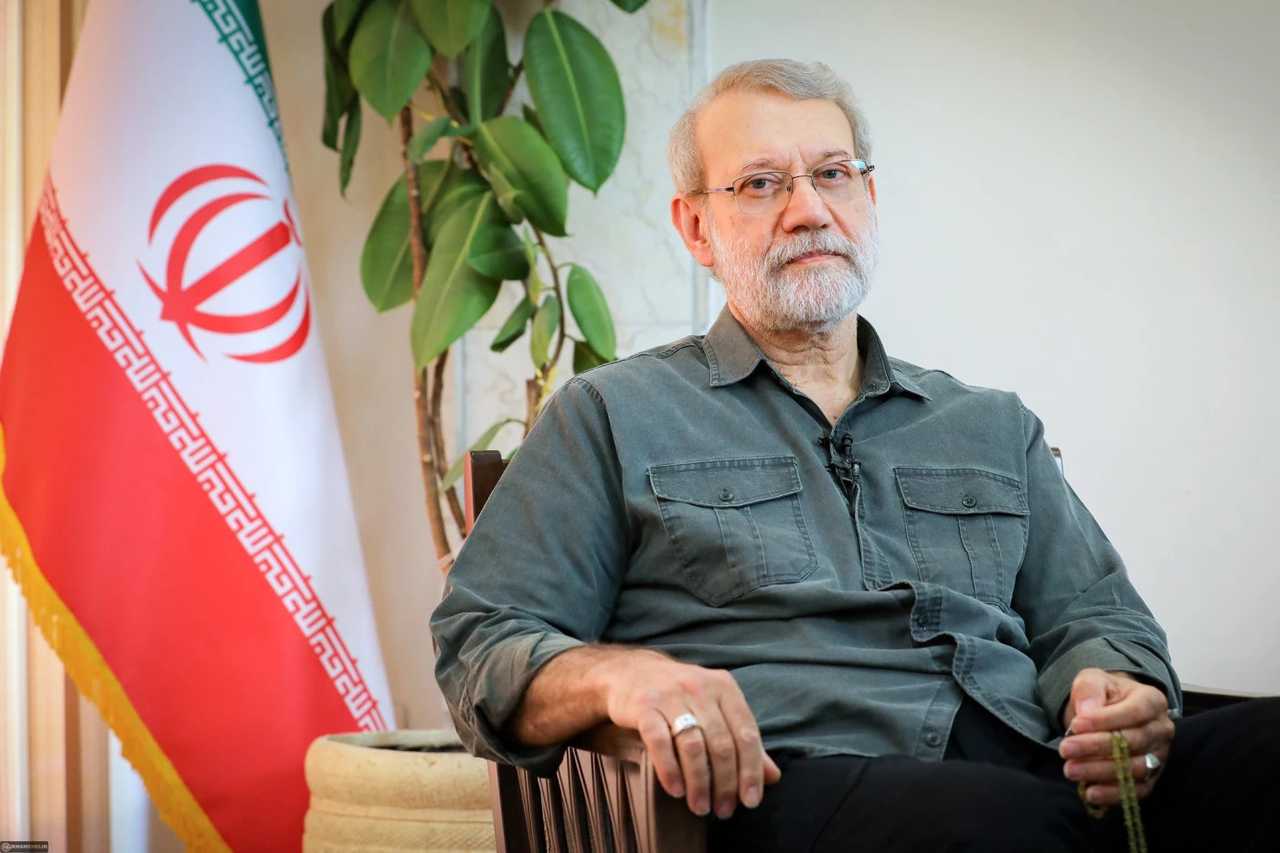
Ali Rasouli argues that Larijani was an executor, not a strategist, and that his assassination matters less than the regime’s inability to imagine a credible end to the war.
On Tuesday, 26 Esfand 1404 (March 17, 2026), an hour after Israel announced that it had targeted and assassinated Ali Larijani, secretary of Iran’s Supreme National Security Council, and before Iran had yet confirmed the news, a user supportive of the Islamic Republic wrote on X that, “if” the report of Larijani’s assassination was true, nothing important had happened. His argument was simple: since the 1980s, the regime has become highly skilled at “managing the consequences of assassinations.”
On the other side, Israel was trying to present the operation as a major achievement. In the Israeli narrative, which later spread to Trump as well, Larijani was described as the Islamic Republic’s “effective” or de facto leader. That is, as the figure who in recent months, before and after the killing of Ali Khamenei, had held the reins of security affairs. If someone occupied such a position even before Khamenei’s death, that would certainly give him particular weight in developments after the killing of the commander-in-chief.
How can the gap between these two narratives be bridged? One narrative reaches back to Ruhollah Khomeini’s famous line from the early years after the 1979 revolution — “Kill us, and our people will become more awakened” — while the other speaks of the “total destruction of the regime’s command-and-control structure.”
But beyond Larijani’s actual weight and place in the current condition of the Islamic Republic, others have examined this development from the perspective of “war-ending scenarios.” For example, on that same Tuesday, Vali Nasr and Trita Parsi wrote that killing Larijani was part of Israel’s effort to pull the United States ever deeper into the quagmire of war. Their point was that if negotiations were to arise over de-escalation, controlling the war’s scope, or even ending it, the United States would inevitably have had to negotiate with Larijani. Now that Larijani is dead, two things are likely to happen: first, his replacement will be more radical; second, because such a figure would lack a balanced relationship with both the technocratic and military wings of the Islamic Republic and would presumably be closer to the military side, he would lack either the capacity or the will for the major political decision required to pursue de-escalation.
This, too, is another model for confronting the issue of “Ali Larijani’s assassination.” Anyone can analyze the event from any angle, but because events are moving so quickly, people do not have time either to lay out the foundations of their analysis or to respond to criticisms. What is currently being offered as post-event analysis resembles a rough sketch for a superficial reading of events more than something that truly clarifies the nature of the event and its connections to other factors.
To understand the real place of this assassination, it must be viewed within the framework of war-ending scenarios. The current situation will ultimately lead to one of three outcomes: total defeat for the United States, total defeat for Iran, or the end of the war through a political-security balance that both sides can tolerate.
In the two scenarios of absolute defeat, Larijani’s presence or absence is not, in itself, a decisive factor. For example, if Iran’s offensive and defensive strategy, combined with geopolitical pressure — what it is doing now — is supposed to lead to outright victory, then Larijani’s assassination will not create any decisive rupture in that trajectory.
Those who, in analyzing Larijani’s assassination, summon Khomeini from the grave and equate the production of loyal cadres and managers in the early years of the revolution with the year 1404 (2025–2026) and the revolution’s old age are, in effect, treating the scenario of Iran’s total victory as a predetermined certainty.
In the scenario of total American victory, too, Larijani’s absence is not a negative factor; on the contrary, it simply means that one more objective on the war’s target list has been achieved. Those whose starting assumption is America’s absolute victory assign great weight to Larijani’s assassination from this angle and imagine it as a decisive achievement.
There is, however, a third scenario, something between those two absolutes: that the war ends through a political-security agreement. Perhaps in this scenario one could speak of Larijani’s role and consider it important. But those who imagine the war’s outcome within such a scenario do not necessarily think alike.
Among supporters of this scenario, there is a range of figures, each of whom assigns greater decisive weight to one side of the conflict. Analysts close to the Revolutionary Guards, and even Mohammad Bagher Ghalibaf, the speaker of parliament, describe a situation in which Iran ends the war either through “absolute victory” or through a “political deal” under terms in which the United States not only accepts Iran’s missile, nuclear, and proxy capacities, but also yields to a new economic-security equation in the Strait of Hormuz, one in which Iran would collect tolls from passing ships.
One such figure is Foad Izadi, an analyst tied to IRGC think tanks and one of their media faces, who has even done the math and says that charging tolls to ships would generate $73 billion a year.
At the other end of this spectrum are those who argue that the United States and Israel will keep peeling away the regime layer by layer until, eventually, one layer agrees to a power-transfer deal. In other words, the project of the Islamic Republic’s gradual dismantling would begin from within the Islamic Republic itself. These people believe the regime will ultimately reach the point of exhausting its missile and drone stockpiles, and that at that point, alongside surrendering its missile, proxy, and nuclear files, it will, through the agency of the Islamic Republic’s “deal-making layer,” move toward normalizing relations with the United States, economic partnership with Trump, and de facto acceptance of Israel.
Naturally, in neither of these two camps could Larijani have played a role so decisive that the war’s fate would hinge on whether he lived or died.
But even within this broader scenario of determining the war’s outcome through a “deal,” there is a third possible condition: that the war becomes politically and economically too costly to continue; that the United States wants to end it by whatever means possible; that Iran reaches a similar position; and that both sides ultimately settle for a face-saving return to the same crisis-producing equation that existed before the war. In that case, Iran would continue pursuing its nuclear, proxy, and missile policies, but with less capacity and greater difficulty; the United States, meanwhile, would gain a few years of breathing room and simply wait in the hope of the Islamic Republic’s internal collapse.
The only situation in which Larijani’s role might have stood out was this probable one. But are there any signs of such a situation on the horizon? On the Iranian side, we have a statement from the regime’s third hidden leader declaring that the war will end with Iran’s absolute victory and that the United States must pay reparations or face Iranian fire. Even if we treat this as wartime bluster rather than a genuine statement of policy, how exactly is the Islamic Republic supposed to retreat from its current position in the Strait of Hormuz? In exchange for what concession?
And leaving Hormuz aside, how would the tensions generated by the nuclear, missile, and proxy issues be managed in such an outline for ending the war?
More importantly, returning to the crisis-producing imbalance that existed before the war began — even if the Strait of Hormuz issue were somehow resolved — might count as a middle outcome for the Iranian side, but for the American side, given its implications, it would amount to the same thing as “total defeat.”
Larijani was certainly a key figure in the Islamic Republic’s power structure over the past few months. But the current situation is so complex that he cannot be imagined as the key to every locked door. In Iran, what has so far been unfolding on the ground is the implementation of an “offensive-defensive plan in response to the American and Israeli attack.” Did Larijani have a political initiative or strategic plan for managing events after this wartime plan was put into motion? We have seen no sign of one. Could Larijani, as a BBC Persian analyst put it, have turned the regime’s “hard fall” into a “soft landing”? There was no sign of that either.
Ali Larijani was an important figure in the Islamic Republic, but he belonged more to the generation of “executive managers” than to that of “strategic managers.” In that executive role, he mattered, but the “endgame of the war” is not especially connected to his existence or nonexistence. The Islamic Republic’s main problem today is not who was assassinated, but whether it has any idea at all for ending the war.
Ali Larijani was not an “innovator” or a “theorist.” He was a manager who carried out whatever was asked of him, regardless of the cost. His record is right in front of us, both in state broadcasting and in parliament. He implemented the initiatives of the Islamic Republic’s killed leader, but he was not himself a strategist or an original strategic thinker. In his two stints as secretary of the Supreme National Security Council, during Mahmoud Ahmadinejad’s presidency and again over these past few months, one can see that he merely executed what was demanded of him rather than “bringing forth a new design.” A striking example of his record can be seen in his disastrous handling of the January uprising and in turning those protests into the greatest massacre in contemporary history. Could someone who, between two wars, failed to show any “initiative” and preserve the regime’s social capital suddenly appear in the role of “Churchill” and “Kissinger” and steer the Islamic Republic safely through its current ordeal?
For survival, the Islamic Republic now needs, more than ever, an “innovative and forceful figure,” someone capable of creating a parallel plan for a durable end to the war and building a bridge between “wishful thinking” and “reality.” Larijani was not such a figure, and neither Mojtaba Khamenei nor the current crop of officials and commanders are either. For now, the regime’s current strategists are security bloggers who helped push the system into its present condition. Will the Islamic Republic’s phoenix be born from Larijani’s ashes? Unlikely.