

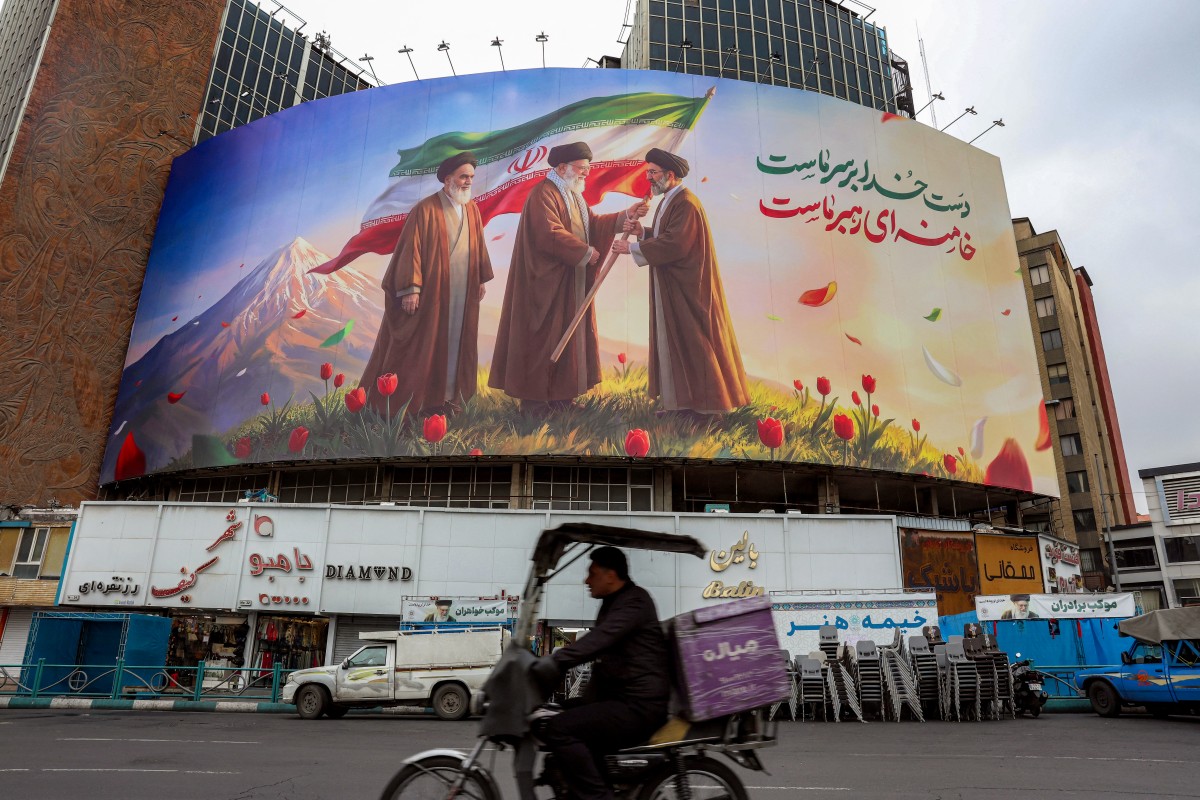
The regime must move beyond Khamenei’s legacy to survive, yet its entire power structure is built on that very legacy.
An Avenging Leader or a Revisionist One?
After Ali Khamenei was killed on 9 Esfand (28 February 2026), and as U.S. and Israeli attacks intensified in the days that followed, the Islamic Republic had two options for filling the vacuum at the top of the system: it could choose an avenging leader or a revisionist one.
Although Mojtaba Khamenei, Ali Khamenei’s son, has been announced as the new leader of the Islamic Republic, we still do not know what condition he is in or what plans he has prepared for the regime.
By all appearances, Mojtaba Khamenei should be seen as an avenging leader, someone whose first priority would be avenging the deaths of his father, mother, sister, and other relatives who were killed in the early hours of the joint U.S.-Israeli attacks. But by what means, and under what conditions, could such vengeance be pursued?
The Structure of the Deadlock
During Ali Khamenei’s lifetime, there were two centers of power in the Islamic Republic: the Supreme Leader and the leadership apparatus on the one hand, and the IRGC on the other, as the military, security, and repressive arm under the Leader’s exclusive control.
Despite the two wars — the 12-day war and the current war — the internal balance of power in the Islamic Republic has still not changed. The crucial point is that both wars were themselves the result of the exhaustion, or escalating costs, of the security strategies pursued by these same two centers of power. The three-part strategy of “nuclear threshold, missiles, and proxies” not only defined the regime’s security doctrine; it also shaped the internal distribution of power within the Islamic Republic and determined the position of every force within it. In other words, each actor’s weight within the regime was determined by its relationship to these three strategies and by the role it played in advancing them.
The two current wars, driven by the United States and Israel, have from the outset aimed at destroying these three strategies. For now, despite the bombardment, the killing of senior officials, and even the death of the Islamic Republic’s leader, the regime’s security logic still revolves around those same strategies. Why, despite such devastating blows, does the Islamic Republic refuse to abandon the main sources of tension? The answer is that the current Islamic Republic, and the configuration of power within it and around it, is built entirely on these strategies. To bargain them away, without any possibility of constructing new security strategies, would amount to the very “unconditional surrender” Donald Trump desires.
There is also a technical issue here. A replacement security strategy cannot be built overnight. Even if the costs of the existing strategies have become intolerable, and even if they now produce insecurity rather than security, creating an alternative strategy would still require, at best, several years and a period of calm. This mismatch between the time available and the solution required explains the current deadlock of the Khameneis’ Islamic Republic.
For that reason, the current centers of power in the Islamic Republic — the IRGC and whatever remains of the leadership apparatus — simply do not have the time they need to reorganize themselves around a new strategy.
No Alternative Strategy in Sight
In the final decade of his life, the slain Leader of the Islamic Republic, Ali Khamenei, tried to build such an alternative through the policy of “looking East,” that is, by joining the protective ring of two powerful security and economic actors seen as counterweights to the United States: China and Russia. He failed. It was not that the Islamic Republic was unwilling; rather, Beijing and Moscow refused to enter such a costly game, because they regarded the level of security instability embodied by the Islamic Republic — together with those same three strategies — as too high. They were unwilling to tie themselves to such an unconventional actor in a game with an uncertain future.
Now suppose that, as of today, this second war by Israel and the United States against Iran has come to a halt, and Mojtaba Khamenei wants to pull the system out of its present condition. What can he do to prevent a third war from breaking out? What strategy could replace the previous security doctrines? Who would carry it out? On what forces and economic resources could he rely to make such changes possible?
Change on this scale requires powerful actors and substantial resources. The IRGC, which is itself part of the current crisis, is now the Islamic Republic’s only remaining shield against collapse. What strategy could both keep the regime from falling and, at the same time, transform the internal balance of power and its regional security doctrine in a way that might lead the Islamic Republic toward some degree of stability?
These are questions for which no answers exist. The selection of Mojtaba Khamenei as leader of the Islamic Republic is itself the result of those unanswered questions.
Why a Revisionist Leader Was Impossible
How could the Islamic Republic have turned to a revisionist leader? To choose such a leader at a moment when the IRGC, through nighttime parades and the intimidation of the public, had taken control of the streets, would have amounted to a dagger in the heart of that force. From the regime’s perspective, the logic is straightforward: the actor that now controls the final defensive layer must, for the time being, be kept protected and content.
But keeping the IRGC protected and content has the opposite effect on the regime’s existential threats. The more the appointment of a new leader tilts in the IRGC’s favor under present conditions, the more the level of danger facing the system rises.
Today’s Islamic Republic is effectively run by the force that controls the streets. And it is precisely the conduct and maneuvering of that same force that has driven the regime into its current crisis. Any way out now depends on the new leader’s ability to create alternative security strategies while under bombardment, or under the looming threat of war from the United States and Israel. That is the deadlock in its simplest form.
For now, the Islamic Republic is trapped between the first Khamenei and the second, Mojtaba Khamenei. The system’s survival depends on moving beyond Khamenei’s legacy — but is the Islamic Republic, and its entire structure of power, anything other than that very legacy? The arrival of a second Khamenei will not reduce the regime’s existential threats, even if it does not intensify them. He has taken his father’s seat as if to test the old proverb: perhaps salvation lies only in postponement.