

Khamenei’s funeral is not the end of an era, but a test of whether inherited power can still hold the Islamic Republic together.
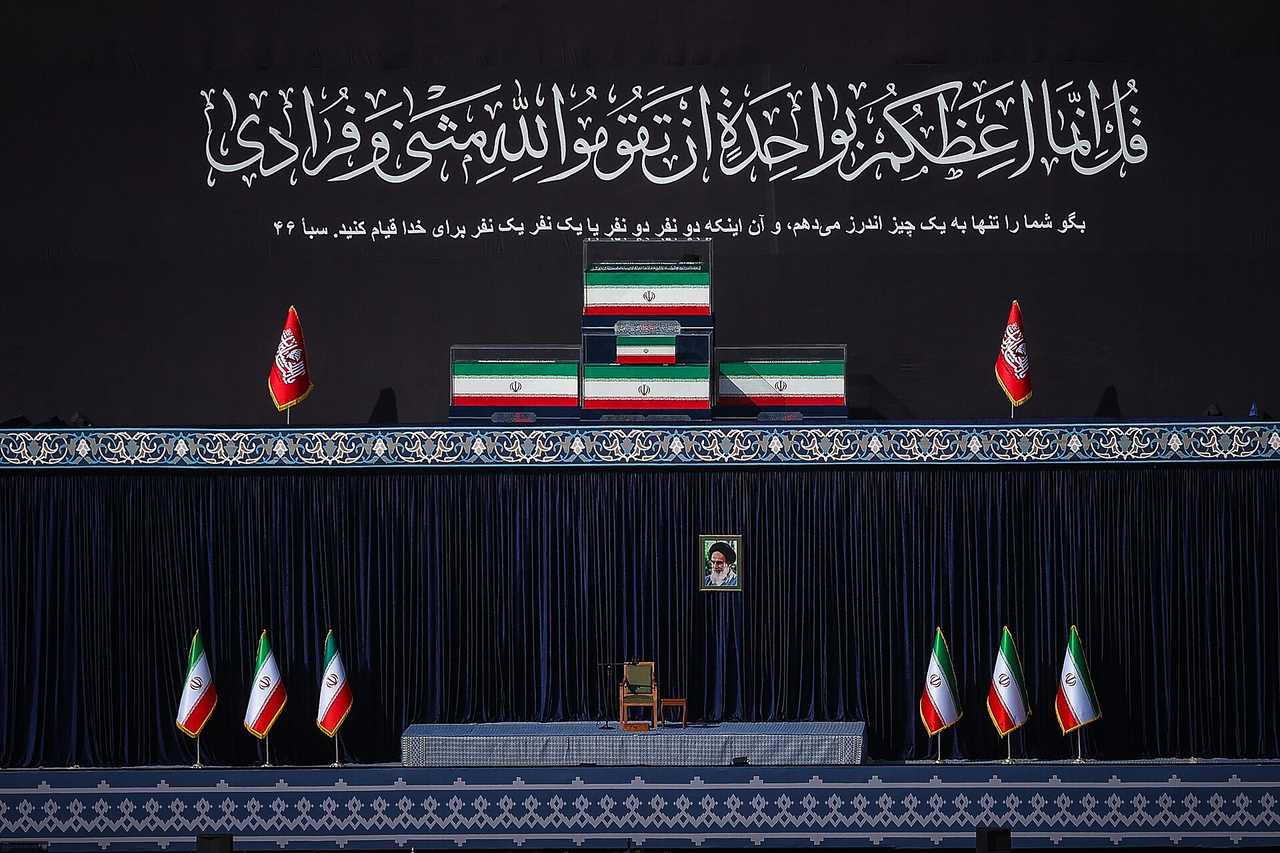
Ali Khamenei’s funeral is not merely a ceremonial farewell to the slain leader of the Islamic Republic. As the coffin is carried on people’s shoulders, power too is being moved from hand to hand. The elegies are not meant only to draw tears; what matters is the political statement hidden inside them. The crowd weeps, but the cameras are not looking only for tears. They are looking for allegiance. The coffin being carried above the crowd bears “Ali Khamenei’s legacy,” and what holds Khamenei’s body is not simply a few pieces of wood and metal.
In this sense, the death and funeral of Ali Khamenei is not simply a ritual farewell to the second leader of the Islamic Republic. It is as if his body is still speaking about its legacy.
The central question in the long farewell to Ali Khamenei is precisely this “legacy.” On the day Khamenei is buried, what will the Islamic Republic do with his coffin? Passive mourning? Revenge? Unity? Or, more important than all of these, the consolidation of a successor?
Every slogan, every television report, and every grand display of sorrowful mourners is a political statement the government wants to extract from the death of its leader: the regime still stands and continues to its survival.
But standing is not enough. The real question is how the regime will walk after Ali Khamenei.
Media reports from the several-day funeral ceremony have focused on the massive display of crowds, slogans of revenge, and the government’s attempt to produce an image of cohesion. But this spectacle remains incomplete, because its leading actor has not yet appeared on stage. For two decades, the “ghost of Mojtaba Khamenei” has had an ambiguous presence in the labyrinthine corridors of power in the Islamic Republic. There was no need for this ghost to take visible form, because the “Leader” behind this privileged son was present and remained the heavy center of politics.
But that heavy weight is now being carried from one side to another in his coffin. However vast and magnificent the farewell ceremony may be, it cannot by itself solve the riddle of the real transfer of power. The ceremony of conferring the cloak of the martyred leader will certainly remain incomplete without the presence of Khamenei II. Once Ali Khamenei’s body is buried, Mojtaba’s ghost must inevitably take form. Otherwise, the struggle over what should be done with the legacy of Khamenei I will push the Islamic Republic into a crisis of survival.
But emerging from the shadows is not Mojtaba’s only problem. His larger problem is this: at the moment he becomes visible, what exactly will he be leading? The Islamic Republic of Khamenei II is no longer the system of the 1980s and 1990s, when its leader could play cat and mouse among the factions, raise someone to the top or throw him into humiliation with a few sentences, bring parliament into line with a gesture, and turn the street into a site of repression with a single sermon. The system Khamenei I has left behind for his son looks more like a machine whose parts still work, but whose instruction manual has remained in the pocket of the man whose coffin is now being carried on people’s shoulders.
Successfully consolidating a new leadership is not easy. In fact, that very process requires a calculated passage beyond the legacy of the former leader. Khamenei I did exactly this. His first step in consolidating himself was to move beyond Khomeini’s legacy, but he did so under the cover of loyalty. Slowly and steadily, he changed the arrangement of the factions, elevated more obedient forces, turned the Islamic Revolutionary Guard Corps (IRGC) into the main partner in power, and ultimately transformed himself from the shaky leader of 1989 into the absolute architect of the system. Khamenei managed to compensate for his weakness — the absence of Khomeini’s charisma — through networking, elimination, patience, and engineering. Ali Khamenei did not abandon this method until February 28, 2026. This comprehensive intervention in arranging the forces of the system, and his role as the single and unrivaled stage-manager of official power, helped him consolidate himself.
But will the existence of this method help the third leader in the period of his unveiling and consolidation?
Here we return to the importance of a “calculated passage beyond the former leader” for the “consolidation of the new leader.” Unlike Ruhollah Khomeini, Khamenei I so thoroughly identified the Islamic Republic with himself that moving beyond him is not merely moving beyond one person. It is moving beyond the architecture of the system’s power. The bitter irony is that this same highly engineered structure of power must now elevate someone whose credibility comes not from himself, but from his blood relation to the architect of that structure. And to pass through the system’s survival crisis, Khamenei II must inevitably show that he still holds his father’s authority to architect power — that he can, with a gesture, place factions and individuals on the elevator of power and decide whether to send them to storage or install them in the penthouse of the system.
The formal mechanisms of power transfer in the Islamic Republic may be able to carry Mojtaba as far as the leader’s chair. But they cannot delegate charisma and authority. In other words, the “Office of the Leader” may be transferable, but the authority of the turbaned father cannot be registered in the son’s name at a notary office.
The Islamic Republic as a political system is now caught in precisely this predicament. It has lost its compass. It is because of these necessities, and because it has no answer or solution to them, that the funeral of the second leader has acquired a function beyond mourning, unlike the funeral of the first. The government wants to turn the farewell to Khamenei I into a kind of visual referendum. The cameras record the wave of the crowd; slogans, elegies, and even Quranic verses are arranged and edited together so that the propaganda machine can say: Look, the nation still stands behind the system. And by “the system,” it means the political mechanism of Khamenei I.
The organizers of the farewell are looking for allegiance. But they do not know, and do not say, allegiance to whom? To the dead Khamenei or the living Khamenei? To the father’s legacy or the son’s future? To the system or to the IRGC?
The answer is not yet fully clear, and this is precisely the situation that has filled the ruling establishment with anxiety. The more the government emphasizes the grandeur of the ceremony, the more it reveals that it has a problem with the “transfer of grandeur.” When Khamenei I came to power, he was unstable, but he could still govern with his past. His presence in the revolution and his experience occupying the second seat of power allowed him to overcome the initial obstacles in the period of unveiling and consolidating his leadership. Mojtaba, however, does not have that past. Worse still, he is supposed to govern over a future that it is not yet clear he himself will survive.
The question of the IRGC is decisive here. If Khamenei I was able to raise the IRGC, which had once stood on the threshold of dissolution, to the status of a partner in power and keep it under his cloak, Mojtaba faces an IRGC that is no longer, as it was in 1989, merely the arm of the system. It is now one of the system’s main names. In a situation of war, sanctions, succession crisis, and fear of mass uprisings, the IRGC sees itself not as the guardian of the successor, but as the holder of veto power over the successor. This is where the crisis of borrowed authority becomes visible. If Mojtaba shows his face, he must, on the very first day, rely on those who can remind him the very next day that the throne of power, without our bayonets, is nothing but wood and iron.
And this is where history summons itself in its most ironic form. The Islamic Republic, which overthrew monarchy with the slogan of death to hereditary politics, now stands before the very question it was supposed to have buried forever: what does the son do after the father? Of course, the official apparatus constantly says this comparison is unfair: Mojtaba is not a prince; he is a jurist, a revolutionary, a man of the backstage, trusted by faithful and revolutionary forces. Very well. The only problem is that they cannot explain why all these virtues have, by sheer coincidence, gathered in the son of the previous leader. Historical accident, perhaps. In authoritarian systems, historical accidents usually know the path to the house of power very well.
At the international level, Khamenei’s funeral is viewed from another angle. Will Iran after him become more hardline or more open to negotiation? Are the slogans of revenge and blood vengeance the prelude to an escalation of war, or tools of bargaining? Is Mojtaba a continuation of Ali, or a frightened version dependent on the IRGC? These questions matter directly to Washington, Tel Aviv, Beijing, Riyadh, Doha, and Moscow. But inside Iran, for the people, the questions are simpler and more devastating: when will we finally see peace?
The transfer of power does not happen only at the top of the political system. More important than the top is whether the social body accepts that transfer. For people who have spent years living between inflation, repression, the pain of migration and exile, war, sanctions, and fear, a change of leader does not necessarily mean a change in life. If Mojtaba drives his father’s machine in a more nervous and aimless way, society will very quickly understand that the son is not governing; the father’s coffin is still giving the orders. Government by coffin is not very durable.
If the elaborate ceremony now underway cannot solve the riddle of power transfer, and if it fails to display a path out of crisis, what will we witness? In the absence of the system’s architect, what remains of the Islamic Republic may be able to fill the streets with farewell ceremonies for a few days. But once the elegies end, the street will again become the site where the price of bread, youth unemployment, and grieving families appear. Worse still, the future looks terrifyingly empty of hope, and terrifying for everyone — both political actors and ordinary people.
Khamenei’s funeral is not the end of an era, but the testing of the “possibility” of beginning an era that has not yet found its own name or shape. If Mojtaba appears, he must prove that he has something more than a family name at his disposal. If he does not appear, it will have to be explained why the system has hidden its heir at the very moment of allegiance. And if the IRGC is seen more than anyone else, perhaps the answer has already been given. What answer? That the Islamic Republic after Ali Khamenei may have a leader, but its center of gravity lies elsewhere.
Khamenei’s coffin has two contradictory meanings for the Islamic Republic today. It is both capital and calamity. It is capital because it can produce a few days of mourning, anger, and loyalty. But its calamities are not small either, because it constantly reminds everyone how deeply the nature of this system was tied to a single person. “Being Mojtaba” in such a situation is extremely difficult.
To get out from under his father’s coffin, Mojtaba must both be his heir and not be his prisoner. He must use his father’s name while also showing that he is not merely the continuation of that name. He must rely on the IRGC while at the same time proving that he is not its hostage. He must build the pillars of his legitimacy out of mourning for his father, and then, once the mourning ends, still have something with which to govern. This is difficult for any successor. For a successor with borrowed authority, it is even more difficult. It is not an easy task. In a government where the dead are not allowed to retire, staying alive is no simple matter for the heirs.