

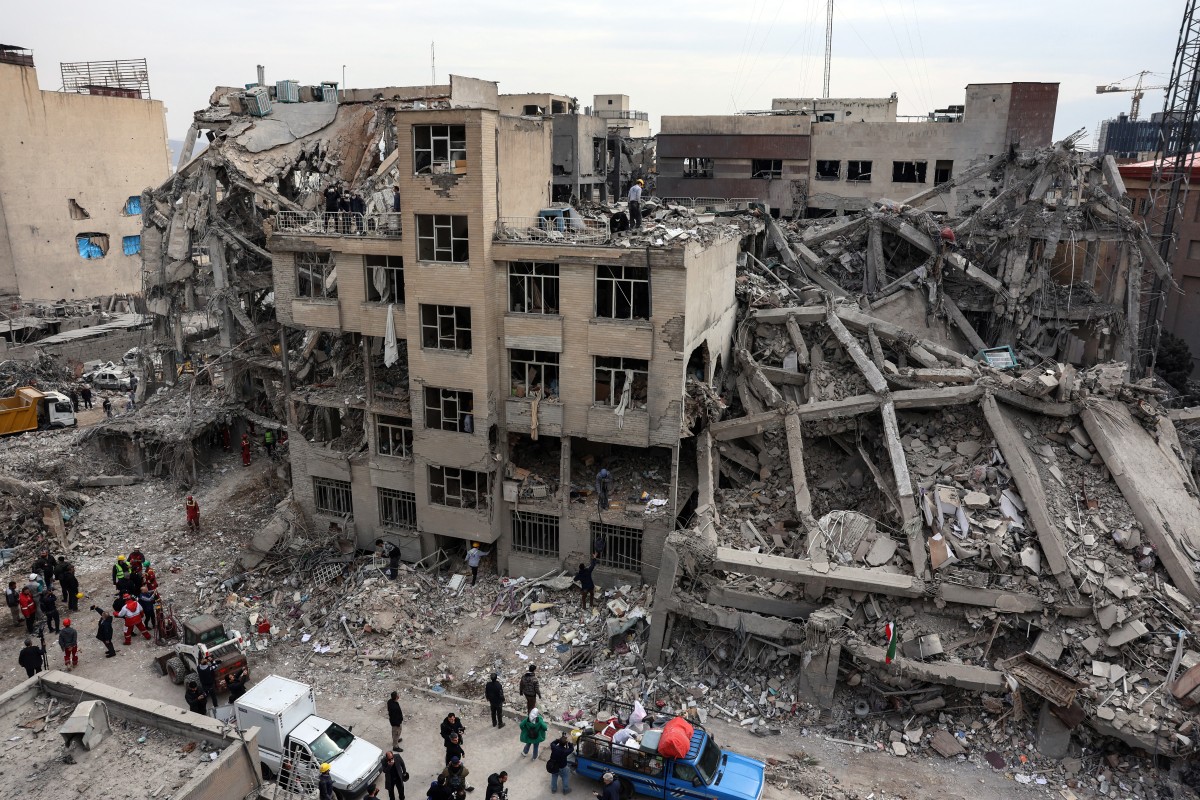
A Tehran resident recounts the first days of war: devastation, fear, looting, and the return of a life once again overshadowed by conflict.
This eyewitness, born in the 1980s and living in Tehran, says the damage in some parts of the city has been extremely severe. Referring to Arash Street in Tehran’s affluent Zafar neighborhood, he says that in an alley called “Fars,” almost everything has been reduced to rubble, leaving behind a massive crater.
An eyewitness who was in Tehran when the attacks began says he will never forget the morning of the first day of the war. According to him, on Saturday, 28 February 2026, at around 9:35 a.m., he was at his workplace on the tenth floor of an office building.
He recounts that suddenly an extremely loud and unusual sound was heard — something like a burst of machine-gun fire that seemed to come from very close to the ground. From the direction of Vali-e Asr Street, toward the south, smoke and explosions could be seen. According to this witness, in those very first moments, areas around Argentina Square, the Ministry of Intelligence building, and the residential and administrative complex of the Supreme Leader came under attack. He and his colleagues watched these scenes from their workplace. The city was plunged into shock, and many people did not know exactly what was happening.
This witness says that despite years of protest and criticism of the country’s political situation, he has never left Iran. He took part in the protests of 2009, 2017, 2019, and 2022 (1388, 1396, 1398, and 1401 in the Persian calendar). Even so, he says that despite having opportunities to emigrate to countries such as the United States, Canada, New Zealand, Sweden, and France, he stayed because of his attachment to Iran and his hope for the country’s future.
He also speaks of his family’s hardships over the years: from the confiscation of the family’s property after the Revolution to his father being denied a university faculty position because he had studied in the United States. According to him, his brother was also arrested by security agencies in 2015 (1394) and disappeared for weeks, only to be released after a heavy financial penalty.
A few days after the war began, a government building — a glass-fronted structure about 13 to 15 storeys high — was hit in a midnight strike and almost completely collapsed. The witness says that only a section roughly one storey high now remains standing.
He also recalls an incident at a half-built lot at the entrance to a residential alley. According to him, around 15 workers at the site were buried under the rubble after an explosion caused the ground to cave in. It is said that these workers were Afghan nationals. Rescue forces arrived within the first hours, but the scale of the fire and debris was enormous.
According to this witness, the destruction in some parts of the city has been extremely severe. He points to Arash Street in the Zafar district and says that in an alley called “Fars,” almost everything has been flattened, and the ground has turned into a huge crater.
Alongside the devastation, security problems have also emerged for residents. This witness says that one night, two Peugeot cars carrying eight men approached their half-destroyed building and tried to cut through the locks and chains on the entrance door with a grinder in order to get inside. In a critical tone, he asks where the police were at that time.
He says that three units in their building, which were damaged in the attack, belonged to tenants who are now facing heavy losses. The destruction was more severe on the lower floors of the building.
According to this witness, the building’s entrance door had also been torn off by the blast wave. They were forced to order a metal accordion-style door through an acquaintance who is a blacksmith in Firuzkuh, a town east of Tehran, and it was built within a day. Even so, finding a vehicle and driver to transport it to Tehran was difficult.
In the days after the attack, the residents of the building had to stand guard themselves to prevent theft. According to him, the building superintendent and the son of one of the neighbors stayed awake all night inside a car parked in front of the building to protect the damaged property from looting.
This witness, born in the 1980s, says he belongs to a generation that was born under the shadow of the Iran-Iraq War and is now once again living under that same shadow. In closing, he says he feels a profound sorrow for the country and for his own life as well: “I grieve for my homeland, and I grieve for my own life.”