

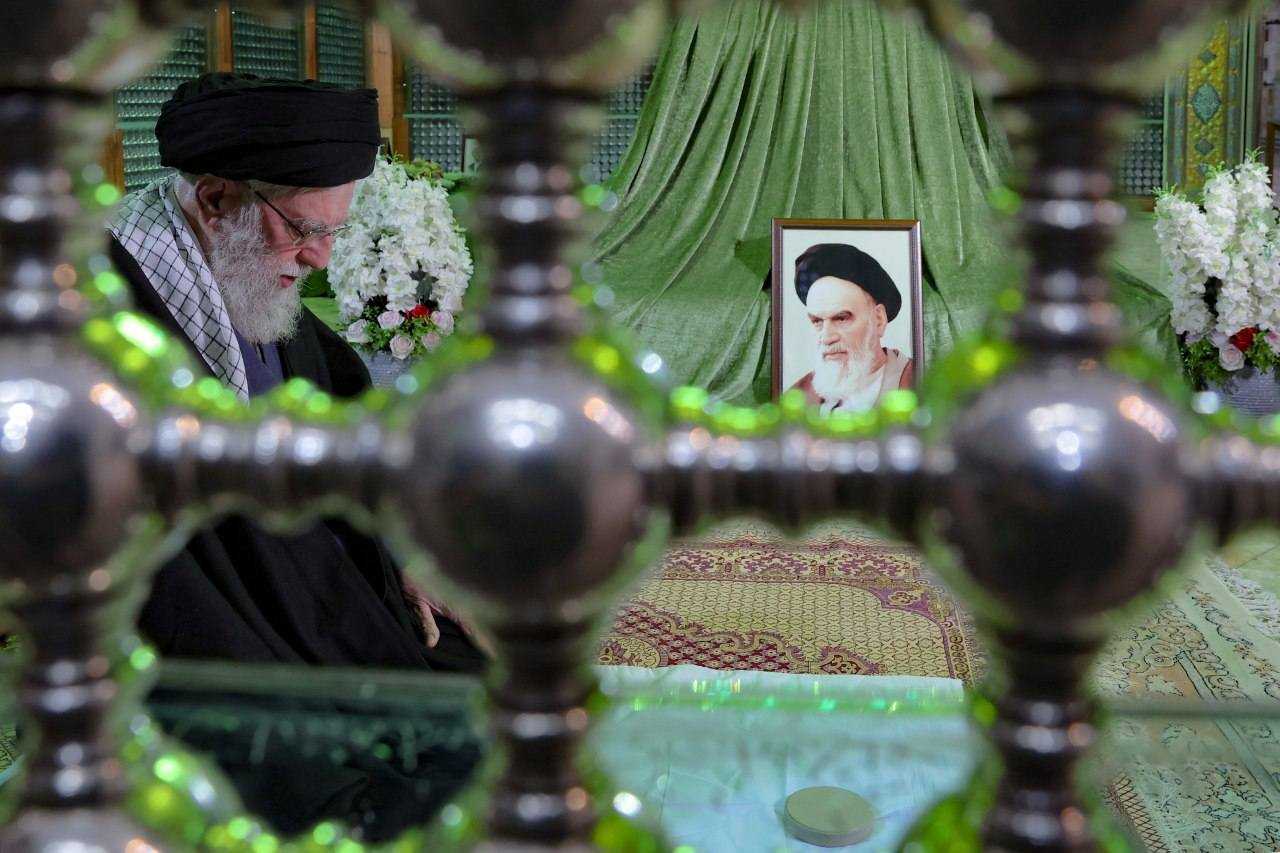
Khamenei hollowed out the Islamic Republic to build an ummah-centered Islamic government; yet he never produced a viable successor order, leaving a deep crisis of rule and succession.
Why was Ali Khamenei indifferent to the warnings of senior political officials within his own government over the past three decades? Why did he ignore Akbar Hashemi Rafsanjani’s advice since the 1990s to address core crises such as hostility toward the United States and Israel? Why, despite opposition across all pillars of his own system, did he persist in the dangerous gamble in Syria and the expansion of proxies?
Dozens of similar questions can be listed. One can respond by blaming everything on his “stubbornness” or “delusion” and move on. But can all of it really be explained by these two traits? To understand his behavior, we must look from a different angle: the kind of leadership Khamenei imagined for himself.
In recent months and years, the Islamic Republic has been in an emergency condition. A race for survival sharpened especially after the twelve-day war. The system is now facing a crushing combination: a survival struggle, the inertia of the “martyred leader’s” strategies, a succession crisis, public discontent, and a regional war. Beyond the news of the day and the war whose flames are burning Iran, who was Khamenei and what did he want?
Was Khamenei Another Khomeini?
Two concepts must be clarified here: the “founder of the revolution” and the “founder of the Islamic Republic.” Khamenei was not the founder of the revolution. Ruhollah Khomeini played that role, and Ali Khamenei was one of hundreds of his disciples who, by the twists of fate, became the second Supreme Leader.
In his ten years of leadership, Khomeini created a hybrid skeleton: elements of the Pahlavi state structure fused with institutions built around velayat-e faqih (“guardianship of the jurist,” also rendered as “rule of the jurist”). A patchwork model mixing quasi-republican bureaucracy with clerical institutions that, in practice, could function under Khomeini’s authority.
We do not know whether Khomeini, had he remained Supreme Leader longer, would have altered this structure in favor of building an “Islamic modern civilization” or an “Islamic government.” But his record suggests that after the early jolts of the revolution and attempts to export it, he hit a hard wall, retreated, and largely accepted this mixed form within the limits of what seemed “possible.” Even on the Levant (especially Lebanon), he favored a symbolic “meaningful” presence, not the kind of political, military, and economic commitment that would consume the state.
When Khamenei assumed leadership of the political system, he faced two choices: to be a “manager-leader” or a “founder-leader.” Manager-leaders treat the existing order as a given, aiming to preserve stability and manage crises within established structures. Founder-leaders treat state and nation as projects to be remade: they seek to create a new order, redesign power, and redefine identity. Founding can promise “making history,” but it also carries the risk of chronic instability, because it requires rupture and rupture has consequences.
Forward Toward an Islamic Government
The beginning of Ali Khamenei’s leadership coincided with post–Iran–Iraq war reconstruction. Rafsanjani, as a representative of “manager-leader” pragmatism, held enormous influence. Under Khomeini, Rafsanjani stood near the center of decision-making while Khamenei, as president, remained largely on the margins. After Khomeini’s death, Khamenei moved into a non-ceremonial role that allowed him, gradually, to implement his own vision.
Khamenei advanced three projects in line with the idea of a founder-leader:
• Reconfiguring the goals of the Islamic Revolution through a movement toward Islamic government
• Reconfiguring structures and shifting the geography of power inside the country
• Positioning the Islamic system in its regional and international environment
To realize the first project, he tried to move beyond the idea of a ruler of the nation and to build his own ummah, investing heavily in cultural and propaganda “headquarters,” transnational religious institutions, and the reshaping of the regime’s cultural theorists.
Khamenei was always enamored of the idea of a “single ummah of Muslim brothers.” Before the 1979 revolution, he translated three books by Sayyid Qutb, an ideologue of the Muslim Brotherhood, into Persian. Qutb’s core idea was simple: Islam and governance are intertwined; Islam did not merely arrive to govern, its survival depends on governing.
When Khamenei became Supreme Leader, he had an opportunity to implement this idea, and to push the Islamic Revolution beyond Iran toward an ummah project. In this vision, velayat-e faqih became a tool: a set of capacities meant to enable the establishment of Islamic government across Muslim lands.
It can be said that Ali Khamenei was the one who, little by little, dismantled the Islamic Republic in favor of founding an Islamic government. In Khamenei’s revisionism, Islamic government stood above the Islamic Republic, and the ruler of the ummah was meant to gradually replace the leader of the nation. Even in the statement his office published announcing his reported killing, traces of these ambitions can be seen: the text refers to Khamenei as the “Leader of the Ummah.”
A Young Revolutionary Government
Khamenei’s second project was to change and reorganize domestic structures, institutions, and centers of power in Iran to serve the idea of Islamic government. Over 36 years, formal republican structures were hollowed out through parallel councils and “headquarters,” tighter approval-based vetting, stronger appointed institutions under the Supreme Leader, and expanded intervention by the leadership office across execution and policymaking. Elections were steadily reduced toward a largely ceremonial process, while actors who saw governance as welfare and administration were removed.
Khamenei sought an obedient executive fully aligned with his vision. Ahmadinejad was his first concerted attempt to conquer the state apparatus and it failed. The nuclear-security crisis and the aftermath of 2009 forced him, for a time, to accept a government with one task. Rouhani could not deliver and was discredited. Raisi solved nothing and died in a helicopter crash. By the time it was Pezeshkian’s turn, the system was in absolute crisis and the government could do little more than administer daily affairs.
The rise of the “IRGC sons” was another curtain in the same project. Khamenei shelved early debates about dissolving the Revolutionary Guards and instead turned them into the backbone of his order. Thirty-six years later, they became central across politics, economy, culture, media, and foreign relations. Khamenei’s ummah was supposed to become something like them. It did not.
The Geography of the Islamic Ummah
Unlike the first Supreme Leader, Khamenei saw the surrounding region and the expansion of power as a path toward forming a unified Islamic ummah. Yet he remained trapped in the fractured reality of the Muslim world. What idea could make Shi‘a and Sunni into one ummah? This was the great question of his life.
From this angle, his insistence on hostility toward Israel becomes more intelligible. In his view, Israel could unite Muslims around a single task: eliminating Israel and securing Islamic victory. When regional states moved toward coexistence with Israel, the project shifted toward building non-state actors and proxies. But one problem remained: the stature and capacity of the forces advancing this project never reached the level he desired. Perhaps aside from Qassem Soleimani, no relatively capable force truly emerged.
In the end, Ali Khamenei dismantled the Islamic Republic in pursuit of an Islamic government. He destroyed one order and failed to deliver its successor. Neither did the Iranian nation merge into an Islamic ummah, nor did Muslims worldwide consent to become an ummah. He turned the Islamic Republic’s domestic political structure upside down, yet could not build a functional, desirable ummah-centered structure in its place. He threw the region into disarray but proved incapable of building a powerful “ummah axis.” He died for his idea, and the bitter result of the project he pursued for 36 years can be tasted in today’s Iran and Middle East.
In the end, Ali Khamenei left behind the system entrusted to him in its most critical days, a crisis that, it seems, the system will not be able to survive.