

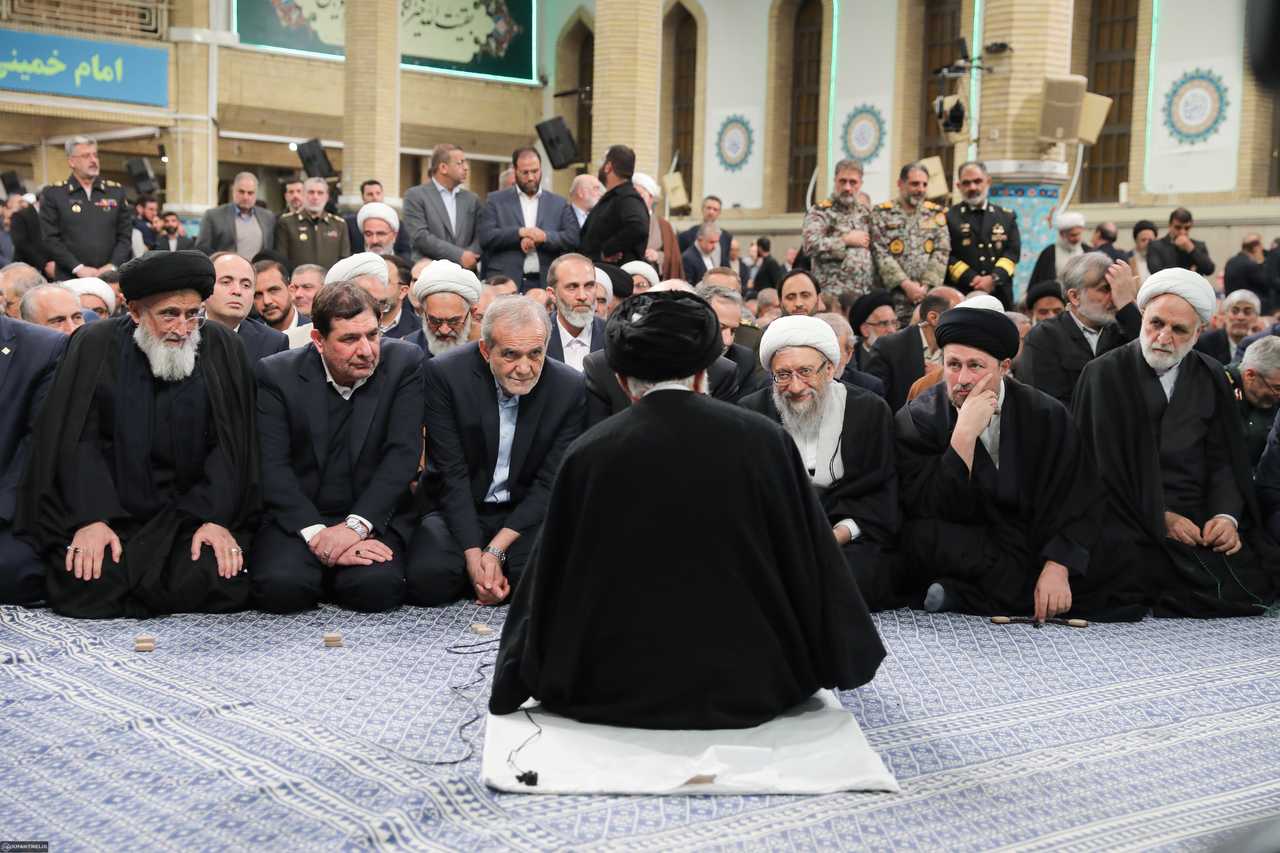
The 12-day war with Israel shattered Khamenei’s long-standing “Leader’s Narrative,” which shielded him from blame and cast crises as the fault of others. With the snapback mechanism activated, the regime has shifted to a new doctrine of “sacred unity,” framing hesitation as prudence—but its survival remains uncertain.
Building Khamenei’s Narrative
After Khomeini’s death in 1989, and before the Revolutionary Guards (IRGC) built their regional empire in the Middle East, the Guards turned inward—working to secure Ali Khamenei’s fragile leadership by discrediting rivals and amplifying his authority.
After the Iran–Iraq War, a key moment came in 1992, when Khamenei warned of a “cultural invasion” he claimed was more dangerous than the war with Iraq. He accused the West of trying to corrupt Iran’s youth and urged loyalists to act—even if the state or judiciary refused. This rhetoric gave militias like Ansar Hezbollah a green light to harass intellectuals and intimidate ordinary citizens throughout the 1990s.
From then on, what became known as the Supreme Leader’s Narrative took shape: a worldview that divided society into “friends” and “foes”—those who supported the regime against the West, and those branded as serving Western interests. Its ultimate purpose was to shield Khamenei from blame, secure his untouchable position, and legitimize the repression of dissent. Even powerful insiders like former president Akbar Hashemi Rafsanjani could suddenly be recast as “enemies” if the narrative required it.
The 12-Day War and What Comes After
The 12-day war between Israel and Iran has created an entirely new reality for Khamenei.
For the first time in nearly 35 years of his rule, the Supreme Leader’s Narrative has broken down. The old formula—dividing society into “good” and “bad” camps while shielding the Leader from blame—no longer works.
This ideological framing, portraying Khamenei as someone who never errs, had survived earlier crises so long as they did not threaten the regime’s existence. The loss of Syria, the assassination of Qassem Soleimani, even the collapse of the nuclear deal in 2018—none were treated as existential. Each setback could be blamed on “traitorous politicians” or on people accused of “abandoning the Leader.” The mantra of “betrayal and neglect” always provided cover. But this time, it doesn’t.
Israel’s strike was devastating; the confusion that followed even greater. Khamenei now rarely appears in public. The propagandists who built their identity on staging a permanent battle of “friends and enemies” are adrift, their ringmaster absent.
The current phase of the nuclear crisis—marked by the activation of the snapback mechanism—is fundamentally different from the U.S. withdrawal from the nuclear deal in 2018. Expectations have shifted. Under the old rule, when the regime’s tentpole was threatened, the Leader himself had to act, intervening in the crisis and restoring the situation to its “normal” phase. Before the crisis reached an existential level, officials could always say: “The Leader does not meddle in executive affairs; failures are the fault of treacherous politicians.” But now? Even the regime’s foot soldiers know the Leader’s Narrative is failing. A “firewall” works when the attack is at the software level—propaganda and blame—but when the system’s hardware is under direct strike, a firewall cannot save him.
That is why Sedaye Iran, the electronic magazine of Khamenei’s office, urged followers on 28 September (6 Mehr) to drop the “good vs. bad” framing, at least temporarily, and to refrain from targeting domestic politicians too fiercely:
“Undoubtedly, the main culprit is the hostile Western front. We must not allow the arrow of blame to be turned inward and create new distractions at home. People’s energy and motivation should be directed toward a precise identification of the enemy and designing an appropriate response.”
The article unveiled a new “operating system” to replace the old Leader’s Narrative: a so-called “sacred unity.”
Sacred Unity
But switching is not easy. For decades Khamenei has sacralized his own image; sharing power with subordinate politicians runs counter to that history. Even in his most recent public remarks—made as President Masoud Pezeshkian traveled to New York to try to blunt the snapback—Khamenei slipped back into old habits, taking aim at figures such as Rouhani and Zarif for tying the 2015 nuclear deal (the JCPOA) to a ten-year timeframe. Old reflexes die hard.
Since the 12-day war, Khamenei’s public visibility and image management have become secondary concerns — a new development in his rule. His tenure has long been punctuated by image crises (being seen as a junior partner to Rafsanjani, as a conservative counter to Khatami, or as a leader who accepted negotiations with the U.S.). Now the question is survival.
Under the old operating system, the Leader was expected to intervene directly to restore order, punish traitors and humiliate enemies. By that logic, decisive responses could range from declaring jihad to pursuing a nuclear option, striking regional targets, closing the Strait of Hormuz, or even pre-emptively hitting Israel — gestures meant to show that the Leader can turn defeat into victory.
The new model, billed as “sacred unity,” gives political cover for restraint. It reframes hesitation, delay, or caution as prudent solidarity: if the Leader invites subordinates to the table, he must accept their limitations. In practice, that pushes the regime toward the most conservative responses to threats—from the snapback to the risk of open war.
But the Islamic Republic now faces multiple existential crises at once. Resources are scarce, and the regime’s militias and supporters are no longer the zealous volunteers they were in the 1980s.
Clinging to the old operating system raises expectations that the Leader must display “righteous anger” and act decisively. The formula is simple: fury must be aimed at the United States. Yet there is a difference between projecting anger to a domestic audience and roaring at an enemy with the capacity to destroy you.
The Limits of Sacred Unity
Outside the regime’s circles, nothing is normal. Israeli officials now speak openly about assassinating Khamenei, while former U.S. President Trump has bragged that he could have taken the opportunity. Regime leaders themselves discuss the risk of their own meetings being bombed; Revolutionary Guard commanders admit they cannot tell whether the next round of conflict will begin today or tomorrow.
Under the old paradigm, decisive action was the answer. Even Mahmoud Ahmadinejad could be reined in. In that logic, the Leader would ultimately declare jihad, build a bomb, attack Saudi Arabia or Kuwait, close the Strait of Hormuz, strike Israel preemptively, or hit U.S. bases. Why? Because intervention by the Leader was always meant to restore order and punish traitors and enemies.
The new operating system—“sacred unity”—recasts hesitation as wisdom. If the Leader sits at the same table with subordinates, he must also accept their limits. That means tolerating their fear and timidity, and responding to existential threats like the snapback with the most conservative posture possible.
But switching systems does not guarantee survival. Khamenei’s Islamic Republic, as it has evolved under his personal rule, has developed a life of its own. To endure, it would need to project overwhelming force to shock society into submission. This does not mean the political system will collapse tomorrow, but it does mean Khamenei’s version of the regime is vulnerable. Calls for unity and caution can only soothe symptoms, not cure the disease.
Does Khamenei have the time and courage to preserve his regime? No one knows. People cling tightly to the worlds they have built for themselves. A ruler who avoided radical change throughout his reign is unlikely to act differently now, in old age and weakness.