

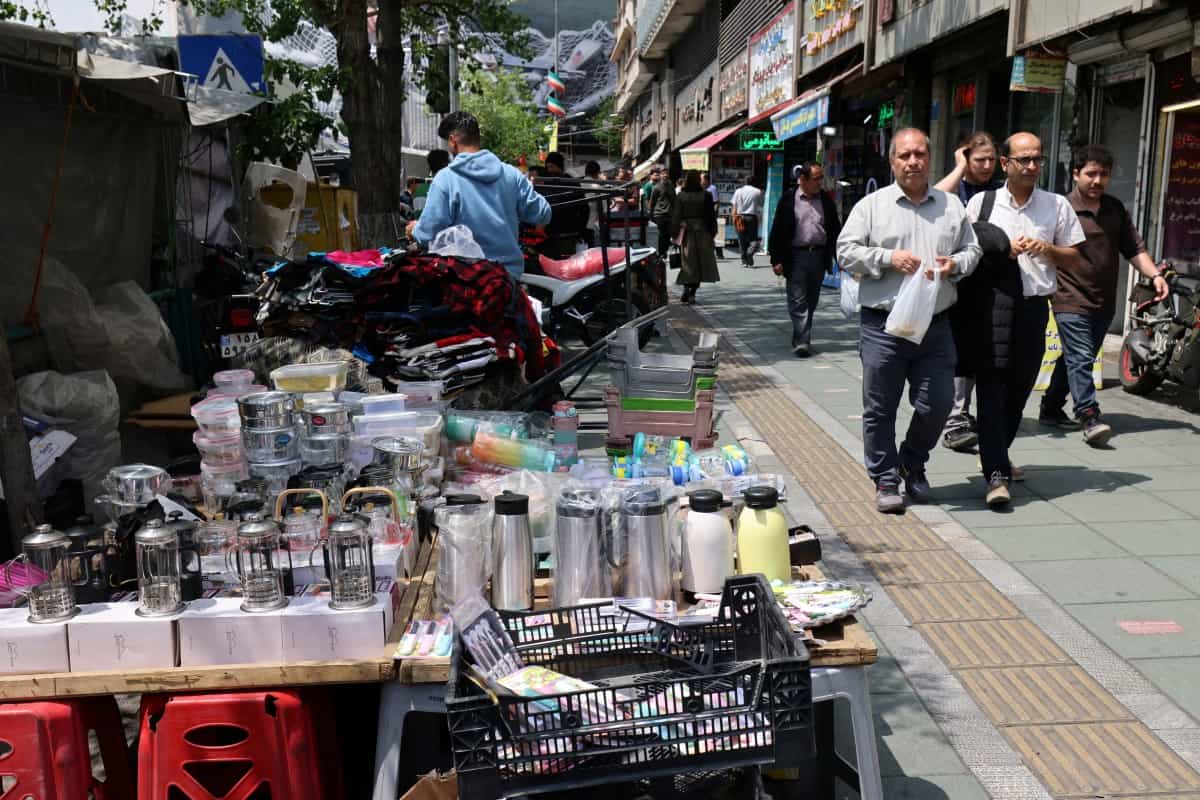
After the ceasefire, Iranians face local wages and global prices, while reconstruction risks restoring profit before rebuilding life.
The morning after the war, life began exactly where it had already been stranded before: in the bread line, in overdue rent, in a prescription for which you can only afford half the medicine, in a worker who does not know whether he will still have a job next week, and in a family calculating whether, if it pays the rent, it must remove meat, treatment, or transportation from one of the broken columns of life. The ceasefire may have reduced the sound of explosions and dust-filled eyes from daily life, but the echo of war remains in people’s ears — in their ears and on their tables.
Wars, after their military ending, often enter the kitchen: into the empty refrigerator, the electricity bill, the installment notebook, the small room whose rent has raced ahead of several months’ wages.
The U.S. and Israeli military attack on Iran has also placed a direct cost on everyday life: the dead and wounded, damaged homes, schools and hospitals thrown out of their normal functioning, refineries and fuel tanks that were targeted, workshops that shut down, routes that were cut off, and jobs destroyed along with every warehouse, production line, shop, or service unit.
No comprehensive and reliable estimate of the total economic damage of the war has yet been published. But even the scattered data available are enough to make its social scale undeniable. The war did not target only military facilities; it further devastated the interconnected chains of work, healthcare, education, energy, housing, and livelihood.
When the power grid, a refinery, a fuel tank, a road, a port, a factory, a telecommunications center, or an urban facility is damaged, its cost is not recorded only in development-budget lines. It returns to people’s homes in the form of blackouts, higher transportation costs, slower production, shortages of goods, rising insurance costs, jumps in construction expenses, and lost jobs. Every destroyed infrastructure pulls down several chains of life with it. Damage to fuel tanks or refineries is not only a matter of gasoline and diesel prices; it also puts pressure on truck fares, the cost of transporting flour, the price of construction materials, the operation of food cold-storage facilities, electricity for workshops, and even workers’ daily commute. Disruptions to telecommunications centers or the internet do not only interrupt communication; they also throw online sales, money transfers, education, media work, medical services, and family contact out of normal functioning. A damaged school or hospital also places a new burden on families: they are forced more than before to pay out of pocket for costs that should be public and social.
Rial Wages, Dollarized Life
Iran after the war faces a simple and brutal contradiction: costs have become global, but wages have remained local. Raw materials, medicine, parts, transportation, insurance, energy, exchange rates, and even market expectations understand no language except the language of the dollar, the euro, and geopolitical risk. But workers, teachers, retirees, and employees still receive their wages in rials. This gap is not only a gap between income and prices. It is a gap between life and the future.
The currency market can absorb this gap; people cannot. After news of the preliminary memorandum, the dollar retreated for a while and the stock market surged. But this calm looked more like a political pause than entry onto a path of stability. A few days later, the dollar and the euro again moved into fluctuation. Until the fate of the 60-day negotiations, banking sanctions, oil exports, transport insurance, and Iran’s access to financial markets becomes clear, the currency market will price not according to today’s rate, but according to fear of tomorrow.
In such a situation, insecurity is not only fear of bombs. It is fear of a lease that may not be renewed, medicine that may not be found, and a price that may change again tomorrow.
As long as the horizon remains dark, employers fear hiring, families cut back on purchases, young people give up on forming a life, and society retreats into survival mode. Even before the war, Iran’s economy stood on the edge of exhaustion. Inflation, sanctions, capital flight, investment stagnation, the crisis of pension funds, energy imbalances, chronic uncertainty, and declining purchasing power had for years been gradually shrinking life. But the war has given this erosion new speed and form. What was previously the daily experience of crisis has become the normalization of collapse.
Hojatollah Mirzaei, an economist and former manager of pension funds, has estimated that Iran’s economic growth in 2026–2027 could fall to between negative 8.5 and negative 10 percent. The shrinking of gross domestic product means workshop closures, falling government revenue, pressure on public services, reduced welfare budgets, and millions more people falling below the poverty line.
And one shocking figure: according to the same estimate, around 4.5 million more people may be added to the population below the poverty line. A poor society is not only a society without money; it is a society that loses the ability to make decisions about the future.
When Recession Reaches the Table
The Purchasing Managers’ Index, or PMI, is one of the fastest thermometers of the economy. When this index falls below 50, it means the economy is contracting. In March–April 2026, the PMI for the overall economy fell to 38.5, and the industrial PMI to 37.4 — one of the lowest levels in the history of this index in Iran. The meaning of this number is clear: production has declined, new orders have fallen, sales have dropped, inventories of raw materials have become emptier, and hiring has moved toward layoffs rather than expansion.
In official language, these are called “index components.” In real life, each of them has a face. A decline in orders means a workshop cancelling its second shift. A shortage of raw materials means a worker has shown up, but the production line is asleep. A fall in exports means a firm no longer has enough foreign currency to import parts. A decline in hiring means a young person returning home again after months of searching. When industry cannot breathe, it is not only the factory that suffers; the neighborhood, the shop, transportation, the family, and the city shrink with it.
In the system governing the economy, future developments are part of today’s calculations. If a factory manager does not know whether trade routes will remain open, whether sanctions will be lifted or return, or whether insurance, banks, and the internet can be trusted, he will not expand production. Recession does not come only from lack of money; it also comes from fear of the future. Iran after the war is in precisely this situation: return to the prewar situation is no longer possible, and the period of reconstruction has not yet begun. In the meantime, the cost of waiting is paid by the lower classes.
Housing is the most ruthless form of this pressure now placed on their shoulders. According to a member of parliament’s Construction Commission, more than 70 percent of household income is spent on rent. This means that after paying rent, families have almost nothing left for food, treatment, education, and transportation. And this is while, for years now in Iran, rent has no longer been only the cost of residence; it has become a tool of reverse class mobility. It pushes people from city centers to the margins, from larger homes to smaller units, from familiar neighborhoods to more insecure geographies, and from stability into suspension.
At the same time, rising construction-material costs, shortages of parts, disruptions in transportation, and the rush of demand toward undamaged housing units after the war have all pushed rents higher. The landlord transfers risk onto the rent; the builder transfers risk onto the sale price; the tenant, however, sometimes has only a temporary contract and unpaid wages.
The same logic operates on the household table. Economic reports show that the cost of basic food items for a family of four in April–May 2026 exceeded 21 million tomans, equal to around 71.5 percent of the minimum wage. This means that if a family wants only to secure a minimum amount of food, the bulk of its wage has already been spent in advance. Rent, transportation, treatment, clothing, school, internet, electricity, and debt still remain. This is no longer poverty in the classical sense; it is the precise architecture of incapacity. Every day, the household must remove something from its livelihood basket so that something else can remain.
Bread is the last stronghold of the table. When the price of lavash reaches 2,700 tomans, barbari 10,000 tomans, and sangak 15,500 tomans, society understands the message: even the cheapest item for filling the stomach is no longer secure. Monthly inflation of 8.8 percent in April–May 2026, heavy food inflation, and jumps in essential costs show that price pressure has passed the warning level and entered the stage of daily erosion. People are no longer afraid only of high prices; they are afraid of tomorrow’s prices.
Rebuilding Life or Restoring Profit?
In such an atmosphere, talk of a 300-billion-dollar reconstruction and development fund for Iran, included within the framework of the Iran–U.S. memorandum of understanding, may at first seem like an opening. But this fund, even if it ultimately takes shape, is not cash that will enter people’s tables tomorrow, nor direct compensation, nor a guarantee of immediate improvement in livelihoods. Reports indicate that this mechanism is meant to consist mainly of private investment in areas such as energy, logistics, transportation, industrial production, and infrastructure. Most importantly, its operationalization depends on a final agreement, the lifting or suspension of sanctions, financial licenses, and political and nuclear commitments.
The issue lies precisely here. If reconstruction begins from above, through large funds, infrastructure projects, foreign companies, and credit lines, it does not necessarily mean the reconstruction of people’s lives. A refinery, port, steel plant, or airport may be rebuilt, while real wages continue to fall. Capital may arrive, while workers remain temporary and precarious. Projects may be inaugurated, while rent still swallows the main share of wages. Reconstruction without social justice may be only another name for the return of profit, not the return of life.
Another danger is that the reconstruction fund, instead of compensating for the social damage of war, may become a gateway for connecting Iran even more unequally to the global market. That is, the cost of war would remain on the shoulders of labor, tenants, retirees, and damaged families, while the profits of reconstruction would go to contracting companies, foreign investors, financial intermediaries, and sections of the ruling class. In such a case, reconstruction could become a new form of reproducing the livelihood crisis that existed before the war: people would live with a collapsed rial, while the country’s future would be priced through dollar contracts, investment returns, special privileges, and cheap labor.
This is precisely the point at which one must ask: who pays for the damage of war, and who profits from reconstruction? If the losses are socialized while the profits remain private, the reconstruction fund will not be the treatment of war, but its continuation in the language of economics.
On the other hand, the reconstruction fund can also become a tool of political pressure. When access to capital, reconstruction, and the lifting of restrictions is conditioned on Iran’s future behavior, the country’s economy remains in a state of semi-suspension. The investor waits, the state waits, the currency market waits, the factory waits. But the household cannot wait. Rent comes due at the end of the month. Bread is bought every day. Medicine must be obtained this week. Livelihood, unlike diplomacy, does not recognize 60-day deadlines.
The question of Iran after the war is not only the reconstruction of physical destruction, but the reconstruction of the capacity to live. A country in which millions are employed yet poor, an industry trapped below the line of recession, families that spend more than 70 percent of their income on rent, and wages that run out before the end of the month cannot be saved by an investment fund — unless reconstruction begins from the table, housing, wages, healthcare, school, job security, and direct compensation for the damages of war.
The war may have stopped in the sky, but its echo continues in the price of bread, in the rent bill, in the blackout of the production line, in the medicine queue, in the damaged home, in the lost job, and in the eyes of a young person who no longer plans for the future. If the end of war is to have any meaning, it must begin by returning the future to everyday life: not only through the reopening of straits, the release of assets, and the signing of memoranda of understanding, but through this simple question: with local wages and global costs, what hope will a family wake up with tomorrow?