

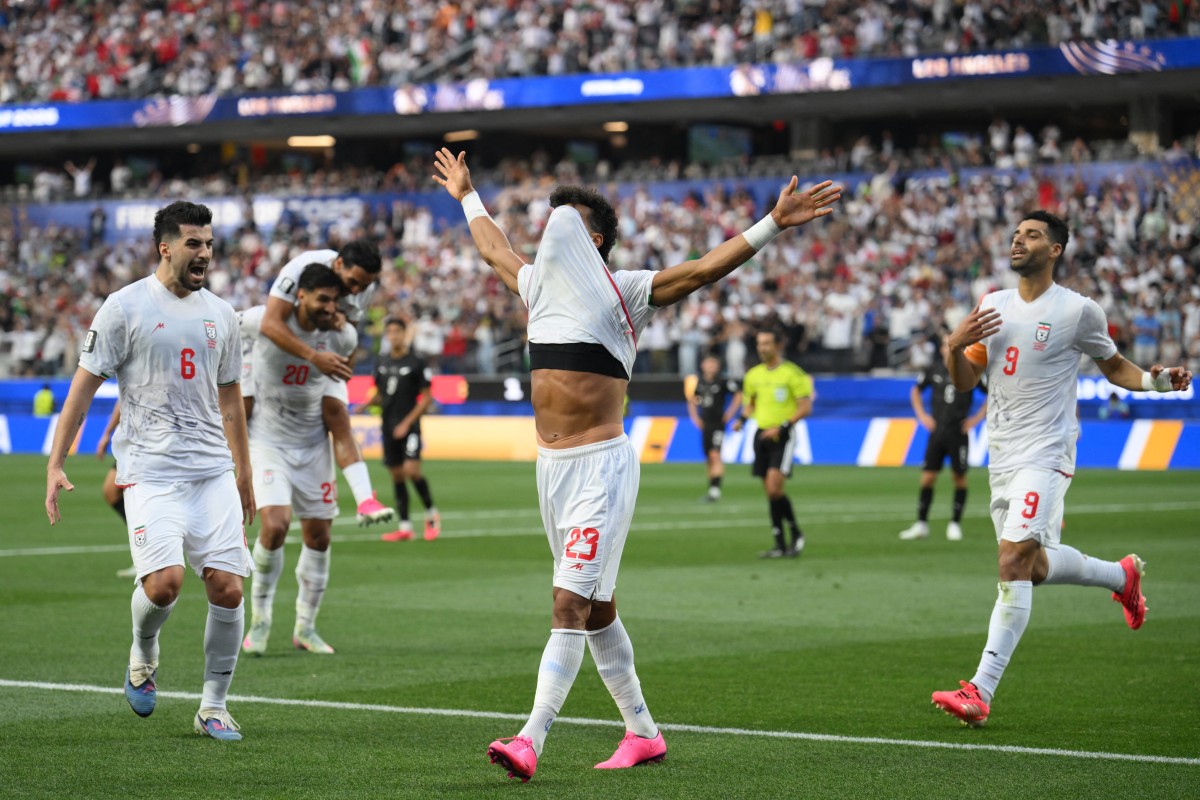
Iran’s national football team has become a battlefield over stolen symbols, collective memory, and who gets to speak in the name of Iran.
In the 2026 World Cup, part of the Iranian diaspora seems less interested in lineups, tactics, or qualification chances than in organizing political campaigns around Iran’s national football team — Team Melli, as it is known in Persian.
Calls — especially from Pahlavi-aligned right-wing sections of the opposition — to appear in stadiums with the Lion and Sun flag, display images of protesters killed by the Islamic Republic, invoke names such as Majidreza Rahnavard, a young protester executed by the Islamic Republic during the Woman, Life, Freedom uprising, and protest against a team some now call “the regime’s team” have shaped much of the political atmosphere around Iran’s World Cup presence. Because the tournament is being held in cities such as Los Angeles, Toronto, and Vancouver — major centers of the Iranian diaspora — opposition groups have found more space to turn the event into a political stage.
This raises a difficult question: what happened to a football team that, for several generations of Iranians, was once a source of national pride, joy, and solidarity? Why do some Iranians today, especially in the diaspora, not only refuse to support the national team, but even celebrate its defeat?
For many Iranians, the memory of November 29, 1997 — when Iran qualified for the 1998 World Cup after the playoff against Australia — remains one of the most powerful moments of collective life. Millions poured into the streets. Strangers embraced one another. Sweets were handed out. For a brief moment, the national team became a shared language that could suspend political, social, and cultural divisions.
Twenty-five years later, on November 29, 2022, the same national team lost to the United States and was eliminated from the World Cup. This time, many Iranians celebrated the defeat. In some cities, sweets were again distributed — but now for the opposite reason. That night, in one of its bitterest moments, Mehran Samak, a 27-year-old protester from Bandar Anzali, was shot dead.
If the national team had once gathered millions around a shared feeling of pride and hope, in 2022 it became a mirror of a much deeper rupture between society and state. The World Cup in Qatar began while Iran was in the middle of the Woman, Life, Freedom uprising. News of protesters being killed, arrested, and repressed dominated public life. In that atmosphere, many expected the players — among the most visible public figures in the country — to show clearer solidarity with society’s pain.
The players’ meeting with Ebrahim Raisi before leaving for the tournament, reports of rewards, and the ambiguous positions of some members of the team reinforced the impression that the national team stood closer to the state than to society. At the same time, some players referred to the suffering of the people, and in the first match against England, the team refused to sing the national anthem — a gesture many read as protest. Yet most avoided explicit political positions.
Perhaps it was the misfortune of this generation of players that the most important tournament of their careers coincided with one of the most turbulent moments in contemporary Iranian history — a moment in which every silence, smile, goal celebration, and even singing or refusing to sing the anthem immediately acquired political meaning.
Between Symbol and State
But the question remains: how much resistance can be expected from players who work inside a highly securitized and tightly controlled structure?
Iranian football has long been caught between sport and politics. From Nasser Hejazi and Ali Daei to Ali Karimi, Voria Ghafouri, and Sardar Azmoun, athletes who have taken independent or critical positions have faced professional, legal, and political pressure. Popularity among the people does not protect them from power; sometimes it makes them more vulnerable.
The importance of national team players lies not only in their popularity. In the minds of many Iranians, they are not merely athletes. They carry part of the national story. They are symbolic representatives of a country with which millions identify. That is why, whenever society faces a political crisis, all eyes turn toward them.
The crisis of Iran’s national football team is therefore not just a football crisis. It is a crisis in the relationship between nation, state, and collective representation.
In recent years, many critics of the Islamic Republic, especially in the diaspora, have found it increasingly difficult to separate the national team from the ruling political structure. For them, the team no longer represents the nation, but has become part of the symbolic machinery through which the state presents itself as the exclusive representative of Iran. The intervention of military and security institutions in football has only strengthened this perception.
But here lies the central danger: if the national team and other shared symbols are handed over entirely to the state, society loses one of the few remaining spaces where collective memory and belonging might still be contested.
National teams are not merely propaganda tools for governments. They are part of a nation’s memory. Many Iranians first experienced shared joy, defeat, pride, and belonging through these matches. The question is whether surrendering this space to the state means surrendering part of that memory as well.
The binary that has formed around the national team is dangerous: either love Iran or protest against the state. But these two should not be opposed to one another. One can oppose the Islamic Republic, remain faithful to the memory of those killed, criticize the coach, the football federation, and the behavior of some players — and still refuse to let the state monopolize the meaning of the national team.
The Islamic Republic, like many authoritarian regimes, has tried to use sporting success to strengthen its political narrative. But exploiting a national symbol is not the same as owning its moral meaning. The joy of Iran’s qualification in 1997 was not created by the state. The tears after Khodadad Azizi’s goal do not belong to any government. Such moments belong to collective memory and to the people who lived them.
Perhaps the Islamic Republic’s most important victory has not been capturing the national team, but persuading part of its opposition that opposing the state requires cutting themselves off from this part of actually existing Iran as well.
But no society becomes free by handing over its memories, symbols, and collective memory to the dominant political power. Collective freedom begins when society once again reclaims the right to interpret and own its shared symbols from the monopoly of a repressive state.