

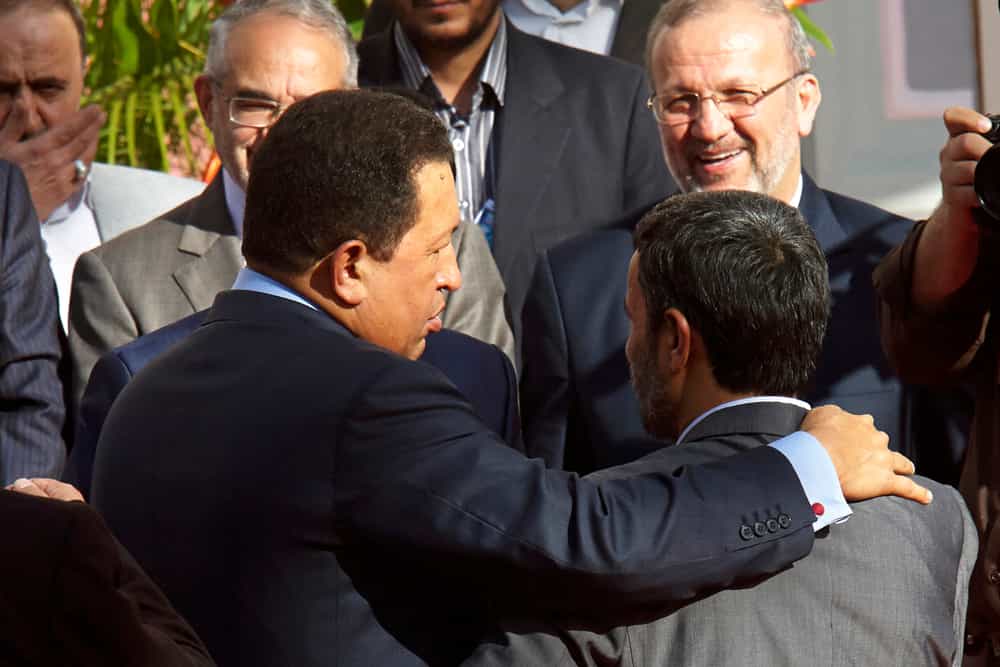
Ahmadinejad’s turn from anti-imperialist icon to reported imperialist coup candidate exposes the danger of mistaking anti-American rhetoric for liberation politics.
Remember the image of Ahmadinejad in Caracas, beside Chávez and Maduro; an image that appealed to many on the global left: a president from the Global South standing against imperialism. Less than two decades later, that image has been inverted. Maduro has become Washington’s victim, and Ahmadinejad, according to reports, has been considered as a possible U.S. and Israeli option for post-Khamenei Iran under the so-called “Venezuelan model”: removing the leader while keeping much of the state structure intact. This is not merely the fall of a figure. It is the disgrace of a political naivety that mistakes rhetoric against the United States and Israel for emancipatory anti-imperialist politics.
The Caracas Image
November 2009, Caracas. Iran’s president, Mahmoud Ahmadinejad, in his gray jacket meant to signal modesty and down-to-earth simplicity, descends the airplane stairs as Nicolás Maduro, then Venezuela’s foreign minister, welcomes him.
A few hours earlier, in La Paz, he had stood beside Evo Morales and spoken of unity against “imperialism.” Now in Caracas, he was playing the role that part of the global left was eager, almost hungry, to see: a president from the Global South, angry at “imperialism,” hand in hand with Hugo Chávez, speaking the familiar language of resistance, independence, and struggle against U.S. domination.
In Caracas, he and Chávez spoke of “imperialism.” In Bolivia, lithium, mining, technology, and “independence” were on the table. Bolivia’s Salar de Uyuni, the vast lithium-rich salt flat in the country’s southwest, was not merely a source of the lithium needed for the battery economy of the future. It had become a stage on which the geopolitics of resources, national independence, and anti-imperialist theater appeared in a single frame.
But history sometimes turns an image around with cruelty and shows what lies behind it. Less than two decades later, Maduro is no longer the host of anti-imperialists. The United States has abducted him, and his fate, under the title of the “Venezuelan model,” has been turned into a formula for intervention. And Ahmadinejad? The same man who once delivered speeches in Caracas against the “global empire” has now, according to a New York Times report, been considered by Washington and Tel Aviv as an option from inside the system for Iran after Khamenei.
Anti-Imperialism Without Emancipation
In reality, the image of Ahmadinejad as an anti-imperialist statesman was cracked from the beginning. Ahmadinejad was neither a representative of Global South liberation, nor a figure of socialism, nor even an independent statesman in the radical sense of the word. He was the president of a regime that, at home, repressed workers, students, women, teachers, journalists, oppressed national and ethnic minorities such as Baluch people, and political opponents, and abroad turned anti-American language into capital for bargaining. His anti-Americanism was not necessarily anti-capitalist, anti-class domination, or anti-repression. It was more like a political currency: a coin to trade in the market of crisis.
The first lesson of Ahmadinejad’s fate lies here: not everyone who speaks against the United States is necessarily anti-imperialist. If anti-imperialism is separated from the people, class, freedom, and equality, it can easily become the diplomatic language of repressive states. In such a situation, “imperialism” is no longer the name of a global relation of domination. It becomes a ready-made insult used to cover prison, corruption, suffocation, executions, and domestic repression. Even at the time, some Iranian and international leftists warned that legitimizing Ahmadinejad in the name of peace meant, in practice, legitimizing a government against which the people of Iran had risen up.
In 2009, abroad, Ahmadinejad was the hero of the “Axis of Resistance” and the friend of left-wing Latin America. At home, his disputed reelection became the immediate trigger for the Green Movement and one of the widest waves of repression after the revolution. There was no contradiction. This is the logic of authoritarian states: beyond their borders, they raise the flag of independence; in the streets, they raise the baton. At the United Nations, they speak of global justice; in Evin, Tehran’s main political prison, and Kahrizak, the detention center notorious for torture after the 2009 protests, they reveal the true meaning of their sovereignty. His presidency was accompanied by international isolation, economic crisis, inflation, the collapse of the currency, and the intensification of the nuclear conflict. The 2009 election led to protests that the government answered with violence.
From Power Insider to System Critic
Then the turn began. Ahmadinejad was pushed out of the center of power, clashed with Khamenei and the security circles, registered several times as a presidential candidate, and was disqualified: in 2017, 2021, and 2024. The same man who had once been the product of an alliance between the Supreme Leader’s office, the Revolutionary Guards, and oil-based populism gradually reconstructed himself as a “critic of the system”; not a democratic critic, not a popular opponent, but a wounded politician, expelled from the table of power, searching for a new stage.
From the very beginning of his political career, from Narmak to Caracas and from Caracas to who knows where, Mahmoud Ahmadinejad was a man of turns and reversals: from a student aligned with the pro-Khomeini “Line of the Imam,” hostile to the left, to a model provincial governor under Rafsanjani’s government, and finally to the modest-living mayor of Tehran; from the favored candidate of the Supreme Leader’s office and the Revolutionary Guards in 2005, to a president whose eleven-day withdrawal from public duties made his rift with the same center of power public; from the president who, in 2009–2010, called protesters “dust and debris,” to someone who later said officials must be held accountable by the people; from an aggressive symbol of the nuclear program, to a semi-internal critic of the system and an accuser of the “smuggler brothers,” a reference to IRGC-linked oligarchs who bypassed sanctions and accumulated wealth through corrupt networks; from the head of a government that mocked UN resolutions, to a politician who spoke of engagement with the world.
In Ahmadinejad’s revolving trajectory, the year 2019 has special importance. In an interview with The New York Times, Ahmadinejad praised Trump. Trump, in his words, was a “man of action” and a businessman who could calculate costs and benefits. This was no longer the voice of the same speechmaker from Caracas. It was the language of transaction, naked and without ceremony. The former anti-imperialist had suddenly discovered that imperialism, too, might be a good partner, provided that the accounts were calculated properly. This turn is not strange. Someone whose hostility to the United States was never built on a critique of global capitalism or solidarity with the oppressed can, sooner or later, turn that same hostility into an offer of negotiation with the businessman in the White House.
This turn has now reached an almost farcical point: the United States and Israel, in a plan resembling the Venezuelan model after Maduro’s capture and the cooperation of Delcy Rodríguez, Venezuela’s vice president, have considered Ahmadinejad as an option from inside the system to lead Iran after a possible collapse. The Guardian writes that the attack near his home was designed to free him from what the report described as house arrest, although the plan quickly went off course.
Remarkable. The same man who, at the “World Without Zionism” conference, spoke of the “occupying regime of Jerusalem” vanishing from the page of time, and shortly after called the Holocaust a “myth,” has now become an option for Israel.
This is not the irony of history. It is the poison of history. Someone who was once, for part of the global left, a “symbol of resistance against imperialism” now appears as a possible option for the same United States and Israel to engineer power in Iran. This is not only Ahmadinejad’s disgrace. It is also the disgrace of outlooks that mistake politics for gestures. Crude and naive anti-imperialism, because it has no class or democratic criterion, is quickly deceived by voice, flag, slogan, and a shared enemy. For such a politics, it is enough that someone curses Washington for him to be elevated as a hero.
Beyond Ahmadinejad
But the issue is larger than Ahmadinejad. The United States and Israel, too, have shown their true faces in this story: designers of political rearrangement. For them, the issue is not the freedom of the people, but finding someone from inside the structure who can preserve order, manage the crisis, and change the geopolitical orientation. The same old logic: the regime is bad, unless part of it can be used. The dictator is bad, unless he becomes a partner. The people matter, as long as they do not damage the scenario of power.
Ahmadinejad is symbolic in this sense. He shows how authoritarian populism can wear three outfits at once: in the Global South, the outfit of the anti-imperialist; at home, the outfit of the repressor of the existing order; and at the moment of crisis, the outfit of a bargaining option. This triad is not accidental. When politics is built not on liberation but on performance, hatred, enemy-making, and transaction, this is where it ends: yesterday’s hero of anti-imperialism becomes tomorrow’s possible pawn of intervention.
It is not only the hollow image of yesterday’s Ahmadinejad that has been exposed today. The edifice of a certain political naivety has also collapsed. Not every anti-American is anti-imperialist. Not every statesman who speaks in the name of the Global South is necessarily the voice of the oppressed within it. Sometimes we are simply facing a prison guard who keeps the prison key in his pocket while, at the podium, reciting the rhetoric of liberation and independence. The catastrophe begins when, in the global translation of this performance, the rhetoric of liberation remains, while the prison disappears; the speech is heard, but the prisoners’ cries are not.