

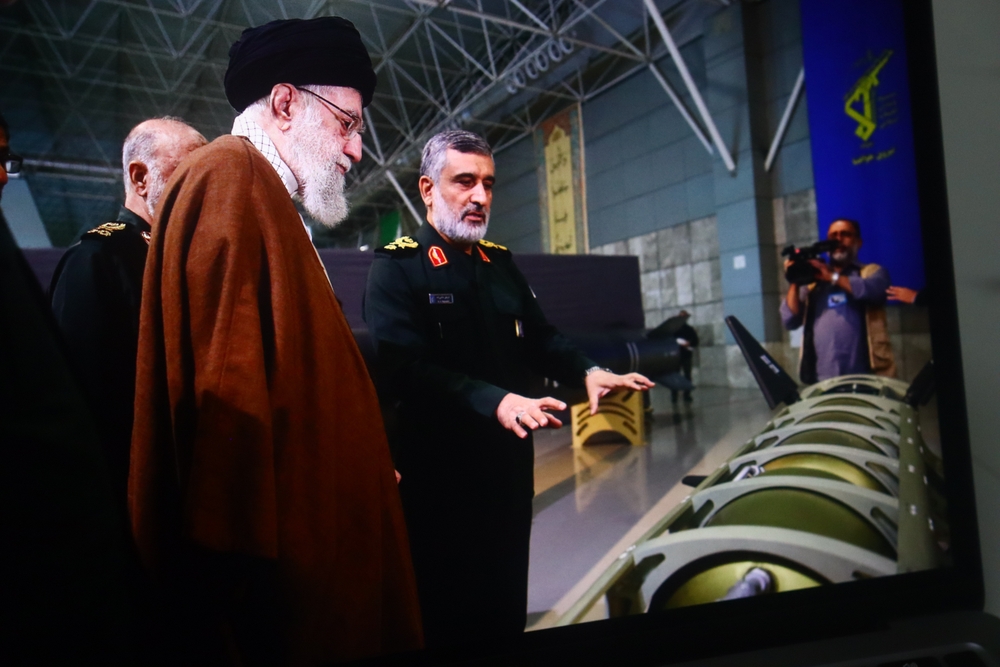
Tehran wavers between war readiness and revolt control, pushing “Cold War” narratives as scarce resources and fracturing proxies deepen paralysis—shifting budgets from social needs to defense without resolution.
“West Asia has entered a new Cold War”—state media and IRGC-aligned sites repeated the line last week.
On October 12, 2025, the daily newspaper Iran ran an interview with Hossein Ajorlou, a strategist close to IRGC think tanks, outlining this “Cold War” as follows:
• Israel’s peace tracks with Palestinians and normalization with Arab states threaten Iran’s security; they will not bring lasting peace and are a prelude to larger tensions.
• Israel has shifted from defense to offense and seeks closure on its “unfinished mission” regarding Iran.
• Europe and Arab states now find confrontation with Iran less politically costly.
These statements invite multiple readings: some take them to mean an inevitable war; others soften the edges and call it a “Cold War” with limited, localized clashes.
By “Cold War,” they mean both sides see direct war as too costly, yet the conflict does not end; covert and pinpoint battles continue without formal declarations. In IRGC-adjacent media, the label does two things: normalizes a higher, long-term level of tension as the new status quo, and primes public opinion for larger military budgets. Accept a protracted “Cold War,” and budget priorities shift from social services to air defense and strike capabilities.
Strategic Indecision in an Unsettled Region
After the 12-day war, Tehran faces a basic question it cannot answer: What, exactly, are the U.S. and Israel planning for Iran? You can hear the preoccupation in senior officials’ remarks. The Supreme Leader tries to frame those 12 days as a victory yet warns that a “neither-war-nor-peace” limbo hurts the system—without assuring that stability has returned.
The uncertainty is structural: command (the Leader, IRGC, military) and the executive (the Pezeshkian government) do not know whether to ready the country for an external war or for the risk of an internal uprising. The two scenarios demand opposite budgets and priorities.
Masoud Pezeshkian, Abbas Araghchi, and other senior officials speak of the “continuing malice” of Israel and the U.S., preparing for a possible war. The government’s spokesperson mentions emergency plans to secure food and essentials for a military conflict, even as he laments being stuck between war and peace. The IRGC, its Aerospace Force, and the regular military issue periodic statements: if the “enemy errs,” it will regret it. At the same time, commanders boast that post-war rebuilding has raised deterrence to where even the U.S. would not dare attack.
State TV is similarly split: one program insists war is unlikely and urges a return to business and the economy; another, hours later, calls the “Westernizers’” optimism naïve and speaks of an inevitable next war—even a pre-emptive Iranian strike.
War Chest vs. Street Calm
War is not the only worry. Economic shock and social unrest weigh heavily. This is not just inflation and discontent; it is the size of the “war chest.” With limited cash, every rial for air defense, missiles, and proxies is a rial not spent on keeping the streets calm.
Officials speak of “major surgery” and “hard decisions.” Pezeshkian says gasoline prices must rise—then adds he will not force it through harshly. What follows the “but” matters most: the first clause lists necessities; the second reveals fears. Security, economic, and political elites worry any decision could spark a nationwide revolt.
Even the ideological core of the regime, while lamenting the loss of the “hijab trench,” stops short of urging a fierce campaign to “retake” it. The same hesitation surrounds fuel prices; bold speeches melt into caution because the smoke of Aban 98—the November 2019 fuel-price protests and their violent crackdown—still hangs in the air.
Paralyzed by fear of an uprising, the state struggles to decide. A system that cannot decide—and cannot deliver basics—becomes easy prey. Crisis firefighting has replaced long-term governance.
Liquidity, Isolation, Survival Mode
Perhaps the clearest non-classified snapshot came on September 16, 2025 (25 Shahrivar 1404) from Central Bank chief Mohammad-Reza Farzin. He said Iran is as alone in finance as it was in the 12-day war: the banking system is carrying the load, liquidity growth has jumped from the 20% range into the 30% range, and with war-related revenue shortfalls, the focus has shifted from “development” to keeping the economy standing at all.
Centrifugal Drift in the “Axis of Resistance”
Caution around war cuts both ways. Tehran avoids steps that might hand the other side a pretext—yet restraint can be read as invitation. Nuclear escalation? Expanding Hezbollah’s capabilities or engineering a reshuffle among allied militias and political arrangements in Iraq? Everything is stuck in “neither war nor peace.” Actions continue, but mostly to “keep spirits up,” not to change facts.
That is risky. A centrifugal drift within the “Axis of Resistance” threatens years of IRGC-Quds Force investment. Commander Esmail Qaani’s frequent trips to Iraq aim to stave it off. But how long can persuasion and promises of future favors and financial make-goods hold? Without deep ideological glue, non-state groups can trim their sails to contrary winds.
What is called the “Iraq front” is not a unified actor like Yemen’s Ansarallah or Lebanon’s Hezbollah. It is a mix of groups and figures with varying ideological ties to Tehran. Some prioritize “building their business” and use the axis for leverage over Baghdad. Firm ideologues are relatively few—Kataib Hezbollah and a faction within Asaib Ahl al-Haq. Even veterans of the Badr line, long nourished by Tehran, are hedging for a safe exit from the Quds Force’s shadow—while preserving their stakes in Iraq’s system.
For Tehran, divergence means cash, not just creed: money, weapons, political cover, and brokering slices of Iraqi state contracts. With Iran’s security aura dented and finances tight—and scarce foreign currency needed at home for inflation control, subsidies, and fuel—maintaining a “loyal network” grows costlier by the day.
Guns or Bread?
Sanctions and oil-sale hurdles have created acute resource scarcity. Choosing where scarce funds go depends on how Tehran reads the next move by its adversaries. If war feels certain, invest in offense and defense. If revolt is the main risk, feed the economy. If both loom?
Military-aligned outlets say the choice is made: only military readiness breaks the stalemate. The new IRGC Aerospace commander touts fresh offensive capabilities—likely new missiles. Reports of defense purchases from Russia and China surface regularly. State TV says air defense is stronger than before the 12-day war—claims that cannot be independently verified.
Reformist and government-leaning media tell the opposite story: collapse and revolt will follow unless funds go to public services and economic relief. After the 12-day war, the Islamic Republic hangs between two absolutes.
If it says “war is coming,” the budget shifts to the IRGC and missile deterrence—while risking a livelihood revolt.
If it says “revolt is coming,” money goes to subsidies, fuel, and street control—while risking weakened deterrence.
Between Two Absolutes
Where should scarce resources go? Tehran has not decided. Its answer may shape its destiny. Since the 12-day war it has muddled through, but soon it will be forced to act. The shock of slain commanders has not worn off; the system’s nerves remain dulled. Economic and security shocks, however, are not waiting; they are already at the door.