

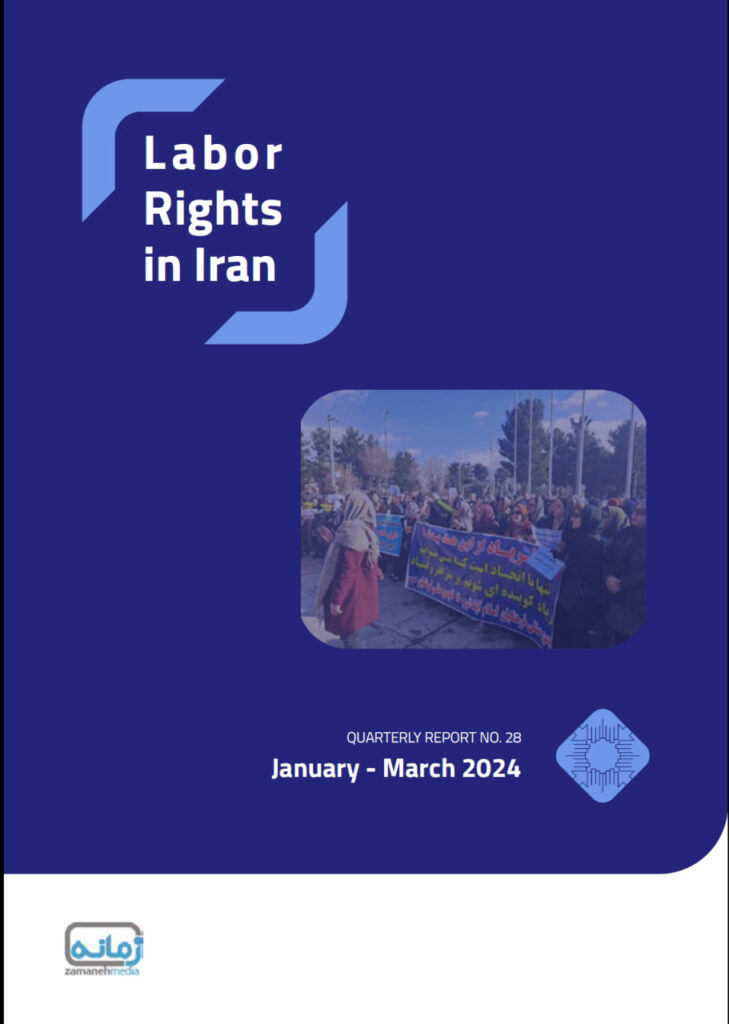
Zamaneh Media’s 28th quarterly Labor Rights Report covering labor-related news and analysis from January through March 2024, is available for download:
According to the Iranian Statistics Center, out of 64 million working-age Iranians, only 24 million were employed in the first quarter of 2024, representing 37.5 percent of the population. Consequently, 62.5 percent were neither employed nor actively seeking employment at the time of the survey. Female employment decreased from 4 million to 3,760,000, making up only one-eighth of working-age women.
In February 2024, the government noted a reduced official inflation rate. Food inflation was reported at 25.7 percent point-to-point, and 41.2 percent annually. However, prices of protein, like white and red meat, soared between 90 to 93 percent, causing workers to significantly reduce or eliminate meat from their diets. In February 2024, the US dollar’s exchange rate peaked at 60,000 tomans which translates to an increase in the price of goods in Iran.
The government continued the policies of wage suppression as it refused to increase the national minimum wage in accordance with calculations of the cost of living and inflation. On March 19, the eve of the Iranian New Year, the Supreme Labor Council set the daily minimum wage at 238,872 tomans, translating to a monthly salary of 7.182 million tomans. Some labor representatives reportedly walked out of the meeting in protest. Nonetheless, the Deputy Minister of Cooperation, Labor, and Social Welfare stated that the legal majority of the council approved the new national minimum wage. As a result, the 2024 minimum wage was set below 9.482 million tomans for a single worker and 10.892 million tomans for a married worker with children.
The Coordinating Center of Islamic Labor Councils of Tehran calculated the cost of living for a four-member family at 32.85 million tomans provincially and 26.55 million tomans nationwide. The government did not accept their calculations. To justify lower wages, the government reduced the recommended daily caloric intake and altered the composition of the food basket used to calculate the subsistence level. The Ministry of Health’s food basket, presented to the Supreme Labor Council, saw per capita cuts in protein intake, including reducing red and white meat, removing fish entirely.
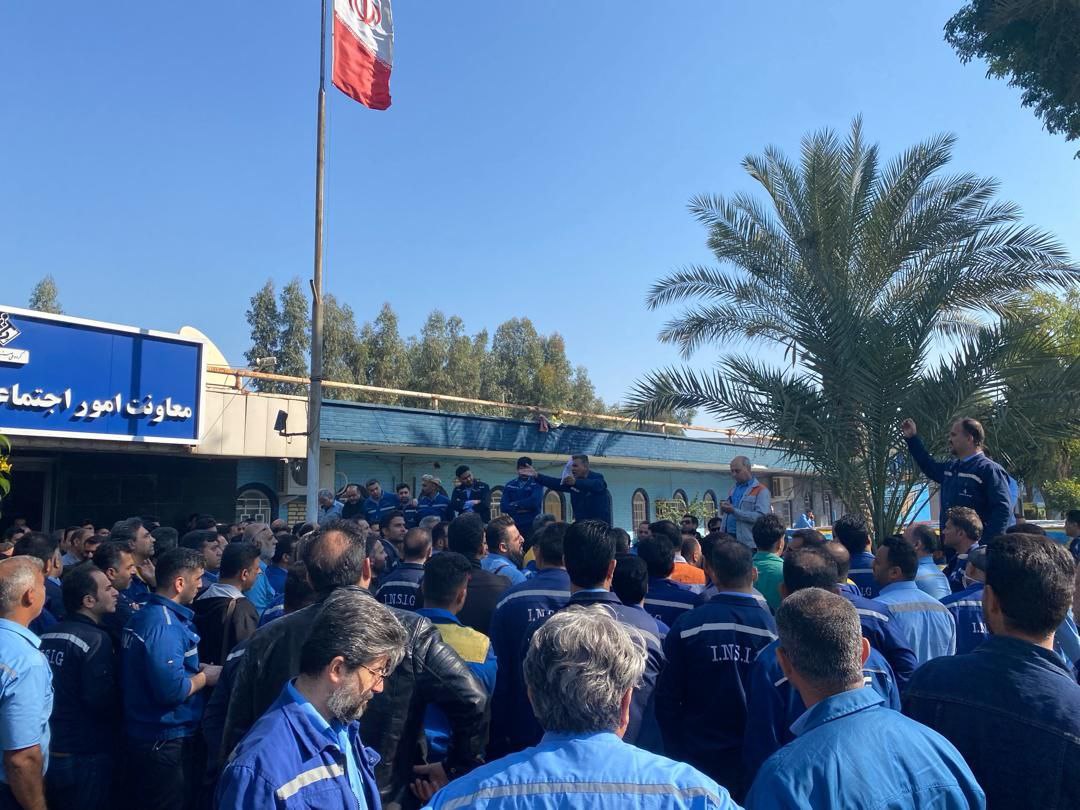
The government’s refusal to align wage increases with the actual inflation rate has led to widespread workers’ strikes. The Iran National Steel Industrial Group (Ahvaz Steel) was the target of the most significant protest, with oil and gas sector workers striking against wage disparities, contract issues, and the lack of welfare services compared to permanent oil industry employees. Municipal workers, social security retirees, miners, contract nurses, and production unit employees were among other protestors, demanding overdue wage payments, wage increases, improved working conditions, permanent contracts, and job classification implementation.
Informal workers faced government crackdowns, with peddlers required to obtain activity licenses, signaling steps to restrict their operations. This period also saw increased violence against immigrants, predominantly Afghans, with heightened expulsions. The government linked the extension of residency, work permits, and immigrant movement to financial deposits.
Zamaneh Media’s 28th quarterly Labor Rights Report does not cover all labor-related events and topics. Our latest special report focused on the plight of the Baluch fuel carriers. For all previously published reports related to workers’ rights, please visit our labor page: