

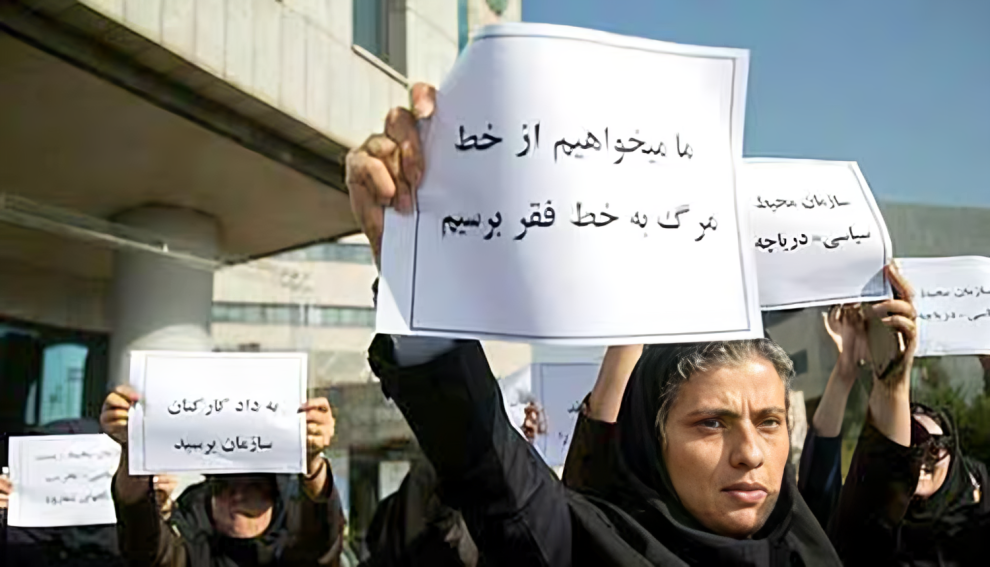
Before the bombs fell, millions in Iran were already being pushed below survival by sanctions, inflation, austerity, and collapsing wages.
Before the U.S. and Israeli military attack, nearly half of Iran’s population was already living below the absolute poverty line. The war did not create this devastation from nothing. It landed on a society already weakened by years of sanctions, inflation, wage suppression, shrinking food consumption, and the systematic transfer of crisis onto the backs of wage-earners.
The clearest sign of this collapse is visible not in abstract economic indicators, but on people’s tables. Iranian households are eating less, especially of basic protein foods. Chicken, once the cheaper substitute for red meat, has itself become increasingly unaffordable. A board member of the Gilan Poultry Farmers’ Association recently said that chicken consumption had “roughly halved.” He linked the decline to the removal of preferential currency, rising production costs, price controls, and the impact of war on imported poultry inputs.
According to his account, chicken production fell from 140 million to 94 million birds in just one month. At the same time, demand collapsed. This is the brutal arithmetic of poverty: when prices rise fast enough, people do not simply switch from one food to another. They stop buying.
Official figures confirm the scale of the shock. The price of factory-farmed chicken rose by more than 190 percent in one year. A kilogram of chicken that cost around 98,500 tomans in spring 2025 approached 290,000 tomans by spring 2026. For millions of families, even chicken, once treated as the last affordable protein, has moved out of reach.
The Shrinking Table
The decline in food consumption did not begin with the war. For years, official reports and domestic economic researchers have pointed to a steady fall in the consumption of meat and dairy. Per capita consumption of protein products declined sharply after 2016. As red meat became unaffordable, chicken replaced it in many household baskets. But now even that substitution is breaking down.
In recent years, red meat consumption in Iran has fallen to around five or six kilograms per person per year, far below both global averages and Iran’s own past levels. Another report estimated that annual household consumption of red meat reached its lowest level in 14 years. The inequality behind these averages is even more striking: the richest tenth of society spends more than 33 times as much on red meat as the poorest tenth. Even for cheaper substitutes, such as chicken and rice, poorer households consume far less than the wealthy.
The same pattern appears in dairy consumption. One report showed that between 2020 and 2024, dairy consumption among low-income groups fell to one-third of its previous level, while consumption among the wealthy increased by 50 percent. In other words, the crisis is not only reducing consumption; it is reorganizing nutrition along class lines. The poor are pushed toward hunger and malnutrition, while the rich maintain or even expand their access to food.
This is what impoverishment looks like in everyday life: less meat, less dairy, fewer calories, cheaper food, skipped meals, and a constant calculation of what can be sacrificed next.
Sanctions as a Hidden War
The shrinking of Iranian tables is not new. Over the past decade and a half, every tightening of sanctions has lowered welfare, reduced real income, and weakened the ability of wage-earners to meet basic needs. Sanctions are often discussed as diplomatic tools, but in daily life they operate as a hidden and endless war against ordinary people.
The U.S. withdrawal from the nuclear agreement in 2018 and the currency shock that followed opened the way for a new wave of so-called price liberalization. The state first introduced a preferential exchange rate for importing essential goods, then narrowed the list of goods eligible for it. Later, fuel prices were raised. Under Ebrahim Raisi’s government, the preferential currency system was further restricted and then effectively removed for many basic goods. Food inflation surged.
Sanctions did not act alone. Their destructive force was magnified by domestic policies: austerity, subsidy cuts, privatization, corruption, and wage suppression. The government repeatedly used sanctions as both justification and opportunity. Each external shock became a pretext for “economic surgery”; each surgery meant higher prices, weaker wages, and fewer public protections.
Research on sanctions and the Iranian middle class shows the depth of the damage. One study found that between 2011 and 2019, sanctions reduced the size of Iran’s middle class by 11 percent. Real per capita income fell sharply, pushing large sections of the population below the poverty line. Another study estimated that sanctions reduced real per capita income by nearly 28 percent over eight years. Declining imports, disrupted production, rising prices, unemployment, and falling wages all became part of the same process.
For wage-earners, the damage was not only economic. It was bodily and psychological. Sanctions entered the kitchen, the workplace, the pharmacy, the school, and the hospital. They appeared as unaffordable medicine, cancelled treatment, unpaid rent, lost jobs, and food removed from the family table.
Half the Country Below Poverty
The result is visible in the poverty figures. State-linked estimates suggest that absolute poverty rose dramatically over the past 15 years. By 2024, around 40 to 44 percent of Iran’s population was living in absolute poverty. In early 2026, the head of the State Welfare Organization said the number of people living in absolute poverty had doubled, rising from 16 million to 34 million. He warned that the share of the population below the absolute poverty line may have increased by another ten percentage points.
In other words, by the winter before the military attack, at least half of Iran’s population was likely living below the absolute poverty line.
The same official also warned that middle layers of society were falling toward severe poverty. Around 35 million people, he said, could no longer adequately meet essential living costs, while four million were facing severe poverty. This means the crisis is no longer confined to those historically classified as poor. It has reached wage-earners, lower-middle-class families, pensioners, students, and sections of the middle class that once imagined themselves relatively secure.
This collapse is the product of a long convergence: sanctions from outside, austerity from inside, corruption at the top, and repression of wages from below. Under the pretext that businesses cannot afford higher wages, workers’ real incomes have been pushed downward year after year. Wage suppression is not separate from “economic surgery”; it is one of its central mechanisms. Sanctions make this easier, because the state can present every attack on living standards as a forced response to external pressure.
At the same time, declining state revenue in a corruption-ridden system has been used to cut social spending and accelerate privatization, especially in health care. The result is a society in which people pay more for food, more for medicine, more for transport, more for education, and more for survival itself, while earning less in real terms.
A Long War Against Survival
The military attack has now accelerated a process already underway. Inflation is rising, jobs are disappearing, and the possibility of a deeper recession hangs over the country. For wage-earners, and even for the more secure layers of the middle class, the horizon is frightening.
But the central point is this: war did not begin only when bombs fell. For years, sanctions have functioned as a form of warfare against the conditions of life. They have weakened bodies, emptied tables, destroyed savings, intensified inequality, and helped create the conditions in which austerity could be imposed more violently.
The Islamic Republic’s economic policies have deepened this devastation. Sanctions impoverish; domestic austerity organizes that impoverishment; wage suppression stabilizes it; privatization profits from it. Together, they have pushed millions below the line of survival.
What is unfolding in Iran is therefore not simply an economic crisis. It is a social war over who gets to eat, who gets treated, who keeps working, who falls, and who is abandoned. The poor were the first to be pushed below survival. Now the circle is widening.