

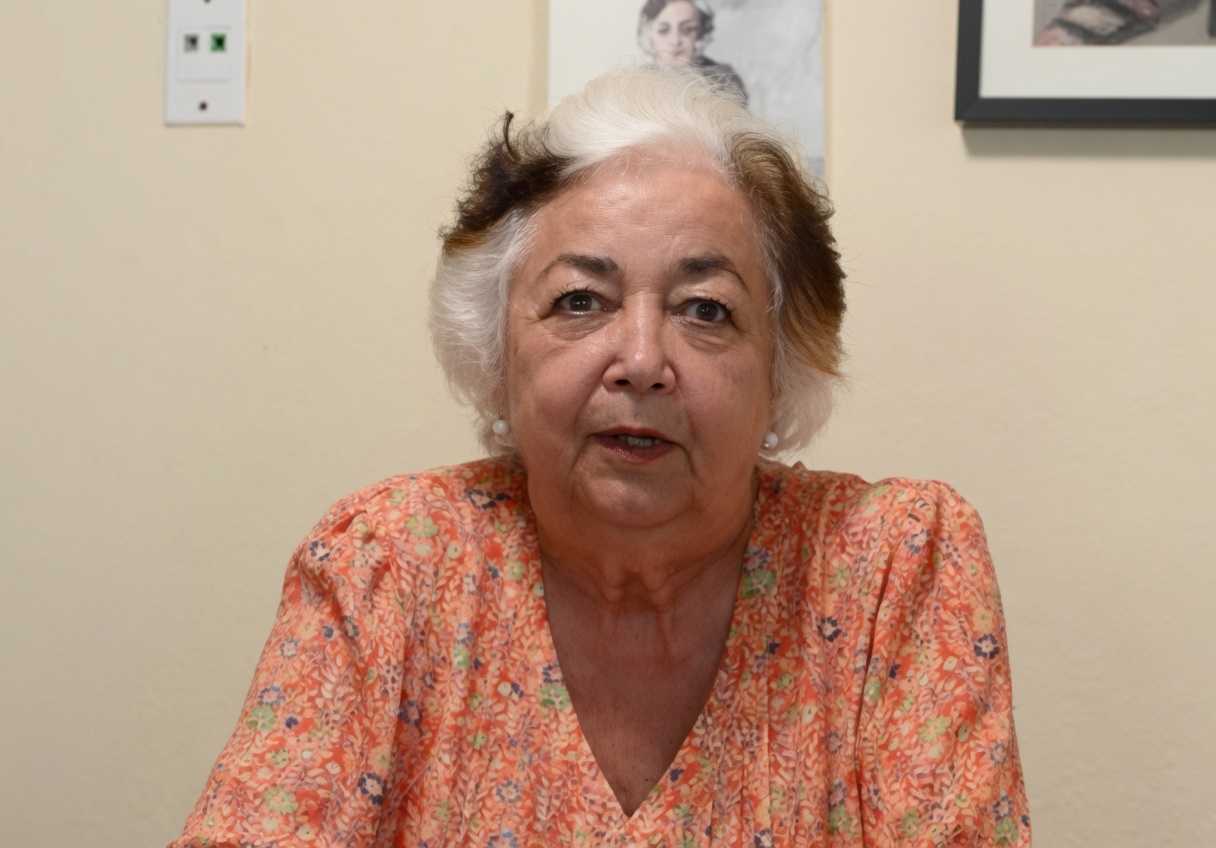
one of Iran’s most influential contemporary writers, died after decades of literary courage, imprisonment, exile, and feminist imagination.
Shahrnush Parsipour, one of Iran’s most influential contemporary writers, died at the age of 80 in a hospital on the outskirts of San Francisco from complications following a heart attack. The writer and translator, who was eventually forced to leave Iran and had lived for decades in the United States, had been hospitalized since last week. Parsipour also had several productive years of collaboration with Radio Zamaneh.
Parsipour was born in 1945 in Tehran. She graduated in social sciences from the University of Tehran and began publishing her stories at the age of 16 under the pen name “Shahrin.” In her first novel, “The Dog and the Long Winter” (1976), she chose the perspective of a teenage girl who encounters the difficulties of a political activist newly released from prison. However, the complacency of the middle class leads her toward a painful inner awakening. The novel offers a realist portrait of Iranian society before the 1979 Revolution: the tension between tradition and modernity, the role of women in family and society, the impact of political activism on personal life, the critique of patriarchal society and women’s restrictions, generational conflict, the effect of politics and ideology on everyday life, and the inner transformation of a female character from passivity to awareness. These themes would recur in her later works.
In the same period, Parsipour gathered her short stories in the collection “Crystal Pendants” (1977). In these stories, by veiling events in a mist of ambiguity and isolation, she created a dreamlike and imaginary atmosphere, portraying romantic melancholy and a strange sadness rooted in loneliness and the loss of identity produced by office life in the big city.
She returned to similar themes in the interconnected stories of “Free Experiences” (1978–79). In addition to these works, she also wrote the children’s story “The Little Red Ball.”
A Turn Toward Eastern Mysticism, Fame, and Prison
In the years after the revolution, Parsipour became increasingly drawn to Eastern mysticism and translated books on philosophy, mysticism, and Chinese history. Her most important translations include “Secrets of Astrology” by Yves Tiffany, “Lao Tzu and the Taoist Masters” by Max Kaltenmark, on Taoism and Chinese mysticism, “From Confucius to the Long March,” “History of China” in four volumes, one of her major translation projects, “Parapsychology,” and “The Western Journey.” These works were not only informative; they also helped shape the mystical and mythological layers of her own novels, such as “Touba and the Meaning of Night” and “Women Without Men.”
Parsipour rose to fame with the novel “Touba and the Meaning of Night” (1988) and the interconnected stories of “Women Without Men” (1989). These two works made her one of the most important voices in contemporary Iranian literature, especially in the field of women’s writing. “Touba and the Meaning of Night,” with its epic, multigenerational narrative, rereads a century of modern Iranian history from the perspective of a woman, Touba, and portrays the social, political, and cultural transformations of society by blending realist, mystical, and mythological elements.
By contrast, “Women Without Men,” with its bold and innovative language, offers a radical critique of patriarchal structures. Using magical realism, it tells the story of five women who cross gendered and social boundaries in search of independence and selfhood. These two works became known not only for their profound engagement with women’s issues, gendered repression, and feminist awakening, but also for their formal innovation and thematic courage, which led to bans and eventually to the author’s exile. They also brought Parsipour international attention and turned her into a symbol of resistant and feminist Iranian literature.
Shahrnush Parsipour was imprisoned several times in Iran. The first time was under the Pahlavi regime in 1974, when she was held for 54 days after resigning from National Iranian Television in protest against the execution of Khosrow Golsorkhi and Keramatollah Daneshian [provide a short sentence introducing these two]. After the Revolution, in the summer of summer 1981, she was arrested along with her mother and brothers after her brother’s publications were found in a car. She was held without formal charges and spent four years and seven months in prison. These bitter experiences were later reflected in her book “Prison Memoir,” one of the most important works of Iranian prison literature, published in Sweden by Baran Publishing. She once said:
“I was not physically tortured, but the humiliation and insults were constant. Sometimes after my release, I would stand under the shower and cry for hours because I remembered the sound of my own crying in prison.”
The Productive Years of Exile
After leaving Iran and during her years in the United States, Parsipour published the novel “The Blue Reason” (1995), the short-story collection “Tea Ceremony in the Presence of the Wolf” (1993), “Shiva, a Story,” and “The Simple and Small Adventures of the Spirit of the Tree.”
Shahrnush Parsipour’s novel “Women Without Men” was adapted into a feature film by Iranian artist and filmmaker Shirin Neshat. Neshat’s first feature film was made in 2009, placing the story in the historical context of the coup of 28 Mordad 1332 (August 19, 1953). Starring artists such as Shabnam Tolouei and Arita Shahrzad, the film won the Silver Lion for Best Director at the Venice Film Festival and was praised for its artistic imagery, feminist narrative, and combination of magical-realist elements.