

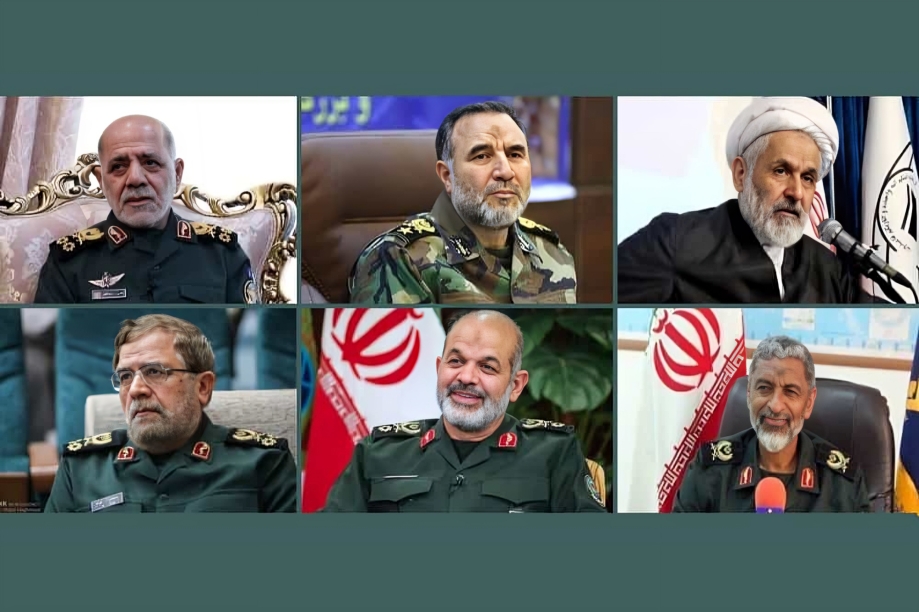
The appointment of veteran IRGC commanders to senior military and security posts has fueled speculation about a broader reconfiguration of power amid an unfinished war.
On the evening of Monday, August 10, Seyyed Mojtaba Khamenei, leader of the Islamic Republic, issued a series of decrees appointing six new commanders to head the Armed Forces General Staff, the Islamic Revolutionary Guard Corps (IRGC), and the Basij. Ali Abdollahi was appointed chief of the Armed Forces General Staff; Kioumars Heydari, his deputy; Ahmad Vahidi, commander-in-chief of the IRGC; Mostafa Izadi, deputy commander-in-chief of the IRGC; Ali Ozmaei, commander of the IRGC Navy; and Hossein Taeb, head of the Basij Organization.
The changes follow the deaths of several senior military commanders. The new decrees explicitly cite the deaths of Abdolrahim Mousavi, Mohammad Pakpour, Gholamreza Soleimani, and Alireza Tangsiri as the reason for appointing their successors.
At the same time, President Masoud Pezeshkian appointed Mohsen Rezaei secretary of the Supreme National Security Council. Rezaei will also serve as the Supreme Leader’s representative on the council. He replaces Mohammad Bagher Zolghadr, whose departure had been preceded by reports of disagreements over whether he should remain in office.
Ali Abdollahi: From IRGC Command to the Head of the Armed Forces General Staff
Ali Abdollahi is a veteran IRGC commander who served during the Iran-Iraq War. From 1987 to 1991, he commanded the IRGC’s 16th Quds Division of Gilan. He later served as chief of staff of the IRGC Ground Forces and as deputy commander of the IRGC Air Force.
In the 2000s, Abdollahi moved into the Islamic Republic’s law-enforcement and executive structures, serving as coordinating deputy and deputy commander of the Law Enforcement Force. Under President Mahmoud Ahmadinejad, he also served as governor of Semnan and later of Gilan Province.
Since 2016, Abdollahi had served as coordinating deputy of the Armed Forces General Staff. In 2025, following the deaths of the previous commanders of the Khatam al-Anbiya Central Headquarters, he was appointed commander of that body. He has now moved from that position to become chief of the Armed Forces General Staff.
The Khatam al-Anbiya Central Headquarters is Iran’s principal operational command center during wartime. Abdollahi’s move from commanding this headquarters to heading the General Staff therefore takes him from a key operational position to the highest level of military command in the Islamic Republic.
Ahmad Vahidi: Former Quds Force Commander Takes Charge of the IRGC
Ahmad Vahidi is another veteran figure within the Revolutionary Guard. He joined the IRGC in 1980 and worked within its intelligence apparatus during the Iran-Iraq War. From 1988 to 1997, Vahidi commanded the IRGC’s Quds Force, after which he held a number of positions within the Defense Ministry.
Under Mahmoud Ahmadinejad, he served as defense minister from 2009 to 2013. Under Ebrahim Raisi, he was interior minister from 2021 to 2024. Before his latest appointment, he had also served for a period as deputy commander-in-chief of the IRGC.
Vahidi’s name has also been associated with the 1994 bombing of the AMIA Jewish community center in Buenos Aires. Argentine judicial authorities have accused him of involvement in the case, and in 2007 he was placed on Interpol’s Red Notice list. Vahidi and the Islamic Republic have denied the allegations.
Vahidi’s appointment at the head of the IRGC, after decades in some of the most important military, security, and government positions, returns him to one of the Islamic Republic’s main centers of decision-making.
Mostafa Izadi: Former Commander of the IRGC Ground Forces
Mostafa Izadi is also a veteran IRGC commander who served during the Iran-Iraq War. From 1989 to 1992, he commanded the IRGC Ground Forces and later held several positions within the Armed Forces General Staff.
Before his latest appointment, Izadi served as deputy for strategic affairs and command oversight at the Armed Forces General Staff. In 2016, he was also appointed commander of the Cyber and New Threats Headquarters within the Khatam al-Anbiya Central Headquarters.
Izadi has now been appointed deputy commander-in-chief of the IRGC under Vahidi. Both men have decades of experience in the Guard’s command structure and in the armed forces’ strategic headquarters.
Hossein Taeb: Intelligence Veteran Returns to Lead the Basij
Hossein Taeb’s appointment carries particular security and political significance. Taeb has previously served as deputy head of IRGC intelligence, head of IRGC counterintelligence, and commander of the Basij Resistance Force. He became Basij commander in 2008 and left the post in 2009, amid the protests following the presidential election, to take charge of the newly established IRGC Intelligence Organization.
Taeb headed the IRGC Intelligence Organization for more than 13 years, from its establishment in 2009 until 2022. His removal that year was one of the most significant changes at the top of the Guard’s intelligence apparatus. He subsequently served as an adviser to the IRGC commander-in-chief.
He has now returned to lead the Basij, an organization that, beyond its military and paramilitary structure, maintains an extensive network of local and social forces throughout Iran. Taeb’s appointment decree also emphasizes expanding local intelligence networks and strengthening the training and organization of Basij forces.
Ali Ozmaei: New Commander of the IRGC Navy
Ali Ozmaei is a veteran IRGC Navy commander with extensive experience in the Persian Gulf. Before taking command of the entire IRGC Navy, he served as deputy commander of the force’s First Naval District and, from 2012, as commander of the newly established Fifth Naval District.
Ozmaei commanded the Fifth Naval District for approximately 13 years, overseeing an area that includes parts of the Persian Gulf and the three disputed islands—Abu Musa, Greater Tunb and Lesser Tunb, which are controlled by Iran and claimed by the United Arab Emirates. In 2025, he was appointed deputy commander of the IRGC Navy and, following the death of Alireza Tangsiri in the recent war, emerged as the leading candidate to succeed him.
Ozmaei, who has spent much of his command career in the Persian Gulf and Strait of Hormuz region, is now commander-in-chief of the IRGC Navy.
Kioumars Heydari: Former Commander of the Army Ground Forces
Unlike most of the newly appointed commanders, Kioumars Heydari does not come from the Revolutionary Guard. He is a senior commander in the regular Iranian Army. During the Iran-Iraq War, he served in the Army Ground Forces. After the war, he held positions including commander of the Ground Forces’ Southern Headquarters, deputy for operations, coordinating deputy, and deputy commander of the Ground Forces.
Heydari commanded the Army Ground Forces from 2016 until December 2025, when he left the position. He has now been appointed deputy chief of the Armed Forces General Staff.
In March 2021, Heydari told the website of the Supreme Leader’s office that the Army Ground Forces had participated in what he called the “January 2019 unrest.” That date does not correspond to the main waves of nationwide protest during that period, and it remains unclear whether he was referring to the December 2017–January 2018 protests, the protests of August 2018, or another event.
Mohsen Rezaei and the Change at the Supreme National Security Council
Alongside the military appointments, Mohsen Rezaei’s appointment as secretary of the Supreme National Security Council is also significant. Rezaei belongs to the first generation of IRGC commanders and served as commander-in-chief of the Guard from 1981 to 1989. After leaving the IRGC command, he entered the political establishment, serving for many years as secretary of the Expediency Council and running several times for president.
Rezaei now replaces Mohammad Bagher Zolghadr at the Supreme National Security Council.
Before Rezaei’s appointment was officially announced, Mohammad Bagher Kharrazi, a cleric and secretary-general of Hezbollah-e Iran, said in a video that Zolghadr was being removed and replaced by Rezaei.
In the same remarks, Kharrazi not only reported the change in leadership at the Supreme National Security Council but also made claims concerning Seyyed Mojtaba Khamenei’s position and internal disputes within the power structure.
A Broader Reconfiguration—or Simply Replacing Commanders Killed in the War?
The timing of these changes, and particularly the placement of several veteran IRGC commanders at the head of military and security institutions, has fueled speculation about a broader reconfiguration of power after the war.
On the one hand, a significant share of these appointments can be explained by the immediate need to replace commanders killed during the conflict. On the other, the selection of figures such as Vahidi, Izadi, and Taeb—all with long careers in the IRGC’s security and command apparatus—alongside Rezaei’s appointment to the Supreme National Security Council, has fueled speculation that the changes amount to more than routine administrative replacements.
Ali Gholhaki, a media activist regarded as close to circles surrounding Hossein Taeb, wrote before the military changes were officially announced that further decrees concerning the armed forces would follow the change in leadership at the Supreme National Security Council. He claimed that Rezaei’s appointment had been under consideration for some time but that disagreements within the government had delayed its implementation.
The composition of the new appointments is nevertheless striking: the Armed Forces General Staff has been placed under a veteran IRGC commander; command of the IRGC has gone to one of the institution’s oldest commanders; his deputy is another senior figure from the wartime generation; the Basij has been handed to the former head of the IRGC Intelligence Organization; and, at the same time, another veteran Guard commander has returned as secretary of the Supreme National Security Council.
This configuration may point to an effort by the state to rapidly rebuild its chain of command after the severe losses sustained by its military leadership. Whether the appointments are simply a response to wartime conditions or part of a broader reconfiguration of power within the Islamic Republic, however, remains unclear.