

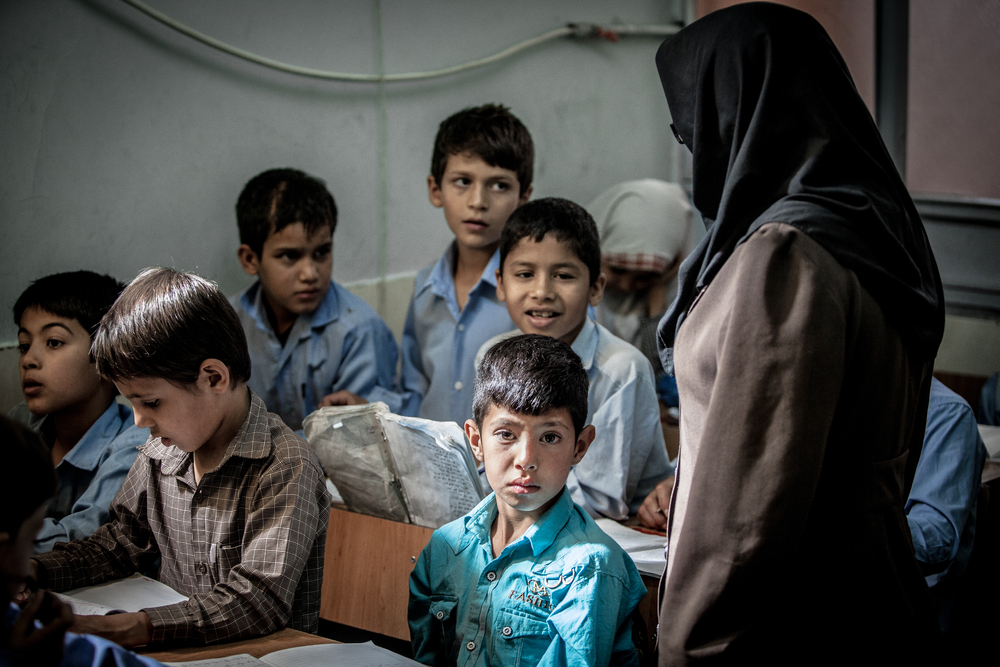
As Iranian classrooms reopen for a new school year, tens of thousands of Afghan children are missing—barred by new regulations, shuttered community schools, and a climate of fear fueled by mass deportations. Once able to enroll with temporary permits or through grassroots initiatives, many now face locked doors, threats of arrest, or expulsion to a country they barely know. This crackdown not only violates Iran’s own child protection laws but also pushes children into labor, poverty, and isolation—building walls of exclusion that may last far longer than any classroom ever stood.
As the new school year begins in Iran, classrooms once again fill with students—except for tens of thousands of Afghan children who, until last year, shared those very desks. Their absence this year is no accident. It reflects both the deepening social discrimination against Afghan immigrants and refugees—intensified in the aftermath of the recent 12-day war—and a deliberate policy shift by Iranian authorities aimed at restricting their access to education.
Over the past months, the Ministry of Education has issued directives barring NGOs and grassroots schools from teaching so-called “undocumented children.” Afghan volunteer teachers, many of whom had taught for years without pay, have been threatened with legal action if they continue. Meanwhile, new bureaucratic barriers—such as the now-mandatory “hologram card” and the elimination of temporary enrollment permits—have made registering children in public schools nearly impossible. Some of these families have lived in Iran for generations, yet each year they face the same uncertainty: will their children be allowed to go to school or not?
The result is a systematic exclusion that leaves thousands of children out of classrooms every year, pushing them into child labor, social isolation, and a future defined by marginalization rather than opportunity.
Legal Restrictions, Bureaucratic Barriers, and the Fear of Deportation
Until last year, Afghan families could register their children using a variety of documents, including temporary census slips or family passports. Some schools even admitted children without formal papers if parents signed a letter of commitment. That door—once partially open—has now been firmly shut.
In 2024, the Ministry of Education handed over control of school enrollment for foreign nationals to the Ministry of Interior, introducing a multi-stage registration process: first, obtaining an appointment through an online system; then securing a referral letter from government offices known as Kafalat centers; and finally approaching schools with approved IDs such as electronic visas or foreign national ID cards.
Anything short of this is rejected. One mother from Tehran described her experience:
“I have an Amayesh card—a temporary residence permit issued to Afghan refugees—and even a family passport. But the school told me the registration system was closed and there was no capacity. My child cries every day because he can’t go back to school this year.”
Some schools have gone even further, openly refusing to register Afghan children regardless of documentation. As one principal reportedly told parents:
“Even if the Ministry sends a directive, we will not register Afghans.”
This hardline approach feeds a growing climate of fear. Many parents worry that approaching schools or government offices might expose them to deportation orders. As one Afghan father put it:
“They sent us from one school to another, and in the end, nobody accepted our children. How can I tell my son to study when every door is shut?”
Their fears are not unfounded. According to Tehran’s governor, Mohammad Sadegh Motamedian, Iranian authorities expelled nearly 1.4 million Afghans in the first half of 2025, including 450,000 from Tehran province. A second wave of deportations, officials say, is already planned. For many families, the risk of being torn apart now hangs over something as basic as enrolling a child in school.
Silencing Civil Society and Closing the Last Doors
For years, grassroots organizations and community-run schools offered a lifeline to Afghan children barred from the public education system. Now, these final avenues for learning are being shut down.
Parisa Pouyan, head of the Child Labour Institute, explained that the Ministry of Education has explicitly ordered NGOs to halt all teaching activities, declaring that “education is the sole responsibility of the state.” Even Afghan volunteers—many of whom taught for free in informal schools—have been threatened with prosecution if they continue their work.
In several neighborhoods around Tehran, long-standing community schools that once served as safe havens for excluded children have already been forced to close. One volunteer teacher described the situation bluntly:
“Last year, these children studied here with census slips. Now they tell us we have no right to teach them. It feels deliberate, as if they want these children erased from the classroom altogether.”
Human Impact: Children Left Behind
The consequences go far beyond education. For many Afghan children, school was the only place where they felt part of Iranian society. Closing that door deepens the sense of exclusion and discrimination, shaping not only their future but also the social fabric of Iran itself.
As one grassroots teacher put it:
“School is the only stable bridge between these children and the host community. When you destroy that bridge, you widen the gap of discrimination for years to come.”
Social researchers warn that educational exclusion fuels cycles of poverty, child labor, and long-term psychological harm. Fatemeh Moghaddasi, a social policy expert, explained:
“Removing children from classrooms reproduces poverty, pushes them into child labor, and isolates them into ethnic enclaves, cutting them off from any sense of belonging.”
Some stories are devastating. One family with four children—grades 11, 7, and 4, plus one already pushed out of school—reported that only the oldest was conditionally accepted because of good grades. The younger siblings were rejected outright.
Others have been deported after years of education in Iran. A 12-year-old girl, born and raised in Iran, was expelled to Afghanistan despite never having seen the country before. A few months ago, an 18-year-old student attempted suicide after receiving a deportation order. She survived, but was eventually forced to leave Iran—a life and education abruptly cut short.
Deportations and the Politics of Exclusion
The crackdown on education has unfolded alongside mass deportations of Afghan migrants. Since early 2025, Iranian authorities claim to have expelled more than 1.4 million Afghans, with another wave of deportations already planned. Officials argue these expulsions will free up housing and classroom space for Iranians—claims flatly contradicted by both statistics and reality.
Tehran’s governor even boasted that 3,000 classrooms were “freed” after deportations, though education officials have never confirmed such figures. In fact, in many areas around Tehran and other cities, Afghan children made up an estimated 50 to 60 percent of classroom populations. Today, after the expulsions, the seats sit empty while thousands of children wander without access to education—a stark reminder that this policy neither eases overcrowding nor benefits Iranian students.
What it does reveal is a broader political agenda: the scapegoating of Afghan migrants amid economic crisis, rising authoritarianism, and an escalating assault on civil society.
A Future at Risk
Even Iran’s own Attorney General admitted last year that denying education to children, regardless of nationality, violates the country’s Child Protection Law. Yet the state continues to erode access to schooling—one regulation, one directive, one closed classroom at a time.
For Afghan children, the cost is immediate and devastating: lost education, fractured childhoods, forced labor, deportation, and social isolation. For Iranian society, the long-term cost may prove even greater—an entrenched system of exclusion that deepens inequality, fuels resentment, and divides communities for generations to come.
As one teacher put it simply:
“When you shut the school door on a child, you are building walls that will last far longer than any classroom.”