

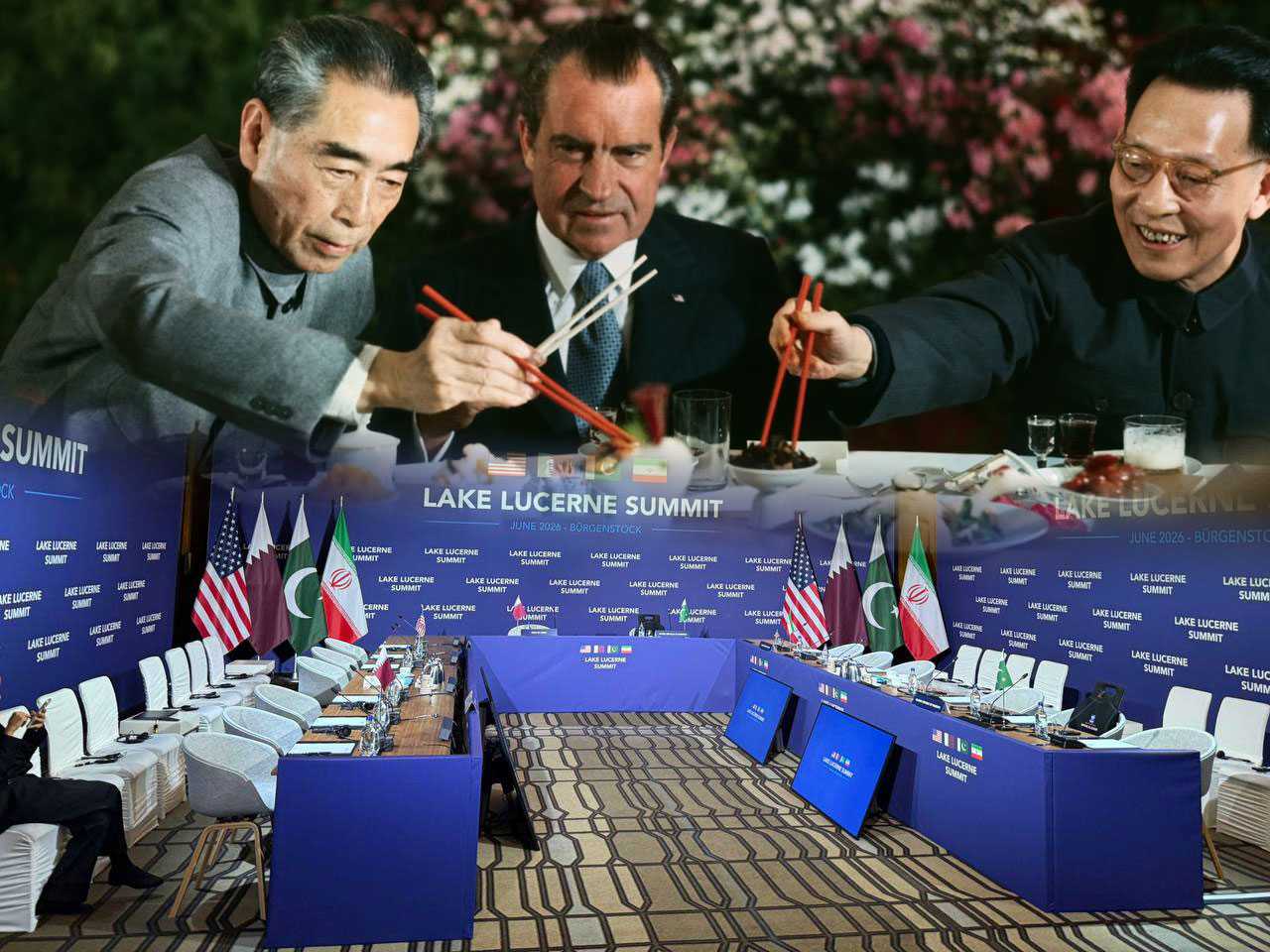
Can Washington repeat its Cold War opening to China with Iran — trading decades of enmity for security coexistence in order to focus on Beijing?
The United States was once willing to establish a form of strategic coexistence with a country it had, only a few years earlier, regarded as part of the “global communist threat.” Why? Because there was a greater enemy: the Soviet Union. Can twenty-first-century America reproduce a different version of that logic and embrace a state it once branded part of the “axis of evil”?
In July 1971, the reporters accompanying Henry Kissinger on his official trip to Pakistan thought that Richard Nixon’s national security adviser had come to Islamabad to meet Pakistani officials. Suddenly, it was announced that he had fallen ill during the trip and would spend a few days resting at a mountain retreat. But the “illness” was only a cover for one of the most important secret missions of the twentieth century. Kissinger quietly boarded a Pakistani aircraft and flew to Beijing. There, he met Chinese Premier Zhou Enlai, laying the groundwork for the greatest geopolitical turn of the Cold War.
The world learned of the trip only when Richard Nixon announced in a televised address that Kissinger had been in Beijing and that, at the invitation of China’s leaders, he himself would travel there the following year.
Fifty-five years later, Pakistan is once again appearing in the background of a major diplomatic effort — this time not to bring Washington and Beijing closer, but to find a path toward coexistence between Iran and the United States. Could these negotiations mark the beginning of a strategic turn? Could Washington apply the same logic it once used to distance China from the Soviet Union, this time to calm the Middle East and focus on containing China?
For now, Tehran, more than Washington, has entered the talks in Switzerland with the posture of the “winning side.” At the same time, J.D. Vance, Trump’s vice president, and other members of the U.S. team tried to present an optimistic image of the negotiations to reporters, speaking of the beginning of a new chapter after the signing of the 14-point memorandum of understanding. Vance even claimed that the Iranian delegation had not paused the talks at all — as if everything were proceeding perfectly.
These symbolic maneuvers show that, for the Iranian side, the question of “external image” matters greatly. The image it seeks to project is meant to refute Trump’s early-war call for “unconditional surrender” during the 39-day war and to create the ground for “negotiations on equal footing.”
But this “equal negotiation” is not limited to symbols or the framing of television images. Both sides have described reaching a “comprehensive agreement” as their ultimate objective. In other words, what is supposed to be built in Switzerland, in Vance’s words, is a “new security architecture for the Middle East.” According to Vance, its foundations were laid on Sunday, 21 June 2026, during negotiations with Mohammad-Bagher Ghalibaf.
This is a major claim. Even the JCPOA, with its complex two years of negotiations, never made such a claim. In fact, it was precisely the distance from such a point, and the abundance of sources of tension between Washington and Tehran, that led the JCPOA to be tested as a “small agreement for bigger steps.” It was, of course, a failed test. Why? Because the disputes between Tehran and Washington were not limited to one or two issues, and the actors involved in this chronic confrontation were numerous and diverse.
“Equal negotiations” for a “comprehensive agreement” between Iran and the United States come with requirements. The most important is that both sides must arrive with genuinely full hands and be ready to bargain over things they had, until yesterday, called “non-negotiable.”
Up to this point, the theatrics, symbolic gestures, and displays of toughness mattered. From this point onward, however, they must be put aside. Both sides must prepare themselves to find credible answers to extraordinarily difficult questions.
Security Fusion, Not Nuclear Fusion
If this memorandum of understanding is to become a durable agreement that transforms Iran–U.S. relations, the two sides will need more than a nuclear deal. They will need some form of mutually recognized security arrangement — a managed coexistence between hostile camps.
We should not forget that the spirit of the 14-point memorandum underlying the current negotiations is not simply the end of war or the resolution of the nuclear file. If we read the text’s ambiguous layers strategically, the two sides are in fact testing the possibility of a form of coexistence: an America that, at the end of the road, is expected to dismantle a large part of the intertwined architecture of hostility and sanctions built over the past four decades; and Iran, for its part, would be expected to come to terms, in practice, with a power it has defined as the enemy throughout the history of the Islamic Republic.
The text of the memorandum does not name Israel. It uses the phrase “U.S. allies.” But everyone — including politicians in Tehran and Tel Aviv — knows what this phrase really means. If this process succeeds, it will mean that the Islamic Republic, Hezbollah in Lebanon, Ansar Allah in Yemen, and aligned groups in Iraq on one side, and the United States and its regional ally Israel on the other, will ultimately have to accept one another as existing realities and live with that fact.
Strikingly, in the very first clause of the memorandum, Washington and Tehran clarify their spheres of influence and effectively treat the other actors in this war as extensions of their own power. There is nothing new about describing militia groups aligned with the Islamic Republic as proxies. But treating Israel, even implicitly, as an extension of U.S. power is politically significant.
This may be the most important part of the memorandum. But diplomatic understandings without enforcement mechanisms are little more than empty words. Unless this “big idea” is translated into a set of specific political and security arrangements, no agreement will endure.
If the final agreement is only about uranium enrichment and provides no answer to the question of security coexistence, it will collapse again with the first regional crisis. For this reason, any comprehensive agreement would need what diplomats call a “modality”: a concrete framework of implementation stages, timelines, guarantees, and verification mechanisms that gradually make such coexistence possible. Sworn enemies are not going to become willing partners overnight.
A “New China” for America?
Is there a precedent for moving from hostility to security coexistence? Yes: China.
In simplified accounts of contemporary Chinese history, it is often said that Deng Xiaoping decided to open China’s doors to the world, and that the new China was born from that decision. But this is not the whole story. The birth of the new China was not simply the product of Deng Xiaoping’s will. The geopolitical conditions and necessities of the Cold War played a decisive role — perhaps an even more decisive one than Deng’s will.
After a series of ideological, territorial, and border tensions between China and the Soviet Union in the 1960s, Washington came to believe it could use this split to contain its main rival. In July 1971, Henry Kissinger, Richard Nixon’s national security adviser, secretly entered Beijing to prepare the ground for the normalization of relations between the two countries. Pakistan was the hidden actor in that journey.
A year later, in February 1972, U.S. President Richard Nixon made his historic visit to China and met Mao Zedong and Zhou Enlai. The trip produced one of the most important geopolitical turns of the twentieth century.
Washington’s goal in this shift was not a sudden fondness for China’s communist system. It was to exploit the deep rift between Beijing and Moscow and create a new balance against the Soviet Union.
The Nixon Doctrine did not simply mean reducing direct U.S. military intervention. In practice, it formed part of a broader rearrangement of world politics. Washington accepted that, in order to contain the Soviet Union, it had to come to terms with communist China. The result of this strategic bargain was that the path gradually opened for China’s integration into the global economy. Capital, technology, export markets, and access to the world economy became available to Beijing, and China, in return, became a counterweight to the Soviet Union.
Put simply, the United States was willing to establish a form of strategic coexistence with a country it had, only a few years earlier, regarded as part of the “global communist threat.” Why? Because there was a greater enemy: the Soviet Union.
The question is whether twenty-first-century America can reproduce a different version of that same logic and embrace a state it once branded part of the “axis of evil.”
For several years, the United States has described China as the greatest long-term threat to its national security. Washington needs more focus, more resources, and greater freedom of action in order to compete with Beijing. From this perspective, a Middle East constantly caught in crisis, war, and tension with Iran is an obstacle to America’s main strategic priority.
This gives force to the possibility that, after testing and discovering that Iran cannot be collapsed at low cost, Washington may be willing to consider a larger bargain with Tehran in order to calm the Middle East. In such a bargain, a durable reduction of hostility with Iran would create more room for the United States to focus on competition with China.
Of course, any one-to-one comparison between what happened with China in the 1970s and 1980s and Iran today faces serious difficulties.
First and most importantly, China in the 1970s had effectively distanced itself from the Soviet Union and had become a potential partner for the United States. Iran today, by contrast, has extensive relations with both China and Russia, and part of its national security strategy rests on those relations.
Second, China under Nixon had begun a specific project of economic development and was ready to absorb capital and technology and integrate into the global economy. The Islamic Republic, by contrast, still lacks a clear consensus over many of the requirements of such integration.
Third, Washington in the 1970s did not ask China to surrender its entire security architecture. In Iran’s case, however, a major part of the dispute is precisely over that security architecture: from the nuclear program to missile capabilities, regional networks, and Tehran’s role in Lebanon, Iraq, and Yemen.
For this reason, even if the United States wants to move toward some kind of larger agreement, one fundamental question remains: in exchange for abandoning or limiting parts of the Islamic Republic’s security architecture, what credible and durable alternative will be offered to Tehran?
Whether or not an answer can be found to this question will determine the fate of the Bürgenstock negotiations and all subsequent talks.
The success of these negotiations does not depend on agreement over the number of centrifuges, or even on the scale of sanctions relief. They will succeed only if the two sides can find a credible formula for a form of security coexistence — one that can replace four decades of hostility and shape a new order in relations among Iran, the United States, and the region.
If the United States has entered Bürgenstock with a Nixon–Kissinger logic — seeking a strategic realignment with a former enemy — and if Iran is prepared to accept the modalities of a major security turn, then we may be witnessing a historic moment. Otherwise, the agreement whose foundations Vance says have already been laid will be no more than a brief pause in the U.S.–Iran war.