Low-cost drones and missiles are eroding the U.S.-led maritime order, allowing smaller actors to threaten chokepoints and global trade.
The roughly 16-hour exchange of fire between Iran and Israel on Monday, 8 June 2026, was the most important military confrontation between the two sides since the ceasefire was established. This short and limited clash once again drew the world’s attention to one of the most sensitive geopolitical spaces on earth: maritime chokepoints.
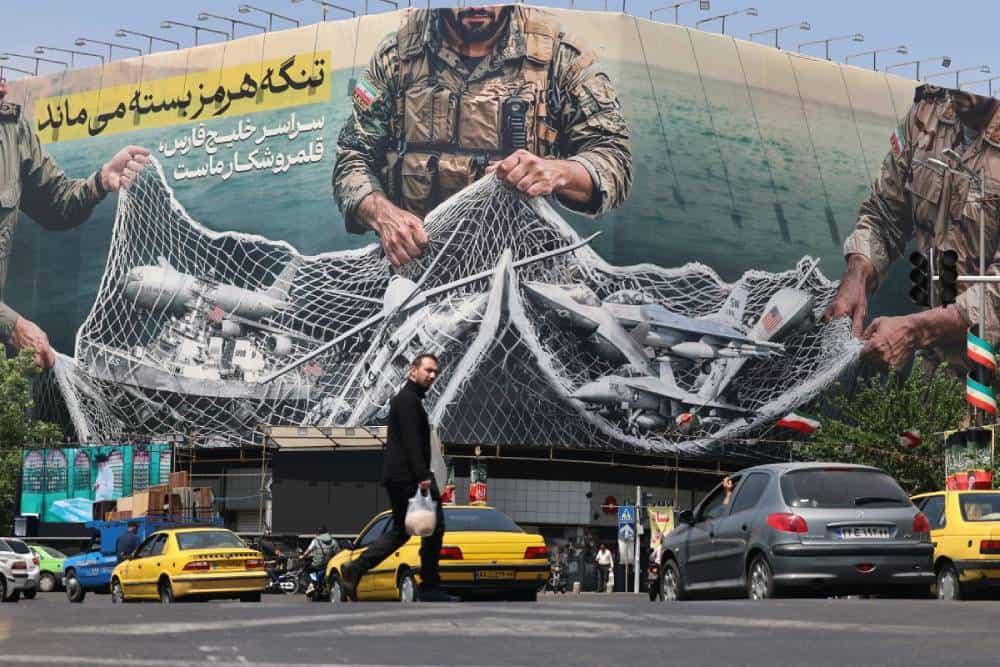
Officials of the Islamic Republic once again spoke of the possibility of broader disruption to maritime traffic in the Strait of Hormuz. On the other side, Yemen’s Houthis announced that Israeli-linked ships would be banned from passing through the Red Sea and Bab al-Mandab, and that they would target such vessels.
What we see today in Hormuz, Bab al-Mandab, the Red Sea, and even the waters around Taiwan points to a deeper transformation in the world order; a transformation that some analysts, including Isaac Kardon, a senior fellow at the Carnegie Endowment, see as the beginning of the end of the era of “American command of the seas.”
Does this sound exaggerated? Perhaps a small image of what has already happened is enough to disprove the charge of exaggeration: a cheap drone in the hands of a militia group, or a short-range missile in the hands of a state under bombardment, can tighten its grip around the throat of the global economy.
In such a situation, America’s ability to target a specific missile site, ship, speedboat, or one-way attack drone at enormous cost loses its fundamental significance. The question, then, must be asked: does Washington still have the capacity to preserve the global maritime order as it did in previous decades?
Eighty Years of Commanding the Seas
After the end of the Second World War, the United States became the main pillar of the international maritime order. International law, maritime treaties, and the extensive presence of the U.S. Navy allowed commercial ships to pass through the world’s most important sea routes under the cover of vast American fleets.
Why do maritime routes, and who polices them, matter? Around 80 percent of global trade is carried by sea, and that trade rests on the assumption that the main maritime routes will remain open. Naturally, the country that can guarantee that these sea routes remain open gains the upper hand in the equations of global power.
Over this 80-year period, the United States, with its aircraft carriers, nuclear submarines, space-based communications networks, and numerous military bases, effectively served as the guarantor of freedom of navigation. Many countries, of course, did not pay a direct cost for this global order, but the United States benefited so much from the privileges of its uncontested rule over sea routes that the costs were worth bearing.
But what is now unfolding in the Persian Gulf, the Red Sea, and slightly farther north in the Black Sea shows that this model faces a major challenge, one that could very quickly spread to other parts of the world.
Forget States: Even Small Actors Can Do It
After 7 October 2023 and the beginning of the Gaza war, a small preview of this situation appeared. From late 2023, Yemen’s Houthis, by attacking ships in the Red Sea and Bab al-Mandab, showed that a non-state actor could disrupt one of the most important arteries of global trade. Major shipping companies were forced to change their routes away from the Suez Canal and Bab al-Mandab and sail thousands of kilometres farther around the Cape of Good Hope in southern Africa. This rerouting increased global transport costs and lengthened delivery times.
The important point is that the Houthis did not need an advanced naval fleet or missiles worth hundreds of millions of dollars to create such disruption. Relatively cheap drones and missiles were able to squeeze the throat of one of the world’s most important trade routes.
Cheap and accessible drone and missile technologies, together with the difficulty of countering them, have given all kinds of actors the ability to adopt a policy of “disrupt in order to gain leverage” whenever they choose. Bullying and threats of destruction have long ceased to be the exclusive property of great powers or regional powers. A small group with cheap equipment can also threaten the United States, Israel, the European Union, and corporations worth hundreds of billions of dollars. More importantly, such threats can be both credible and feasible, and their effects painful and large. Coercion, too, has been democratised.
Hormuz: The Chokepoint That Worries the World
If Bab al-Mandab matters for trade between Asia and Europe, the Strait of Hormuz is vital for the global energy market. Around one-fifth of global oil consumption passes through this route. Or rather, perhaps one should say: passed. In recent days, as traffic through the Strait of Hormuz has increased, officials of the Islamic Republic have once again spoken about the possibility of its complete closure. Every time tensions reach Hormuz, global markets tremble. This is what makes the threat credible — and its consequences painful.
For decades, the dominant assumption was that if Iran, or any other actor, tried to close the Strait of Hormuz, the U.S. Navy would intervene quickly, either alone or by forming a global coalition, and reopen the route. But the experience of the 39-day war showed that the matter is not so simple. Forming a global coalition aside, even if the United States can escort ships, the economic and military costs of such an operation would be enormous. On what scale? On a scale that would make even the United States hesitate. We can already see an example of this in the Strait of Hormuz. Iran disrupted traffic in the strait, but the United States did not step into the trap. Instead of entering the chokepoint to escort ships, thereby exposing its military assets to drones and missiles that can be launched even from the back of a pickup truck, the United States kept its distance and imposed a naval blockade around the wider area. So far, the main purpose of this blockade has been symbolic: to show that Washington still claims command over the maritime order. But does it really?
The Economy of War Has Changed
Perhaps the most important reason for this transformation is the changing economy of war. Today, an armed group can obtain an attack drone for a few thousand dollars. But to intercept that same drone, the United States may have to fire a missile worth millions. This enormous cost gap has gradually made the traditional model of maritime defence inefficient.
In the case of the Houthis, reports show that the United States has spent billions of dollars protecting ships and countering attacks, while the attackers have used systems that are far cheaper. Under such conditions, even if the United States maintains military superiority, it finds itself in a more difficult economic position.
This has not been tested only in the Middle East. Ukraine has also been a theatre for displaying this transformation. One of the most important lessons of the war in Ukraine, the Red Sea clashes, and Middle Eastern crises has been that threatening maritime routes no longer requires a vast fleet. Long-range drones, cruise missiles, and mobile land-based systems can target ships from hundreds or even thousands of kilometres away.
The rules that were once shaped by the range of coastal artillery have now undergone a major revision because of — or perhaps because of the curse of — modern technologies: “artillery” has become cheaper, and the “range of artillery” has expanded from a few kilometres to hundreds, even thousands, of kilometres. A pickup truck in the middle of a desert or plain, 700 kilometres from a strait or major transit port, can carry a 10,000-dollar drone whose launch sends tremors through the global economy in the stock exchanges of London, Frankfurt, and New York. This transformation has made controlling maritime chokepoints far more difficult for major powers than in the past.
It Is Not Only Hormuz and Bab al-Mandab
Although global attention is currently focused on the Persian Gulf and the Red Sea, this trend is not limited to these two regions.
In the Taiwan Strait, Chinese military exercises and pressure have created serious concerns about semiconductor supply chains. In the Baltic Sea, sabotage against cables and undersea infrastructure has become a security issue. In the Black Sea, Ukraine, without possessing a large naval fleet, has been able to damage Russia’s fleet through drones and cheaper technologies.
All these examples carry a common message: the cost of disrupting maritime trade has fallen sharply.
China also occupies a special position in this picture. Unlike Iran or the Houthis, Beijing is not seeking “survival” or “leverage” by directly closing maritime routes. China’s strategy is focused more on limiting its rivals’ access to specific regions, especially the western Pacific. Over the past two decades, China has developed a range of short-range and medium-range missiles, submarines, and surveillance systems whose main purpose is to make U.S. military presence near China’s coasts more difficult.
But more important than China’s military power is its economic power. More than half of the world’s commercial ships are built in Chinese shipyards, and the country possesses the world’s largest network of commercial ports. Today, China exerts its power over global trade less through warships than through supply chains, manufacturing industries, and economic influence.
For this reason, some analysts believe that Beijing does not necessarily need a major naval war to challenge America’s position. It is enough for it to be able to disrupt global trade, or steer it in the direction it wants.
The End of the “Free Seas”?
Taken together, these developments have led some experts to speak of the emergence of a new era: one in which free passage across the seas can no longer be taken for granted. In this scenario, every maritime chokepoint may come to have its own rules. Shipping companies will be forced to calculate not only fuel and insurance costs, but also the political risk of each route.
Ships may need military escorts to pass through certain areas, or they may have to pay additional security costs. Some routes may be temporarily or permanently abandoned, and global trade may become more fragmented than before.
Of course, the United States still has the most powerful navy in the world. But the issue today is no longer military power alone. Cheap technologies, non-state actors, asymmetric warfare, commercial satellite networks, and the economic power of countries such as China have changed the rules of the game.
For this reason, perhaps the most important question of the coming decade is not who rules the seas, but whether anyone can still rule them as they once did. In a world where a militia group in Yemen, or a state under U.S. and Israeli bombardment, can easily and at low cost effectively challenge the order of the open seas and the rules of maritime power, something major has changed. Current events cannot be properly understood through the lens of the post-World War II order. We must say farewell to the old order and prepare for a turbulent period of the formation and consolidation of a new one. How much tension and chaos are we talking about? Far more than what we are currently seeing in Iran and Ukraine.