

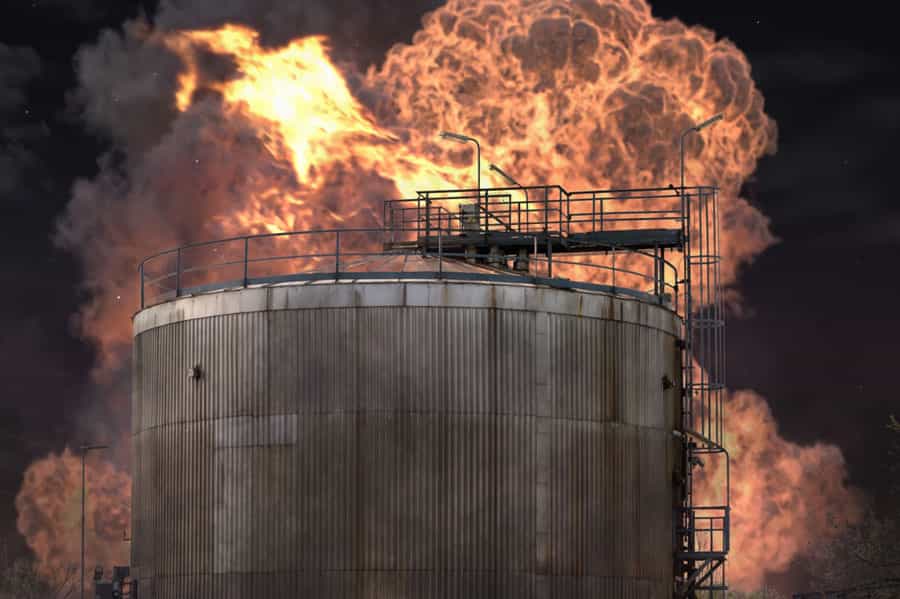
US-Israel attacks on industrial infrastructure may have damaged toxic-waste facilities, threatening groundwater and exposing marginalized rural communities to long-term public-health risks.
Following recent attacks on some of Iran’s industrial and energy infrastructure, concerns have grown over possible damage to facilities storing chemical waste and the leakage of pollutants into groundwater resources. This issue could have serious and long-term consequences for public health, especially in marginalized and rural areas that depend on wells for drinking water.
With the ceasefire and the temporary halt to attacks on industrial infrastructure, especially steel and metal complexes, signs of a new crisis emerging in the subsurface layers have begun to appear. The targeting of these sites may not have been limited to physical destruction. There are serious concerns that chemical-waste ponds and industrial sludge basins belonging to these factories may have been damaged, allowing toxic substances to seep into underground water. If such a scenario has occurred, residents of marginalized areas and surrounding villages who obtain their drinking water directly from these sources will face the greatest risk.
Damaged Infrastructure and the Risk of Water-Source Contamination
Although precise and verified information is not available about the scale of the damage or exactly which sites were targeted, what is known so far indicates that a number of refineries, military facilities, and nuclear sites were struck. Such centers may contain hazardous chemicals and waste that, if storage infrastructure is damaged, can leak pollutants and threaten both surface water and groundwater resources.
The most important damaged infrastructure and sites that could affect water resources include:
Steel and Metal Facilities: Mobarakeh Steel in Isfahan and Khuzestan Steel
According to reports in domestic media, these complexes were targeted on March 27 and 28, 2026, and parts of their infrastructure, including energy facilities and some industrial units, were damaged. If wastewater ponds or sedimentation basins were destroyed or damaged, heavy metals such as chromium, lead, and cadmium could leak into the soil and groundwater tables, contaminating drinking-water sources in marginalized areas.
Petrochemical Facilities: Mahshahr and Asaluyeh
According to ILNA, the Iranian Labour News Agency, during several rounds of attacks from early to mid-April 2026, critical energy-supply infrastructure in these areas was targeted, leading to the shutdown of more than 80 percent of the country’s petrochemical production capacity.
More specifically, parts of the Mahshahr complexes were damaged on April 4, 2026. Further attacks on units such as Amir Kabir Petrochemical were also reported on April 7 and 8, 2026.
In these attacks, power-supply units, including Fajr and Mobin Energy, were targeted and taken offline, causing a widespread production shutdown.
Under such conditions, even if all production units were not directly destroyed, the collapse of energy infrastructure can increase the risk of chemical leakage and water-source contamination.
Chemical Storage Facilities, Including Shamsabad Industrial Town
Multiple reports have circulated on social media and in some unofficial sources about these areas being targeted, but these claims have not yet been independently verified. If the reports are accurate, the destruction of such warehouses could release toxic runoff and high-energy compounds into the environment, creating a risk of soil and water contamination.
Missile Silos and Facilities: Khojir and Semnan
Reports have also appeared in the media and on social networks about these areas, but precise and verified information on the extent and timing of the damage during this period is not available. If these facilities were damaged, the presence of highly toxic fuels such as UDMH, or unsymmetrical dimethylhydrazine, a highly toxic rocket fuel, could mean that rainfall washes these substances toward qanats and underground aquifers.
Wastewater Leakage and Its Possible Scope
In the crisis conditions following the attacks, access to precise official field data is often limited. However, some satellite assessments and evaluations by environmental monitoring organizations, such as the Conflict and Environment Observatory, or CEOBS, suggest that wastewater-storage infrastructure in large complexes, including sites linked to the steel industry, may have suffered structural damage.
Rouzbeh Eskandari, an environmental researcher, considers the leakage of industrial toxins into groundwater during the recent war to be plausible. He tells Zamaneh:
If wastewater ponds or storage infrastructure have sustained serious damage, pollutant leakage is entirely possible and can move through the soil into groundwater tables, especially if protective layers have been destroyed.
Evaporation ponds and basins containing acidic and chemical sludge may lose their floor insulation if exposed to blast vibrations or direct destruction. Given the permeability of soil in the arid and semi-arid regions of the Iranian plateau, these toxic runoffs could move quickly toward shallow aquifers.
Which Heavy Metals Threaten the Water?
Wastewater from steel mills and metal industries is a mixture of some of the most dangerous chemical elements. If this wastewater enters groundwater, the main threats include hexavalent chromium, Cr(VI), used in electroplating and anti-corrosion processes, which is extremely hazardous and highly soluble, allowing it to move rapidly through water; lead, Pb, produced through ore smelting and alloying, which is highly dangerous and can settle in pipes and soil; cadmium, Cd, generated by zinc-refining and steel processes, which is extremely hazardous and remains in the environment for a long time; arsenic, As, present as an impurity in ore, with both acute and chronic toxicity; and mercury, Hg, released from control equipment and industrial fossil fuels, which can transform into highly toxic methylmercury.
Rouzbeh Eskandari says:
Heavy metals such as lead, cadmium, chromium, and nickel are usually present in these wastewaters. Because of their high persistence, they remain in the environment and do not easily break down.
According to this researcher, the speed at which these pollutants reach drinking-water sources depends on the region’s geology, ground conditions, and soil mechanics:
In sandy and permeable soils, pollutants can reach groundwater tables or aquifers in a much shorter period, whereas in clay soils this process is slower.
Why Are We Not Seeing Symptoms Now?
This crisis is called a “silent disaster” because, due to the way heavy metals act in the human body and in nature, and unlike microbial contamination that immediately causes illness, heavy metals bioaccumulate. This means the human body cannot effectively eliminate these metals; over time, they are stored in fatty tissues, bones, and the liver.
Depending on the level of contamination, clinical symptoms may take several months, several years, or even a decade or more to appear. This delay means diseases may only be detected after significant damage has already been done to the body’s organs, making it difficult to identify the original source.
Rouzbeh Eskandari says:
Consuming water contaminated with heavy metals and industrial compounds can have very serious consequences, from short-term symptoms such as nausea, digestive problems, skin conditions, and acute poisoning to long-term effects. The accumulation of heavy metals in the body can have very severe consequences, including kidney and liver damage, neurological disorders—which are especially dangerous in children—and an increased risk of certain cancers, whose symptoms may appear years later.
Is It Too Late for Preventive Action?
It may already be somewhat late to prevent the initial seepage of toxins into the soil. However, measures can still be taken to reduce human exposure, and the focus must now shift to crisis management and harm reduction.
Initial measures include temporarily ending dependence on local wells in high-risk areas and providing alternative water supplies until water quality has been tested, as well as continuous monitoring and sampling of aquifers to trace possible contamination. In the long term, however, advanced filtration systems capable of removing heavy metals will be necessary. Finally, public-health monitoring and periodic testing are needed for the early detection of heavy-metal contamination.
Rouzbeh Eskandari says in this regard:
Groundwater must be sampled immediately, and independent and transparent monitoring must also take place.
According to Eskandari, the full cleanup of groundwater is extremely time-consuming and costly. It may even take years for water quality to return to its original condition.
The expert says the volume of the leakage is very important, as are the type of pollutants and the hydrogeological characteristics of the area. Nevertheless, expert assessment and more precise information require transparent data, and access to this information is in the hands of the government.
Marginalized areas that were already struggling with infrastructural deprivation could, in such a scenario, find themselves on the front line of an ecological crisis. If no action is taken to isolate the drinking-water sources of these areas, human and medical costs are likely to rise in the future.