

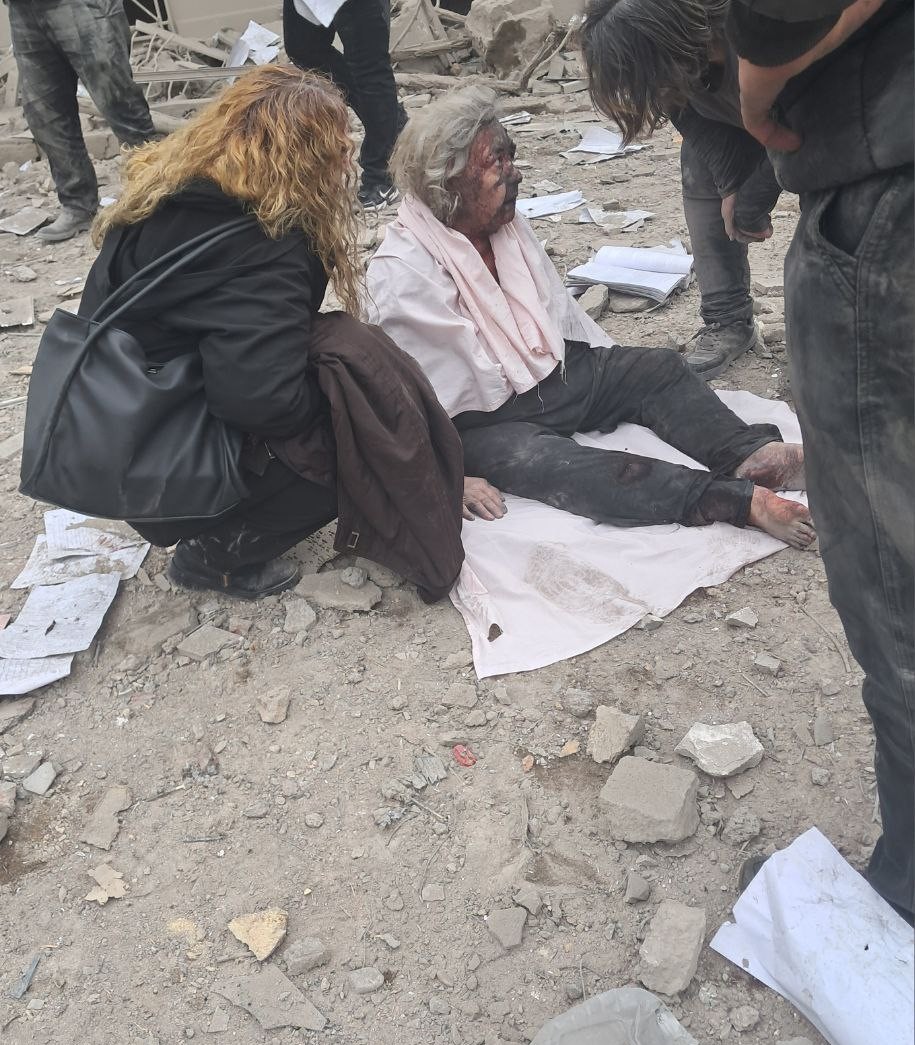
A postwar political transition will not guarantee a better future for women unless their demands are explicitly named and placed at the center.
This article seeks, through field interviews conducted before the war and by comparing them with what may happen to women’s civil movements after the war, to show how war and violence can affect civil movements inside Iran, and women’s agency in particular. This report draws on interviews with several women who have lived in Iran and taken part both in the “Woman, Life, Freedom” movement and in the January uprising. They were asked various questions, but the main one was this: what impact did the “Woman, Life, Freedom” movement have on their everyday lives, and to what extent did it help them reclaim their rights in later movements? I also seek, through these interviews and by comparing them with what may happen to the question of women and feminism in Iran after the war, to focus more directly on this issue. The names have been changed for security reasons.
Narratives of Liberation: Reclaiming Everyday Life, Step by Step
In the first layer of the interviews, what clearly emerges is the flourishing of individual agency that spilled into the public sphere. I asked Sara how much the “Woman, Life, Freedom” movement had affected her daily life. Sara says this became a major force in her life; after the uprising, she was able to play a more visible role in society, felt more confident in her workplace, no longer feared compulsory hijab or the workplace security apparatus, and even appeared without hijab in many places. Sara believes “Woman, Life, Freedom” made women stronger than before; even women in their forties and fifties were far more present in this movement than in earlier uprisings. In her view, the movement affected both women’s personal lives and their social lives, encouraging them to bring change into society.
Maryam sees the movement’s impact in the very texture of her personal life. She says she was able to free herself from all social restraints, and that many things no longer mattered to her. For Maryam, this was not merely a movement of “no to compulsory hijab,” but a “no” to the imposition of many other social compulsions enforced by the state. She says women had become much stronger than before and were looking for a way to reclaim their freedom and independence in Iran’s patriarchal society; for her, life in such a society became bound up with the liberating force of this movement.
Hadis, too, told me:
“In my personal life, I became more confident. Now I think people look at women differently; they understand that women’s independence and freedom in society make possible the independence and freedom of society as a whole.”
She says that we women were the ones who began this path, and that the movement encouraged us to participate, even with our families, in later uprisings. One of the Gen Z girls, Maral, also says:
“I was younger then, but later I understood its meaning within my family through my mother and older sister. We wanted, as individuals in society, to come into the streets against the misogynistic state.”
For all of these women, the civil movement “Woman, Life, Freedom” was the main catalyst in both personal and social life. But what happened after the January uprising, and with the growing threat of war—a possible American and Israeli attack on Iran—could affect the agency of women who, by defying the machinery of the state, had made their independence a priority.
Militarism: How War Pushes Agency Back
One of the main dynamics at work in the question of women and war, and one that feminists often criticize, is the suppression of women’s agency. In civil movements, women are agents of change, but under wartime conditions this agency can be turned into its opposite. In totalitarian states, political mechanisms of misogynistic control can suppress that agency even more easily.
For Cynthia Enloe, war is not merely a political instrument; it also reproduces a particular kind of “aggressive masculinity.” In this structure, the soldier-hero is recognized as the symbol of power and agency, one largely defined in masculine terms, while woman is represented as a being who is “passive, weak, and in need of protection.”
This binary pushes women’s voices to the margins, because society comes to imagine that vital decisions must be made by those who possess “military power.” Military power on the one hand, and the suppression of women on the other, push women aside under the pretext that war takes precedence. The question of women is no longer treated as a priority, and women lose the agency to change their own condition, because the first priority becomes the “homeland” and its defense—even if the question of women must be sacrificed to that ideology. This loss of agency is reproduced across the workplace, the home, and society at large, and women who had won agency before the war are confronted once again with marginalization.
The Rollback of Civil Movements and the Suspension of Rights
The second issue is the rollback of civil movements. In wartime, the dominant discourse changes, and civil demands, under the slogan of “preserving survival,” are cast as luxuries. When war and violence lead to the expansion of coercive ideologies, women’s movements are among the first victims. This rollback takes place through pressure on social spaces, under the pretext of ideological domination and the empowerment of hardline forces. The immense achievement of “Woman, Life, Freedom,” amid violence and in the tension between ideology and women’s liberation, is placed in danger.
The connection between war and rollback is one of the bitterest realities in the contemporary history of the Middle East. War is not merely the destruction of infrastructure; it also produces a return to premodern values and the suppression of achievements for which people have struggled for decades. Any structural critique is repressed under the label of “weakening national morale” or “treason,” and laws meant to advance gender equality are suspended. Women who had struggled to free themselves from guardianship may, because of the wartime atmosphere, be pushed back to their earlier condition, and women’s bodies become an ideological battleground in the process.
The Female Body: An Ideological Battleground and a Tool of Propaganda
In war, women’s bodies become a battleground between extremist groups and nationalist spectacle. On the one hand, women’s bodies are displayed as symbols of a supposedly liberating national struggle; similar to what we have seen in Iranian media, where unveiled women speaking of war and homeland are shown in order to suggest that in the national struggle hijab is no longer the issue. This is a national battle that stages itself through the representation of women, whether veiled or unveiled, on state media.
Many feminist analysts believe that in totalitarian systems, a woman’s body does not belong to herself. Nayereh Tohidi writes:
“Ideological regimes see the female body as a political billboard. When they need to display their ‘virtue,’ they make the chador compulsory; and when they need to show the world that they are ‘popular’ and ‘plural,’ they bring those same unveiled bodies to the front row of the cameras. This is the repurposing of an instrument of repression into an instrument of propaganda.”
The repression of women’s bodies as a tool of ideological display reaches its peak in war, and the female body becomes a vehicle for the display of state ideology—unlike in the “Woman, Life, Freedom” movement, where women’s bodies possessed their own agency and were not instrumentalized.
The War Economy and Women: Pushed Out of the Labor Market
War has a devastating economic impact on women. When women are secure, they can play an important role in the economy; just as, after the “Woman, Life, Freedom” uprising, many women became successful entrepreneurs. But in wartime, the first negative impact falls on women’s employment and entrepreneurship. Valentine Moghadam believes that militarism is the main rival to women’s employment; as military budgets rise, job opportunities in public sectors contract, the economy becomes more masculinized, and women are pushed into the lower and informal layers of the economy.
The militarization of society damages women’s active presence in the economy and in society as a whole. Cynthia Enloe believes that the war economy would collapse without the exploitation of women’s invisible labor. She says:
“Wars are fed by the forced return of women to kitchens and by turning domestic labor into the fuel of the war machine. The war economy replaces destroyed public services with women’s unpaid labor.”
Iranian women, who had managed to play a role even within the country’s damaged economy, lose that influence under wartime conditions, and postwar reconstruction too is usually carried out while ignoring women as consequential members of society.
The Day After Violence
Iranian women have shown that even under repression, they can preserve their agency in the economy and in society. Their presence in male-dominated jobs was a sign of forward movement. But with the onset of war, civil movements carry the potential for rollback, and the question of women is once again pushed to the margins. War and violence—whether imposed by the Iranian state or by foreign forces—cannot have a positive impact on women’s lives.
It has been argued that perhaps the removal of the regime can be achieved only through war, though there is no guarantee even of that. But so long as women’s demands are not explicitly articulated, there can be no hope in the day after war. A better tomorrow, emerging from repeated violence, does not guarantee a better life for women. The only solution is to see women’s condition, to take it seriously, and to place their demands among the other demands on the table; otherwise, women will once again find themselves in the very margin they have spent years struggling to escape.