

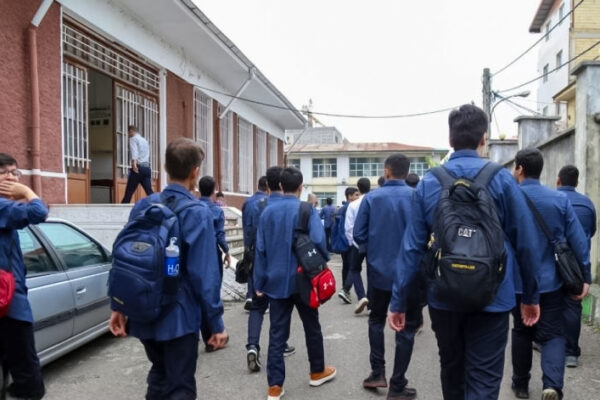
Amid protest, repression, and war, how do Iranian adolescents understand and endure their world? This dialogue portrays a generation still searching for meaning, future, and a way forward, while redefining itself and the world around it amid the collapse of formal education.
A dialogue on the recent socio-political, emotional, and educational experiences of adolescents in Iran
Our dialogue began in 2024, bringing together Shirin Vossoughi, an Iranian scholar of education living and working in the United States, and Darvish, a pseudonym for an Iranian educator and psychologist who has worked with young people ages 13 to 22 in Iran. Our conversations have broadly focused on how best to support youth in navigating the range of challenges they face in the Iranian context, and on thinking together about questions of design, learning, and well-being within complex political, economic, and social conditions. Given the relatively limited attention to Iranian children and young people’s experiences in coverage of the December 2025–January 2026 protests and the U.S.-Israeli war on Iran that began on February 28, we decided to share some of our discussion more broadly in the form of an interview. Darvish has been living outside Iran for several months.
Although our interview builds on Darvish’s conversations with many adolescents from diverse cultural, economic, and ideological backgrounds across different cities in Iran, it is important to state that it is not necessarily generalizable to all adolescents in the country, nor do we attempt to create a representative portrait. In addition to sharing young people’s experiences, we also find it important to share Darvish’s own perspectives as an educator and psychologist.
Moreover, since the beginning of the protests in Dey 1404 (December 2025–January 2026), we have witnessed major and consequential events almost every day, which can undoubtedly influence the content of this interview as well. In short, even now, we do not attempt to place a final period at the end of this conversation. New events continue to occur, and conditions may change again by tomorrow.
S: Can you share a bit about your experiences working with adolescents in Iran, as well as your areas of focus?
D: I began my work about 15 years ago. I started out as a secondary school teacher and later worked as a psychologist in schools and psychological clinics. Fortunately, my experience has not been limited to a single city. Over the years, I have been in contact with many young people from different cities across Iran, including those from diverse cultural, gender, social, and economic backgrounds, and with varying beliefs. Throughout this work, I have been able to observe young people’s engagement in different settings, including school, the street, family environments, and peer groups.
Many hours of my life have been spent talking with youth, whether in counseling rooms, walking together in the streets, or in schools. My approach to communicating with adolescents is not limited to verbal conversation or formal therapy rooms. Sometimes we walk together; sometimes, when they do not feel like talking, we draw, play, or read books. In other moments, we engage in group activities such as discussions, games, watching films, or other shared experiences.
Overall, my goal is to empower adolescents and help them enter the next stages of their lives with awareness. I believe that, unlike adults, who may need therapeutic spaces for various reasons and for whom my role is defined as a psychotherapist, the place for this age group is not the therapy room. Rather, any meaningful change, including improving their emotional well-being, should take place within their school, family, or peer group. This approach has led me, in working with adolescents, to become not only a psychotherapist, but first and foremost a thoughtful, trustworthy friend—someone they can rely on.
S: Given the social and political events of the last few years in Iran, what are some key moments that feel important from your perspective with regard to young people’s experiences and well-being?
D: One of the most critical turning points in my work with this group was the beginning of the Mahsa (Jina) movement, also known as the Woman, Life, Freedom movement. Those labeled as “adolescents” demonstrated in the streets that they had broken free from earlier definitions that confined them within age limits or specific social and gender roles: being under 18, being only a student, or conforming to notions of the “good boy” or “good girl,” which also sharply distinguished boys from girls.
We witnessed scenes such as a school student who, until then, was expected to sit behind a desk, attend school, and spend their time studying and doing homework, now taking part in revolutionary protest; or a boy tying his long hair, inspired by a girl beside him in the street; or a boy wearing nail polish or accessories once labeled feminine. Likewise, girls cut their hair in traditionally masculine styles or adopted behaviors and clothing previously considered masculine. All of this showed that the old definitions no longer worked. If those earlier definitions were meant to define adolescence, these young people effectively shattered them and created their own new meanings.
In my view, the key to the December 2025–January 2026 protests can be traced back to September–October 2022, during the height of the Mahsa (Jina) movement. From that point on, everything changed. The courage of this group to take to the streets was formed there, as if they had long been waiting for such a moment. They found their voice in schools and, in many cases, became more comfortable saying “no” to the systems they directly face, such as the traditional education system and, in some cases, the family structure.
For example, one day a 17-year-old boy told me: “How is it possible that my parents studied within this system, and I have to do the same? Aren’t they from generations before me? How has this system not changed? I want to study something in school that helps me make money quickly—through things like financial markets or YouTube. My father wanted to become an engineer; I don’t. My needs aren’t being met. I don’t want to go to school.”
In the years following the start of the Woman, Life, Freedom movement, adolescents not only continued the revolutionary events of that time, but also witnessed their families becoming poorer day by day. The role of money in their lives became increasingly significant. As their awareness grew, they became more conscious of the inefficiencies of the traditional educational system they were dealing with. Gradually, this awareness extended to the broader system of governance, and their act of saying “no” became more widespread.
Approximately 200 of those killed in the January 2026 protests were school-age students—a number equivalent to an entire school.
S: From your perspective as a psychologist, how have children and young people been affected by the January massacre? What do you notice around their sense-making of these events and the impacts on their well-being?
D: During my conversations with this group after the protests and killings of January, one of the most striking things I noticed was a sense of passivity and helplessness, a kind of complete numbness. Many were no longer attending school or university, had left their jobs, and were no longer meeting with friends. It seemed that long before these protests, a deep sense of hopelessness, disconnection, and lack of attachment to a desired future had already taken shape within them. The protests appeared to be an attempt to open a door toward a more hopeful future, to break out of that inertia.
As is widely known, these protests began with rising prices and the soaring cost of currency, which in turn shrank people’s livelihoods. Months before the January protests, when I spoke with various youth, nearly all of them were in some way preoccupied with financial concerns. One was looking for a job, another for investment opportunities, another complained about rising costs that had cut them off from many recreational activities, and others were trying to earn money to emigrate. Their imagined futures were deeply tied to economic issues and money, so much so that the severe inflation, which peaked in January, dealt a final blow to those hopes and visions.
When I asked those who had taken to the streets during the protests why they did so, a common theme emerged in their answers: reclaiming a future they felt had been taken from them. Many conveyed that they felt they had nothing left to lose, and in many cases, I deeply understood how they were feeling. For example, an 18-year-old girl studying music, whose family struggled financially and had migrated years earlier to a major city, and who had not been able to take the university entrance exam that year, told me: “I go to the streets and I’m not afraid of being killed. They killed me the day they stopped me from playing music on the street and banned my work. If things stay like this, it makes no difference to me whether I’m alive or dead.” She went to the streets, and two of her friends were killed before her eyes.
In all of this, the role of families in shaping how young people interpret their situation cannot be ignored. What parents say and do these days, what news they follow, and how they themselves are affected—all of this matters. Some parents were unable to manage both their own emotions and those of their children at the same time. The mother of a 14-year-old girl told me: “My husband and I are in a very bad state ourselves. We don’t know what to do. We can’t even stop our daughter from following the news, because when we are watching it, she is right there with us and inevitably sees and hears it. We can’t pretend that we are okay.”
Some families were even afraid to send their children to school. For instance, the father of a 16-year-old boy shared: “I truly don’t feel safe. I’d rather he stay home and not go to school.” Later, he told me that out of his son’s class of 29 students, 19 others had done the same.
The emotional and cognitive atmosphere within families is a significant factor in how adolescents interpret their situation, as well as in the broader sense of fear and hopelessness in society. Determining how much of this fear and despair originates from family influence and how much comes from the adolescents themselves requires further inquiry. In any case, these days are passing for this group in a state of ambiguity, anxiety, and fear of an uncertain future—a deeply distressing sense of being suspended in limbo.
S: Since the U.S.-Israeli war on Iran began on February 28, how have young people been affected?
D: All the points discussed so far relate to the protests in December 2025–January 2026. After the widespread killings that took place during that time, this sense of hopelessness became even more pervasive. Gradually, anger emerged alongside it, an intense anger directed at those seen as responsible for the violence.
Just as the ongoing war has had its supporters and opponents, similar divisions existed within this group. However, without overgeneralizing, I can say that in the early days of the war, there were quite a few adolescents who felt optimistic about it. They may not have fully realized that war does not bring democracy, and their lived experiences may not yet allow them to think about the consequences of war in a balanced way, free from emotional bias, especially amid the overwhelming flood of media narratives. Until this intensity of emotion and anger subsides, they may be unlikely to be ready to listen to differing perspectives or arguments.
If we take a step back and look at the situation more broadly: from mid-December, when the protests began, until now, in mid-spring, these adolescents have been directly and indirectly immersed in a violent environment, one that has not only endangered their bodies and lives, but has also set fire to their sense of the future. Now, exhaustion has joined that hopelessness and anger. For example, a 19-year-old boy told me: “We went to the protests with my mother. After that, we were constantly expecting war. Then the war started, and we quickly and anxiously left the city. But now, even though the war is still going on, we’ve come back home… so why isn’t it over?”
I had similar conversations with several other adolescents. A deep fatigue with the situation was evident. As one of them put it: “There’s no job, no school or university running, no internet, we can’t go out, what exactly am I supposed to do?” Perhaps most distressing of all is the fact that alongside everything they described as missing from their lives, there is also no clear end to this situation. It is unclear when it will end, or how.
The war has added another layer of exhaustion to the existing hopelessness. I do not believe nothing can be done, but rather that a young person who has lived through these days, and experienced a rapid succession of overwhelming emotions, now needs clear, grounded, and convincing visions of the future in order to believe in it again. This group has tremendous potential and ideas for how to shape society, and I hope we see a day when they can more fully express these ideas.
S: Could you share with us young people’s current educational experiences and how recent events have affected their schooling?
D: After the Mahsa (Jina) movement, I witnessed a kind of “political adolescence” in schools. Teenagers, as I mentioned before, had learned new ways of saying “no” to various systems of authority. Traditional school methods, such as expulsion or punishment, no longer functioned as they once did. By comparison, this is quite distinct from my generation of students.
From the beginning of the Woman, Life, Freedom movement up until the December 2025–January 2026 protests, something was constantly forming and evolving, eventually reaching its peak after the January 2026 protests. As you know, January is the time of first-term final exams. Many students did not attend their exams, and others said they showed up but were unprepared.
In the days that followed, especially in February, before the war began, I heard many reports of students engaging in political discussions at school, putting up flags, chanting slogans, and even, in some cases, refusing to attend school altogether. After the January protests and the killing of 200 students, many teachers reported that students lit candles in schools or symbolically left desks empty. These are examples of adolescent political action, where a lesson that feels irrelevant to their lives is no longer a priority. The destructive impact of the war, combined with the already ineffective traditional education system, reinforced this shift and further reduced the importance of schooling, at least for now.
Many schools were also forced to close temporarily during these events. At the same time, repeated internet outages made it impossible for many to hold online classes. Even where online learning was possible, many students were not motivated to attend. This academic year created a major gap in the educational progress of all students: unfinished lessons, teachers unable to complete their curricula, and students unable to prepare for university entrance exams.
There are several important questions I find myself thinking about these days: after the war, what kind of students will we actually face in schools? Will they return to sit at the same desks they once shared with their friends? Or will we encounter entirely different individuals, shaped by the January protests and the war? Will it still be possible to talk to them about things like equations, variables, acceleration, and so on? Or will we need to talk to them about life instead?
S: There is a lot of conversation among Iranians today around hope and despair. How do you think about our responsibilities to young people’s need for hope and their connection with the future at a time when some are peddling false hope, and many Iranians continue to struggle for just futures in seemingly impossible circumstances?
D: One of the common questions I ask almost all the young people I speak with is: “How did you spend your day?” I am not necessarily looking for simple daily routines in their answers. There is something deeper hidden in this question: the desire for an ordinary life, and the faint hope that remains for looking toward the future. Since we are talking about the future, let me propose a hypothesis: the meaning of the word “future” in this group’s language is not necessarily the same as it is for those we call adults. That is why we cannot easily make precise or definitive judgments about their future. The best approach is to search for it within their own words.
These days, asking about the “future” is very challenging, because there are fewer and fewer grounds for someone to give a clear, logical, or hopeful answer. For example, recently I was speaking with an 18-year-old boy from Tehran, a 12th-grade student whose final exam year has coincided with these conditions. He was talking about the coming year, about becoming a university student, his interests, and even his possible plans for migration. I was listening when suddenly there was a loud sound: boom. The explosion was so intense that I could hear it through the phone. He fell silent, laughed, and said: “Never mind for now.”
There have been many similar moments recently, almost as if this group does not yet have the space to think carefully and systematically about the future. This is understandable given their current state of uncertainty, when students do not know when they will return to school or university, or what will happen with the war. They should not be put under pressure.
Yet even in these critical conditions, where attention is focused on the “present,” fortunately the path of imagination and dreaming about the future remains open. The crucial ability to envision still exists. Thinking about the future in a definite, structured way may be nearly impossible right now, but imagining and visualizing is not only possible; it may even be necessary and helpful.
One of our most important responsibilities is to keep alive the possibility of imagination—hopeful imagination directed toward the future—as much and as carefully as possible, without being constrained by current conditions. For example, one of my successful experiences was speaking with a 17-year-old girl who, despite being overwhelmed by numerous personal and family problems, and the despair imposed by the war, became a little more alive when she imagined herself five years into the future: where she would live, her financial situation, her lifestyle, without worrying about how exactly she would get there.
What we are trying to do is expand the boundaries of possibility. For now, we do not want to shut down this path of imagination with rigid, logical “how-to” thinking, especially since such thinking is inevitably shaped by current conditions. At the same time, it is important to note that this is not “false hope,” because in many cases, it is precisely these imaginations that create the path forward.
A person who falls into crisis becomes cognitively more prone to various distortions. It is natural for their perception to narrow. One of the most effective and important things we can do is to remind them of the endpoint of this situation: throughout human life, there have always been crises, but all of them have an expiration date and eventually come to an end. We know that despite all the suffering and destruction this war has brought, it will one day end, and things will not remain like this forever. Even though they are experiencing these harsh events at a younger and more sensitive age, youth can benefit from knowing that this painful situation has an endpoint, even if it is unknown, and that they may live some of the best decades of their lives after these crises. These reminders can create a real point of anticipation for them.
One day, I was talking with a 15-year-old boy who is an athlete. He had developed a knee problem, and some doctors advised surgery while others recommended against it. During our conversation, he said: “If I have surgery today, I might not be able to play for six to ten months. But I know and I’m certain that this period of ‘not playing’ will lead to a much longer period of playing without pain or fear.”
He had come to understand that one approach is to become absorbed in the painful days of recovery and see them as endless, focusing only on “not playing.” Another approach is to look toward the time after the pain ends, a real, not illusory point, and see the current situation as temporary. Notice that he says this independently of any political stance or position on the war. His perspective is entirely about the end of turmoil, the end of a pain that has begun.
One of the most important strategies we teach as psychologists is to focus on what we can control and influence, rather than what lies beyond our control. Therefore, another way to help this group is to help them identify the areas where they do have control. These days, we are faced with a group that carries a great deal of pain and many regrets, but the path of imagination is not closed to them. Reminding them of this is our responsibility.
S: What guidance do you think is important to share with families and caregivers working to support children and young people in the face of such layered trauma?
D: When you interact closely with individuals from this age group, you realize that one of their most common and important complaints is feeling misunderstood. Their needs are often assumed in advance rather than expressed in their own words. They do not feel heard. Recently, more than a few months after the war began, I finally managed, with difficulty, to speak to a 19-year-old boy. He told me: “It felt so good just to be able to talk. That alone is enough.”
These days, we need to let young people speak. Let them release their emotions. These are people who feel their future has been destroyed, who feel hopeless. Maybe through talking, they can find some emotional relief. Maybe their minds will become more open.
Group, non-virtual activities—such as gatherings, games, and life-related conversations that can create some breathing room from discussions of politics and war for a time—as well as individual activities, can help keep them grounded. Embodied activities such as walking, and quieter activities such as reading or spending real, present time with family, can help keep them alive in a very meaningful sense.
One 18-year-old girl told me: “When we hear fighter jets now, we don’t take cover like before. We don’t move away from the windows. Sometimes we don’t even wake up. It feels like we’re practicing dying every day. But these days, being able to spend more time with my mother, since there’s no internet, or talk with my grandmother—I’ve just remembered that I have a mother, I have a family… I can stay alive.”
Her mother had no idea about her daughter’s feeling of “daily dying.” She may not have realized how life-giving these simple daily conversations were, conversations that did not exist before because of social media distractions and the busyness of everyday life.
And yet, there are parents who struggle to provide this for their children during these days, because they themselves are not doing well. The situation is so complex that it is hard to say definitively that they are doing something wrong. Perhaps the first group of parents is going above and beyond what can reasonably be expected in these circumstances. And perhaps these moments of shared living, presence, and dialogue can help sustain everyone in the family. This is also a question I think about a lot these days, one that still does not have a clear answer.