

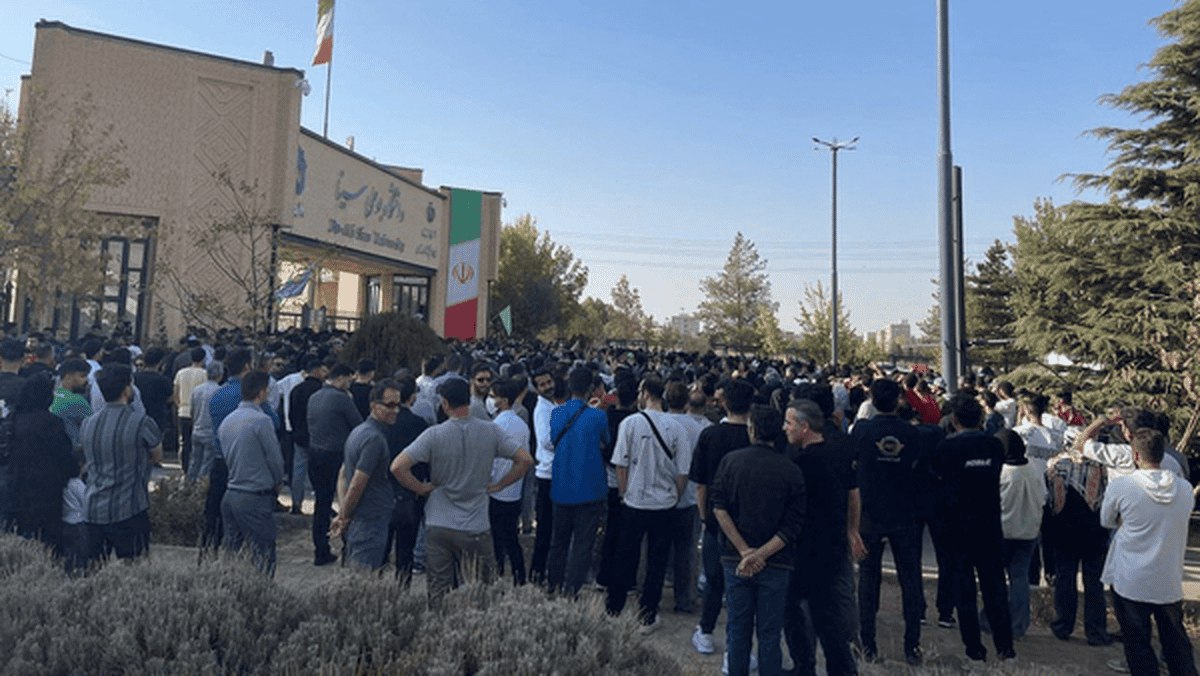
At Bu-Ali Sina University, students protest alleged harassment by Iraqi classmates, scholarships tied to Iraq’s Popular Mobilization Forces, and campus militarization—demanding transparency, safety, and academic and union freedoms.
Radiozamaneh has learned that several Iraqi students participated in messaging groups used to share class and exam information at Bu-Ali Sina University in Hamedan, western Iran. Tensions rose when some of these students—reportedly linked to Iraq’s Popular Mobilization Forces (PMF), a militia coalition supported by Iran—obtained female students’ phone numbers and sent messages proposing “temporary marriage,” a practice in Iran (known as sigheh) that allows a time-limited, contract-based union under Shia law.
While we cannot independently verify any PMF affiliation, female students filed complaints with university officials. Administrators did not act, and families stepped in, after which protests broke out on Monday in Hamedan and quickly grew, with local residents joining the students. Some domestic media described the incident as “harassment.”
In September 2024, Iran’s Minister of Science, Hossein Simayi Sarraf, announced the signing of a memorandum of understanding to provide scholarships to Iraqi students, prioritizing placement at Iran’s top universities—Tehran, Shahid Beheshti, and Sharif University of Technology. Framed as a “resistance” initiative (a reference to the so-called “axis of resistance”), the plan reportedly includes admitting members of the Iraqi Popular Mobilization Forces (Hashd al-Shaabi) to management programs at the University of Tehran without entrance exams. The minister also presented the broader recruitment of foreign students as a strategic goal and set up a special council to pursue it; more than 70,000 Iraqi students are currently studying in Iran.
The demands that go beyond the Axis of Resistance
The security-aligned Fars News Agency reported on Tuesday, October 7, 2025, that more than 200 people gathered at the university gate after “a claim of harassment by some Iraqi students” was raised. Protesters chanted slogans such as “Protection, protection!” and “Iranian student will die but will not accept humiliation.”
Hamedan’s governor, Majid Darvishi, appeared among the crowd, promising an uncompromising inquiry and disciplinary action if the claims are verified. Rokna reported that the Ministry of Science dispatched a special delegation to investigate.
While state media have sought to narrow the issue to “harassment,” and social-media commentary has focused on the students’ Iraqi identity, campus demands are broader: transparency in university governance, an end to academic censorship, and guarantees for the safety of cultural and political activities on campus.
Students also warned explicitly about security pressures, restrictions on independent associations, and sweeping interference in university affairs.
Resistance to the militarization of the university
In July 2023, activists at the University of Tehran issued a statement condemning the admission of Popular Mobilization Forces (PMF) personnel as students, rejecting the presence of any military force on campus—whether in uniform or in the classroom—and vowing to resist it.
They also criticized the university’s record of hosting “affiliated professors” and Basij paramilitaries, describing the entry of PMF forces as a “military incursion into the university.” According to the statement, authorities have hollowed out campuses by repressing, suspending, and expelling genuine students, while bringing in borrowed cadres from Iraqi militias; meanwhile, students from poor and working-class backgrounds face obstacles to entry and continuation through commodified education, a commercialized entrance exam, political quotas, mandatory hijab, and punishment for activism.
Linking these struggles to the Woman, Life, Freedom movement, the statement argued that reclaiming civil rights runs through education; at the fork of erasure or survival, passivity equals annihilation—so standing firm is the only path.
Against ethno-nationalist and reductive accounts of the student protests
At first glance, the Bu-Ali Sina protests might seem to revolve around a single moral incident. In reality, they reflect deep mistrust of macro-policies in higher education and resistance to militarization and the erosion of university autonomy.
They can also be read as a direct response to programs that gradually replace critical students with loyalist cadres—packaged as “resistance” scholarships for paramilitary groups such as Iraq’s Popular Mobilization Forces (PMF)—with the aim of breaking campus dissent from within.
The demand to address harassers was merely the spark. What followed was broader fury over censorship, security pressures, and the lack of educational justice. Reducing these complex protests to a simplistic “Iranians versus Iraqis” frame or to ethnic nationalism distorts their anti-authoritarian core, stifles wider demands, weakens social solidarity, and derails the struggle for a free, independent university.