Iran’s water crisis is becoming a public health and justice crisis, with its heaviest burdens falling on marginalized communities
In the aftermath of the recent war and amid growing geopolitical tension, Iran’s water crisis is becoming a public health and justice crisis. Renewable water resources have fallen sharply over the past half-century, sounding an alarm for food security, public health, and social equality. The crisis has pushed several provinces toward severe water stress, with the heaviest burden falling on marginalized communities, small-scale farmers, women, and children.
Mahsa Naqavi Sheikh-ol-Eslami, an environmental expert, spoke with Zamaneh about the concept of the “water exposome”: the total accumulation of environmental, social, chemical, and psychological exposures that shape human health over a lifetime. She argues that Iran’s water crisis cannot be understood only as a question of scarcity or infrastructure. It must also be understood as a crisis of environmental justice, public health, and social resilience. In conditions of geopolitical tension and postwar vulnerability, she warns, the war can multiply the crisis in unprecedented ways.
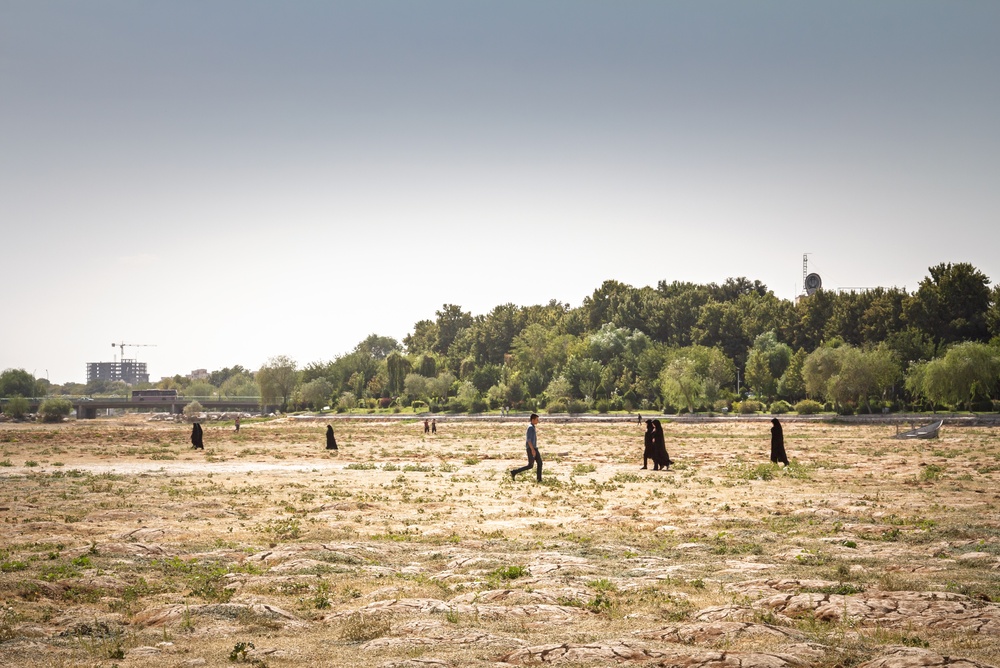
Over the past several decades, Iran’s renewable water resources have dropped by around 30 billion cubic meters, from roughly 130 billion to less than 100 billion cubic meters. This decline has been shaped by climate change, reduced rainfall, rising temperatures, excessive extraction, and the growing imbalance between supply and demand. Provinces including Razavi Khorasan, South Khorasan, Semnan, Yazd, Kerman, Sistan and Baluchestan, Isfahan, Qom, and Qazvin are now approaching severe water stress.
According to the Falkenmark indicator, a widely used measure of water stress, Iran’s per capita water availability has fallen below 1,300 cubic meters per year. At the same time, land subsidence, the drying of wetlands and rivers, and the spread of dust storms have intensified. High levels of water loss in distribution networks, estimated at 20 to 30 percent, alongside groundwater contamination, have made the crisis even more complex.
This water stress threatens not only food security and the livelihoods of farmers and local communities. It also damages public health as water quality declines through salinity, nitrates, and heavy metals, increasing the risk of gastrointestinal, skin, and respiratory diseases, and even cancer. Poorer provinces and vulnerable groups, including rural communities, women, and ethnic minorities, carry the greatest share of this burden. Unequal access to water fuels forced migration, poverty, and social tension, while exposing the failures of an unsustainable development model.
Addressing the crisis requires not only technical solutions, such as water recycling and improved monitoring, but also fair management and a transformation in patterns of consumption. Zamaneh spoke with environmental expert Mahsa Naqavi Sheikh-ol-Eslami about these questions.
Environmental Justice and the Water Exposome
At the beginning of the conversation, Mahsa Naqavi Sheikh-ol-Eslami introduced the “exposome” as the main framework for her analysis. She explained that the exposome refers to the sum of all environmental, social, and chemical exposures a person encounters from the beginning of life in the womb until death. These exposures go far beyond air pollution. They include the quality of drinking water, food, chemicals in the workplace and home, infections, medicines, social stress, poverty, and everyday lifestyle.
Naqavi Sheikh-ol-Eslami emphasized that today’s diseases, including diabetes, heart disease, cancer, and mental health disorders, are rarely caused by one factor alone. They are usually the result of long-term interactions between environmental and social conditions. Unlike traditional approaches that ask, “What is the impact of the water crisis on health?” or “Who is responsible?”, the exposome approach asks how a lifetime of exposures combine to shape human health. It is an interdisciplinary, evidence-based, health-centered approach focused on prevention.
She compared human health to a film rather than a photograph:
“Human health is more like a film than a still image. If we look at only one frame from a film, we see just a very small part of the story. But the exposome watches the whole film of a person’s life from beginning to end: all the scenes, all the characters, and all the interactions. This is the perspective that allows us to understand why some individuals and communities become ill while others remain healthy.”
After setting out this framework, Naqavi Sheikh-ol-Eslami turned to the question of social justice:
“Environmental justice is a very simple but powerful principle: no human group should bear a disproportionate share of environmental exposure simply because of its geography, social class, or gender. When we look at the water crisis through the lens of the exposome, it is not a single-factor issue. It is not only about water. It is a chain of cumulative exposures, what I call the water exposome. Let me explain how these chains take shape.”
She continued:
“When water resources decline, marginalized communities, especially vulnerable groups such as children, women, and small-scale farmers, usually have the least power to access alternative resources. This means that the water left available to them is of lower quality and contains more microbial and chemical contamination. At the same time, the drying of lakes and wetlands intensifies dust storms, which are themselves known contributors to various diseases, including respiratory illnesses, cardiovascular disease, and even some cancers. On the other hand, less water means lower agricultural production, and that means food insecurity. Small farmers whose family economies depend directly on water come under severe financial and psychological pressure.”
Naqavi Sheikh-ol-Eslami concluded that polluted water, dust, food insecurity, stress, and poverty accumulate together, placing a heavy cumulative burden on vulnerable communities.
“Social epidemiology has clearly shown that chronic stress caused by poverty and livelihood insecurity has real biological pathways, from increased stress hormones such as cortisol to chronic inflammation in the body. All of these are linked to diseases such as heart disease, diabetes, and mental health disorders. What we see, then, is that polluted water, dust, food insecurity, psychological stress, and poverty accumulate together. They are not separate components. They impose a shared cumulative burden on the bodies of more vulnerable people, especially children and women. This is why marginalized communities, even when exposed to the same water crisis, suffer disproportionately greater health damage: their cumulative exposome has already been heavier from the start.”
For this reason, she argued, water policy must move beyond purely engineering-based approaches. It should be designed around environmental justice. Every decision about water allocation should begin by asking which groups will bear the heaviest cumulative burden of exposure.
The War Exposome and the Impact of Conflict on Water and Public Health
Naqavi Sheikh-ol-Eslami also addressed the effect of armed conflict on water and public health. She referred to a recent scientific study published in February 2026 in the journal Exposome, which formally introduced the concept of the “war exposome” into scientific literature. As an environmental scientist, she explained that armed conflict anywhere in the world systematically acts as a threat multiplier for public health.
“What does this mean? It means that war rarely creates only one type of harm. Instead, it activates several exposure pathways at the same time. Each of these is dangerous on its own, but when they combine, their impact becomes far more severe. For example, damage to water-treatment infrastructure can allow contaminated water to enter household consumption directly. Damage to energy and oil facilities can also lead to oil contamination in soil and groundwater. These compounds can remain in the environment for years, and sometimes for decades.”
She added:
“Consider a child born in the future, a child who was not in the war at all and never heard the sound of fighter jets. Even so, the war exposome can affect that child’s physical, emotional, and mental health for years. In the study I mentioned earlier, research in a war-affected region of Ukraine showed that concentrations of compounds such as trihalomethanes, which are byproducts of water disinfection, had risen significantly in drinking water and remained there for years. These substances can have very harmful health consequences for society in the future.”
According to simulations cited by Naqavi Sheikh-ol-Eslami, attacks on oil-refinery facilities around Tehran could send pollutants thousands of kilometers beyond Iran’s borders, affecting neighboring countries as well. These exposures can increase respiratory disease, cardiovascular disease, and other health problems.
She concluded that environmental crisis management under conditions of geopolitical tension must not be merely reactive:
“We need advanced water and air monitoring systems that can identify these forms of pollution quickly. Critical health infrastructure, such as water-treatment plants, must remain a priority under all conditions. Mental health programs are also extremely important and should be addressed from the first days of a crisis, not only after the crisis has ended.”
Sustainable Reconstruction and Social Resilience After Water Crisis
Naqavi Sheikh-ol-Eslami argued that reconstruction after crisis must mean more than repairing physical infrastructure. From the perspective of the exposome, real reconstruction must focus on population health and social resilience. Environmental justice should be built into the earliest stages of design and planning, not added later as an afterthought.
“This means real participation by local communities, especially vulnerable communities such as children and women, in decisions about water allocation and infrastructure.”
Rather than relying only on hard infrastructure, she said, Iran must move toward nature-based solutions. One example is wetland restoration, which can act as a natural water filter while also restoring vital habitats. She also pointed to precision agriculture, using technologies such as soil-moisture sensors and smart irrigation, as a key solution that can sharply reduce water consumption and help farmers produce more with less water.
She also emphasized the importance of a circular water economy and recycling. No drop of water should be treated as waste. Household greywater and industrial wastewater, once treated, should be returned to the cycle of use. Smart monitoring technologies and early-warning systems can also prevent small problems from becoming large crises.
Naqavi Sheikh-ol-Eslami concluded that climate resilience and sustainable water governance must place the protection of the most vulnerable communities at the center. If reconstruction deepens existing inequalities, she warned, then the next public health crisis is already being built today. Real reconstruction must therefore include not only the rebuilding of infrastructure, but also the rebuilding of physical health, mental health, and social trust.
“If I were to sum up one final point at the end of this conversation, it would be this: water security, environmental protection, and public health are inseparable. From the perspective of the exposome, protecting the environment ultimately means protecting every single cell in our bodies, and protecting the health of future generations. That is why it is so important that we pay attention to it.”
This interview was conducted by Hossein Noush-Azar, who also wrote the text.