

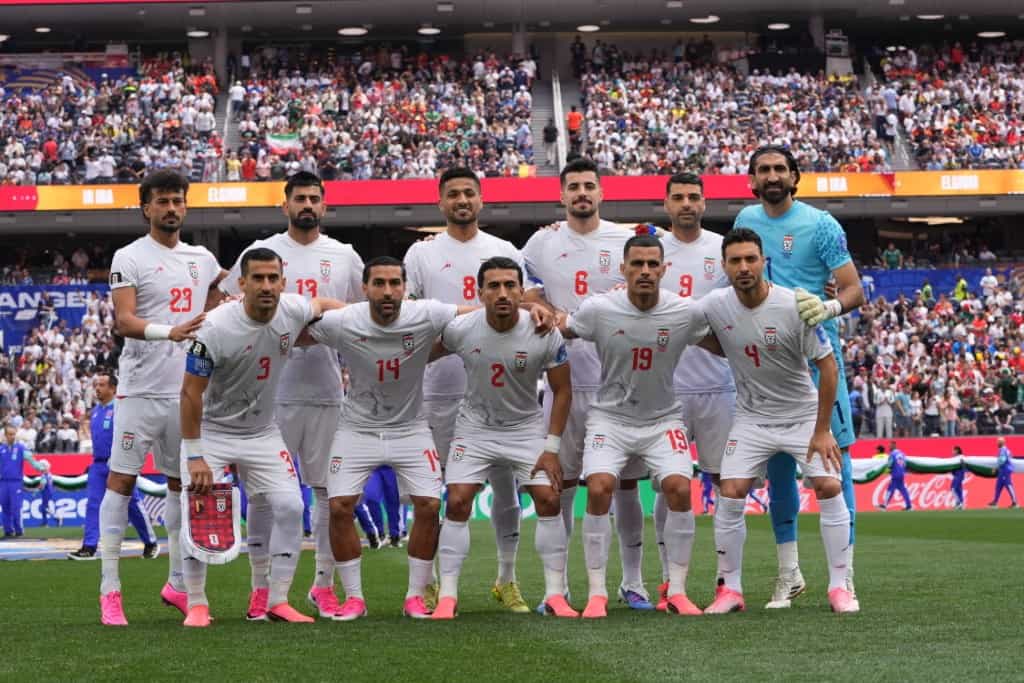
Football in Iran mirrors political fracture, where national belonging, state propaganda, exile politics, and popular joy collide.
Football in Iran has never been entirely separate from politics. But in the 2026 World Cup, this relationship reached an unusual intensity. From fans who openly wish for the national team’s defeat to opponents of the Islamic Republic who still distinguish between Iran and the state, the national team has become a mirror of the fractures and contradictions within Iranian society. This piece examines the complex relationship between football, politics, and Iranian society in one of the most turbulent periods of contemporary history.
Where Did the Story of Iran’s Men’s National Football Team in the 2026 World Cup Begin?
The story begins with a team that many Iranians had long supported, regardless of their political position. Years ago, even Iranian pop singers based in Los Angeles, such as Andy, sang in support of the team and celebrated it. But twelve years have passed since Andy sang for Iran’s football team. In these twelve years, Iranian society and the Iranian diaspora have changed profoundly.
Over this period, Iran witnessed the rise and repression of several protest movements, including the November uprising and the Woman, Life, Freedom movement, the killings during the January 2026 uprising, and two wars waged against Iran since June 2025. Many dreams burned, many ruins were produced, and the gap between people and the state deepened. Fractures also emerged among the people themselves.
The peak of all this came with the recent U.S.–Israeli war against Iran, alongside a discourse of war amplified over the past year in particular by media outlets affiliated with Israel and the United States. Again and again, a binary was repeated: either you are pro-war, or you support the regime.
Eventually, we reached a point where Iran’s men’s national football team was no longer called “Iran’s national football team” by some, but “the Islamic Republic’s team” — meaning a team seen not as representing the Iranian people, but the ruling state. Of course, this tendency to attribute everything belonging to Iran to the Islamic Republic had already been seen and heard in many other cases. For example, when the country’s industrial infrastructure was attacked, some supporters of war said: Why are you upset? These are the infrastructures of the Revolutionary Guards and the Islamic Republic.
Perhaps this same belief and attitude brought some Iranians abroad to a point where they not only wished for the defeat of Iran’s men’s national football team, but also ran after the team bus carrying the lion-and-sun flag, associated today with monarchist and pre-1979 nationalist currents, in order to humiliate the players. They even stood outside the stadium where Iran was to play New Zealand to boo Team Iran and cheer when New Zealand scored against them. Some also managed, by whatever means possible and, as they put it, “smuggled,” to bring the lion-and-sun flag into the stadium and raise it as a form of protest. FIFA had banned the flag from stadiums days earlier, allowing only the flag currently recognized as Iran’s official flag to be displayed during Iran’s matches.
On the other side, there are Iranians who support both Iran’s men’s national football team and the Islamic Republic. Inside Iran, before the team’s departure, this group gathered at night to wish the team victory. At one of these gatherings, where the players themselves were also present, a song was even performed in support of the team.
Supporters of the state abroad, meanwhile, have gone to stadiums with considerable confidence in recent days, or appeared at public screenings to cheer the team. Especially after the signing of the Iran–U.S. agreement, which many of them interpret as a defeat for the United States, this group has gained even more confidence. In the videos and images that have circulated, they appeared stronger than ever in support of Iran’s men’s national football team and raised the flag of the Islamic Republic.
Nor has this been limited to Iranians. Among non-Iranians, too, there have been people who stood with Iran’s official flag against opponents of that flag. One example was an Argentinian man who went to the stadium carrying the flag and, when Pahlavi supporters — who favor the restoration of Iran’s former monarchy — objected, told them that this was the real flag of Iran.
But there is also another group: those who support Iran’s men’s national football team and consider it Iran’s national team, not the Islamic Republic’s team. Many of them may not even have been born in Iran, but whenever Iran’s national team plays, they are ready to cheer and support it. Many do not approach football politically at all. Many others are themselves opponents of the Islamic Republic and have taken part in demonstrations in support of the people of Iran in the streets of Europe, the United States, and Canada. But for them, Iran and the Islamic Republic are not the same. In recent days, this group too has not been spared harassment, humiliation, and attacks by opponents of the national team. In some cases, they have even been questioned and judged aggressively.
Iran’s men’s national football team has not been under pressure only from the public. U.S. visa policies toward members of the Iranian team have also created problems and difficulties for them. According to Iranian officials, Iran’s football team has been staying in Mexico and is allowed to enter the United States only a few hours before each match, then must leave a few hours after the game. This has created difficult conditions that may even affect the players’ physical preparedness. Amir Ghalenoei, the national team’s head coach, described the situation as discriminatory and said that Iran’s team had truly been treated unfairly.
Some players, however, responded to these pressures differently. For example, Ramin Rezaeian, who was named man of the match after Iran’s game against New Zealand, was asked by a reporter about the humiliation directed at the team by some fans. He replied:
I do not want to talk about this. We are here to answer football questions. If there is a problem among the people of Iran, it has nothing to do with you; this is something between us.
Mehdi Taremi, too, before the start of the tournament, responded to a similar question from a reporter by stressing that Iran is bigger than any disagreement. He said Iran’s football team plays to bring joy to all Iranians, whatever their beliefs or political views.
Football, Dictatorship, and Political Ambivalence
The politicization of a national team is not unique to Iran. The historical example of Argentina has not been forgotten: the 1978 World Cup, held under Argentina’s military dictatorship, when Videla’s regime used the tournament to project a positive image of the country.
The accounts of some political prisoners held during Argentina’s military dictatorship from 1976 to 1983 are striking. In the memories of several Argentine political prisoners, there is a sense of deep ambivalence about Argentina’s victory in the 1978 World Cup. On the one hand, they loved football and felt joy at the national team’s victory. On the other, they were distressed that this victory gave General Videla’s military regime greater legitimacy and popularity, while diverting global attention from repression, torture, and the disappearance of opponents.
There are also reports that prisoners held in the notorious ESMA detention center could hear the sound of the crowd’s celebrations during the final and the championship festivities from near the stadium. Some prisoners were even taken by guards into the streets to see the public celebrations — while they themselves were victims of the very regime that was exploiting the victory politically.
But these reactions and feelings among political prisoners did not mean they wished for the national team to lose. Their criticism was directed at the regime’s propagandistic use of sporting achievements.
Experiences in other countries show the same pattern. Under Chile’s military dictatorship, opponents of the regime, despite widespread protests, distinguished the national team as a symbol of the nation from the government. In South Africa, too, the struggle against apartheid targeted the structure of discrimination, not hatred of the nation itself or of national identity.
Iranians, then, are not the first or only people in the world for whom football has become entangled with politics. Even so, football fandom cannot be reduced to politics alone. If we are speaking about fans whose attachment to football is not reducible to politics, and who have always wanted to be in stadiums, then we cannot necessarily describe their actions as political in the first instance.
Football Fandom Beyond the Political and the Apolitical
In his research on the subject, Behdad Bordbar shows that the main force that draws thousands of people to stadiums and millions more to screens and social media is the desire to see their beloved team win. Fans travel hundreds of kilometers, find ways around ticket restrictions, and fill the stands with sound, color, and emotion — not primarily as a political act, but out of genuine attachment and passion for their team. Stating this apparently obvious point matters, because much research on football and politics risks losing sight of this reality. The stadium is, before anything else, a place of joy, competition, belonging, and collective excitement.
At the same time, Bordbar’s research shows that within this atmosphere of passion and celebration, something more is always taking place. Football fans in Iran are neither simply political nor simply apolitical. They resist, but not in the way theories of everyday resistance might predict. Rather than forming a unified opposition against the state, they produce a more complex and often contradictory political landscape in stadiums and in the digital spaces surrounding them.
Ethnic groups long repressed in public life reappear through chants, dances, and symbols. Azerbaijani fans sing in Turkish, wave flags, and display their cultural distinction in spaces where the state cannot easily silence them. Women fans travel in groups, film themselves dancing on the way to matches, and reclaim public space in ways that exceed what the state would prefer. Humor, irony, and dark satire circulate online, challenging official narratives without directly confronting power.
In his conclusion, Bordbar emphasizes that in Iran, being “apolitical” does not mean neutrality. When fans refuse to sing the national anthem, boo the Palestinian flag displayed by match organizers, or mock an image of their team manager because of his perceived links to Hezbollah, they have not exited the political sphere. They are enacting a specific form of politics. The refusal to perform loyalty to the state’s ideological framework is itself a political position. This refusal carries a clear message: “This space belongs to us, not to you.” In a context where meaningful electoral participation has been restricted, and where direct opposition to power can be costly and dangerous, even this quiet refusal carries considerable weight.
What this research ultimately reveals is that the relationship between football fandom and politics in Iran cannot be reduced to a simple binary of resistance versus compliance. Fans differ widely in terms of ethnic belonging, gender, social class, political sensibilities, and their relationship to the state. They use stadiums and digital platforms simultaneously for multiple purposes: to celebrate, to express identity, to mock authority, and to voice grievances and demands.
Football in Iran is a mirror — not the mirror of a unified society moving toward democracy or away from it, but the reflection of a social world that is dynamic and alive, yet fractured and full of contradictions. It is a world in which politics is always present, even when people refuse to describe themselves, or be described, as political.