

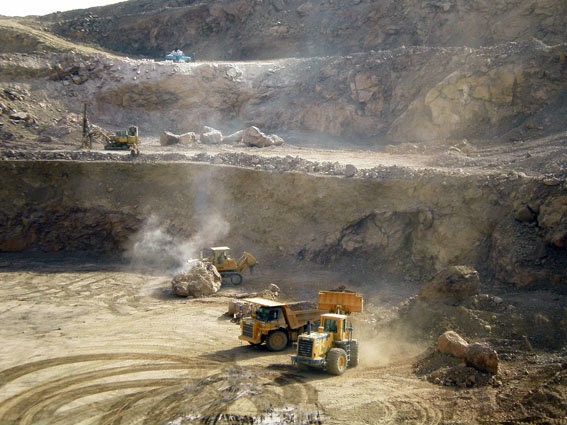
Parliament research shows Iran’s mining sector fosters rent-seeking and monopolies, sidelines local communities, and—rather than driving sustainable development—remains primarily extractive, degrades the environment, depletes reserves, and intensifies inequality.
Reports by the Parliament’s Research Center indicate that the relationship between Iran’s economy and its mining sector is unproductive. Instead of driving economic growth, mining has turned into a hub of rent-seeking and monopoly.
The country’s mines have not only generated stable employment but also destroyed local livelihoods, increasing poverty and inequality. The reports point to rents in information, land, energy, and cheap labor, as well as financial and infrastructural weaknesses. High private profits in mining are coupled with environmental damage and pollution whose costs are imposed on society.
The Center warns that, without proper resource management, the current trajectory will deplete reserves and produce mid-term scarcity of strategic minerals, turning Iran’s mining economy into an instrument of rent-seeking and environmental destruction.
The problem is not that “mining is inherently bad,” but how it is governed and managed. Instead of making mining an engine of balanced, sustainable development, mining in Iran has turned into a mechanism for looting wealth, distributing rents, degrading nature, and destroying social capital. Put simply, mining proceeds not on the basis of science, long-term planning, and the national interest, but on rent, corruption, and opaque, irresponsible decision-making—and from this root, the other crises follow.
A Declining Role of Mining in the National Economy
Economically, mining has not delivered development or national welfare; it has become a burden. Despite loud claims that minerals can “replace oil,” the sector’s share of GDP is only about 1–1.5 percent and has declined in recent years.
The mining economy is stuck at extractivism and raw exports; value-added processing remains underdeveloped. The Parliament’s Research Center in Sustainable Development in the Mining and Mineral Industries: An Assessment of Economic, Social, and Environmental Requirements notes that the sector’s GDP share (excluding mineral industries) fluctuates between 1 and 1.5 percent and fell from about 1.4 percent to under 1.1 percent between 2014 and 2017.
The same report stresses that “replacing oil” is a misconception without structural reform. Meanwhile, profits are privatized while losses—pollution, health impacts, and “rehabilitation” bills—are pushed onto the public, accelerating depletion of strategic resources.
Local Communities’ Alienation and Sense of Injustice
Socially, mining has fractured local economies and social bonds. Decisions about exploration and exploitation are made without the presence, consultation, or consent of local residents, imposing an external fate on communities that regard themselves as rightful custodians of land and water.
Sustainable livelihoods—smallholder farming, traditional herding, eco-tourism—are displaced. Promised jobs often mean temporary, precarious, high-risk contracts, frequently awarded to nonlocal labor, splintering social cohesion. Mining zones have become flashpoints of protest and violent confrontation, imposing heavy social costs on the country.
Illustrative episodes include protests at the Baladeh mine in Mazandaran after a deadly explosion; clashes at the Andirgan gold mine in Varzeqan following road closures by security forces; violent repression around the QolQoleh project in Saqqez; and a Baluch rally at the Taftan mine. Parliamentary analysis itself notes rising conflict, out-migration, and a gradual unraveling of social solidarity in affected regions.
Irreparable Destruction of Natural Resources
Environmentally, mining contaminates water and soil, accelerates erosion, and scars landscapes—threatening the basis of life in many areas. Oversight is reactive rather than preventive; penalties are trivial; “rehabilitation plans” often remain on paper; and monitoring is weak.
Restoration costs are routinely socialized through public budgets, forcing communities that rarely share in the benefits to pay for ecological losses. The Research Center reports that environmental penalties and compensation mechanisms are disproportionate to the scale of damage, enabling harmful practices to persist with minimal consequence.
Law as a Cover for Ongoing Injustice
In governance and transparency, the core problem is a defective decision-making structure based on rent, corruption, and monopoly. Licensing lacks transparency and is vulnerable to organized lobbying. A small, well-connected circle monopolizes permits and can even reshape rules to its advantage.
State oversight is weakened; the rights of Indigenous and local communities are disregarded. Under such conditions, law functions less as an instrument of justice than as a cover for continuing injustice. The Research Center’s findings describe the sector’s structure as a hub for rent distribution and economic monopolies.
Deepening Inequality and the Marginalization of Host Communities
As practiced, mining intensifies social inequality and impoverishes host communities. Decisions without consent violate rights to land and livelihood and strip people of the foundations of a dignified life.
A way out of this crisis hinges on implementing new participatory models whose core is the equitable distribution of power and wealth. This means creating joint decision-making bodies with genuine representatives of local communities, designing transparent mechanisms for a fair share of mining revenues, and prioritizing local labor at all skill levels.
Such an approach can not only restore the social license of mining projects but also, by turning local residents from opponents into beneficiaries, lay the groundwork for balanced, sustainable regional development. The Parliament’s Research Center remains silent on such remedies.