

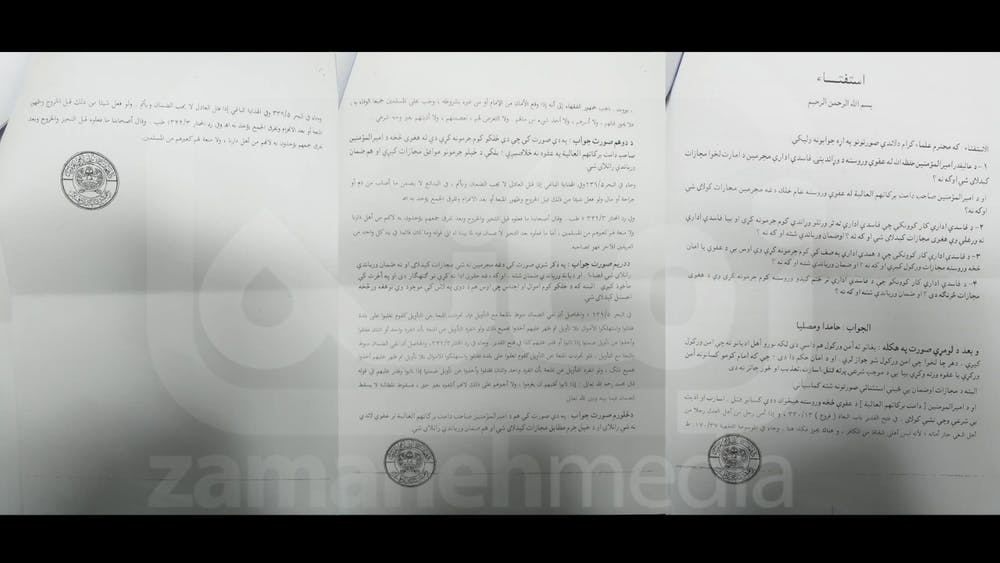
Zamaneh Media has obtained documents that show the Taliban leadership sought fatwas to punish former Afghan government officials, employees as well as armed forces. These include a fatwa to kill those who did not obey the religious law after the fall of the former Afghanistan government.
These documents show that the Taliban are trying to justify the summary killings of former government officials which has been documented by human rights groups.
On December 4, 2021, the United States with representatives of several European countries, Japan and Australia in a joint statement condemned the Taliban for killing former Afghan armed forces, including soldiers, police officers, and intelligence officials. The statement came after Human Rights Watch published a comprehensive 25-page report saying that “Taliban forces in Afghanistan have summarily executed or forcibly disappeared more than 100 former police and intelligence officers in just four provinces since taking over the country on August 15, 2021”.
Zamaneh Media has now obtained documents according to which the Taliban leadership has sought fatwas for these summary killings trying to justify the killings with the Sharia law.
In August 2021, after taking over Afghanistan, the Taliban leadership announce a “general amnesty” for anyone who had served with the previous government including the armed forces and those who had worked with the United States. However they gradually changed policy and they started targeting former armed forces, police, and intelligence officers; they even arrested army officials who had been retired for years.
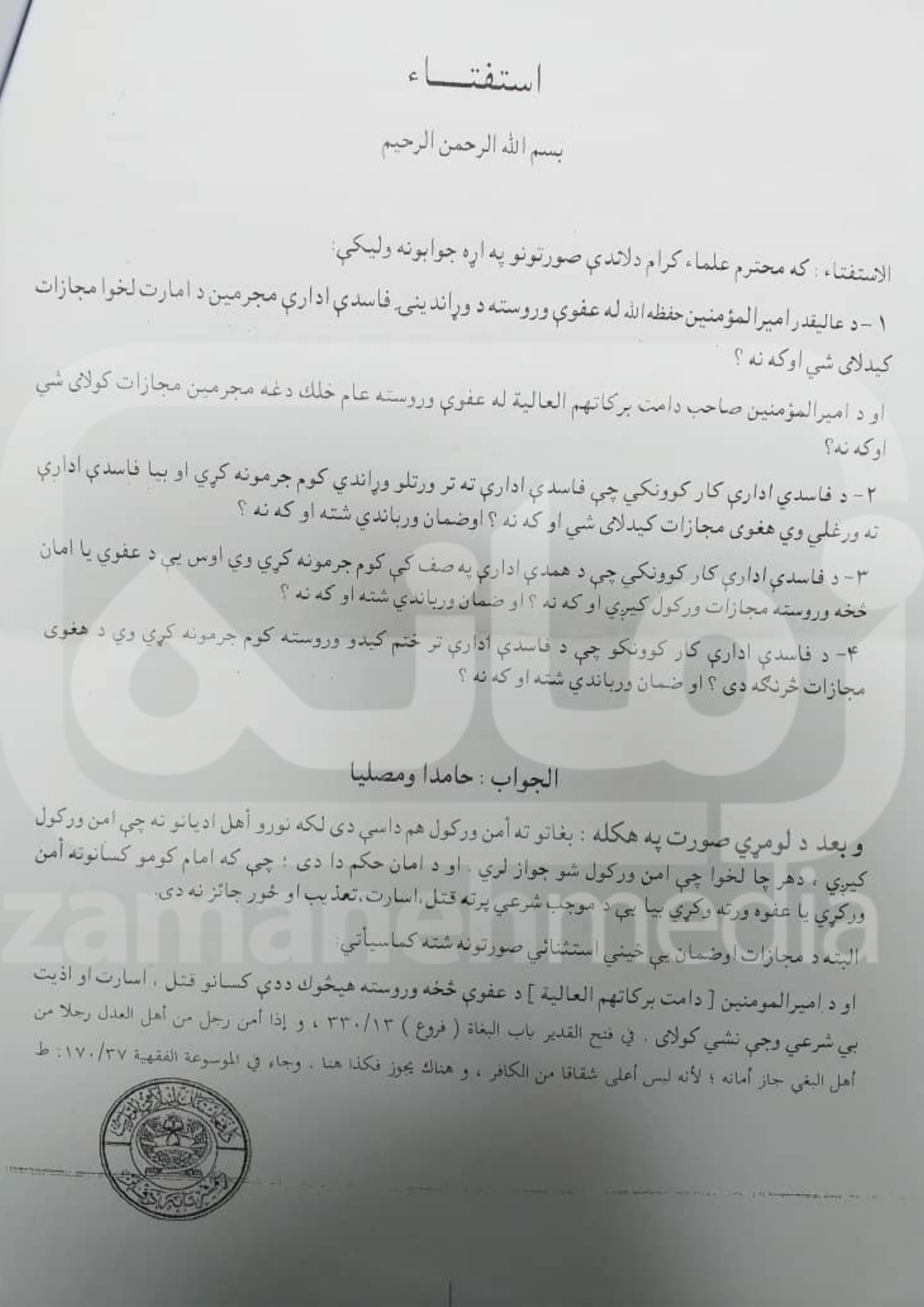

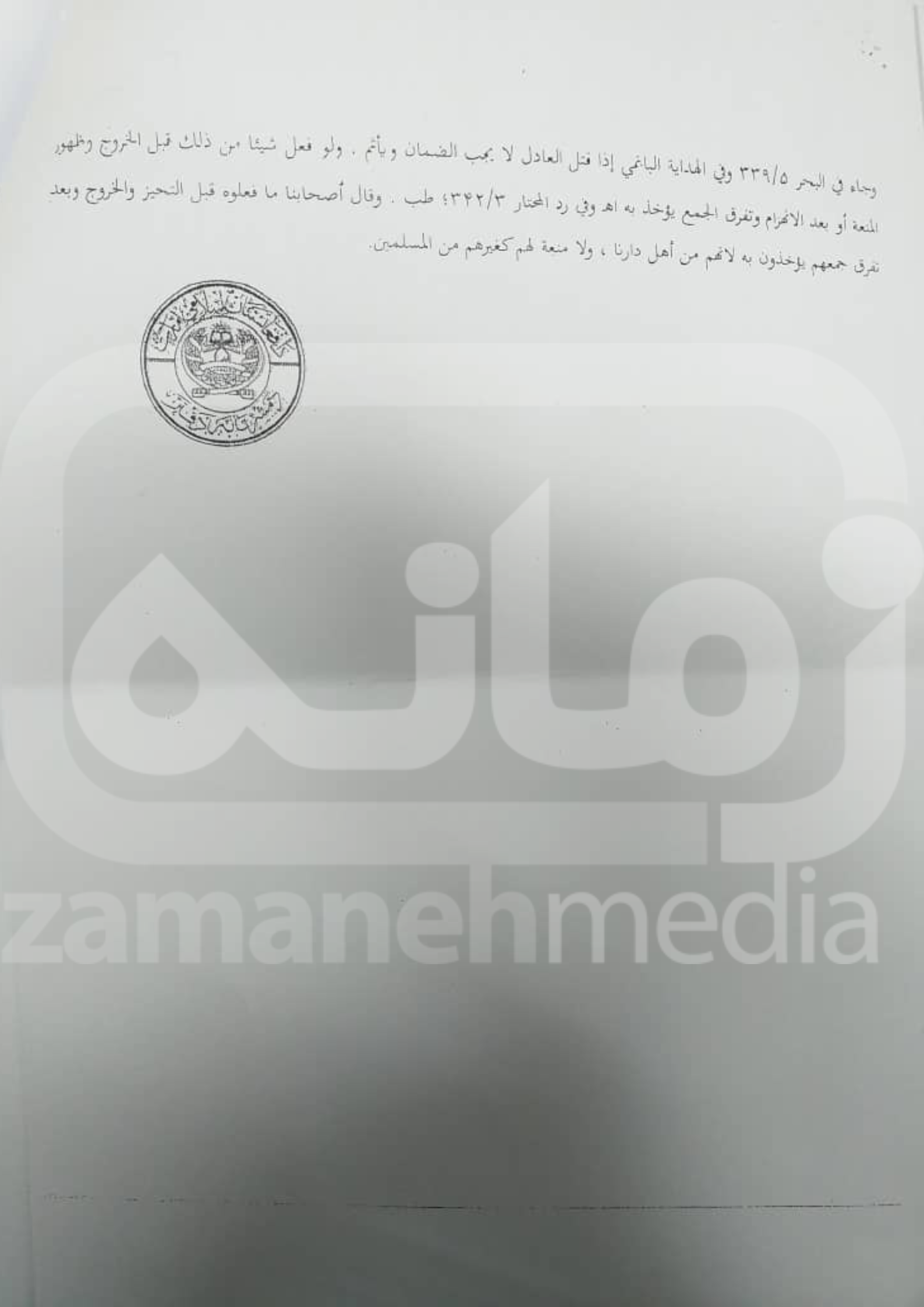
In the documents that Zamaneh has obtained, the Taliban have written to religious jurists asking them four questions seeking fatwas for the punishment of former government employees.
One question is:
“Will the employees of corrupt officers who committed corruption before entering these corrupt offices be punished or not? Will there be bail for them or not?”
To which the religious jurist replies:
“If a person commits any crime, he will not be released from punishment based on the amnesty of the Amir al-Mu’minin. He will be punished according to the crime he committed and bail will be set as such.”
Amir al-Mu’minin (the Commander of the Faithful) here refers to the Islamic ruler or Taliban government.
Zamaneh Media does not yet know who exactly the letter addresses. Former Afghan military officials believe that jurists associated with Darul Uloom Haqqania – a seminary in Pakistan with close ties to the Taliban – are behind the fatwas. These former officials think that the fatwas were issued after Abdul Baqi Haqqani, the Higher Education Minister of Taliban, visited the seminary in Pakistan on 16 April 2021.
In another question, the jurist is asked:
“Will the employees of corrupt offices who have committed corruption in different branches of these offices be punished after the announcement of amnesty will there be any bail for them?”
The jurist replies:
“These criminals will not be punished and there will be no bail for them, but if they have taken possession of the public property, these assets must be taken back from them.”
In one of the questions, however, the jurist issues a fatwa for the punishment of the former employees of the Afghanistan government which can potentially mean the death penalty under the Taliban rule. The jurist is asked:
“What will be the punishment for corrupt employees who have committed corruption after completing their term? Will there be bail for them or not?”
In response to this question, the jurist authorized the summary killings by saying:
“The pardon of the Amir al-Mu’minin does not fall into this category, and despite this declaration, they will be punished according to the crime they have committed.”
Former Afghan intelligence officers see this religious decree as a Pakistani intelligence strategy to uproot the remaining Afghan military personnel by killing them. Gen. Sayed Samar Sadat, a former military commander who previously served as senior intelligence officer in Khost province, says:
“I think foreign intelligence intervention, including Pakistan, is involved. They will not allow the Afghan elite to stay in the country. They will eliminate experienced political, military and civil personnel using this and the Sharia”.
Rahmatullah Andor, another former member of the Afghan Intelligence Services also says that foreign intelligence is involved and that they are using religious rulings to incite more violence.