

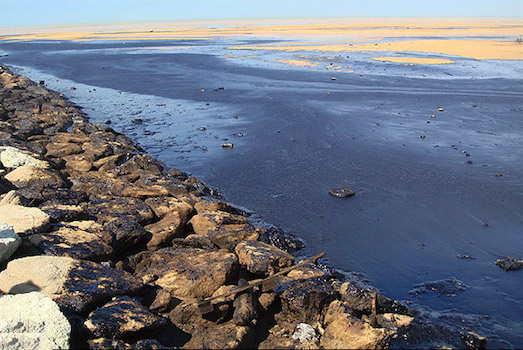

Fuel smugglers are among the main polluters of Persian Gulf waters. According to Iran’s Department of Environmental Protection, smugglers release more than five million litres of fuel into Persian Gulf waters each year.
When these smugglers are chased by the Navy or the Environment Department’s coastal patrols, they empty their fuel cargo into the water to keep from getting arrested. Parvin Farshchi, the department’s marine deputy, told a press conference on Sunday April 20 that smuggled fuel is now the Persian Gulf’s biggest environmental problem, which has intensified in the past two years.
Farshchi cited Navy statistics, saying: “In the past year, more than five million litres of fuel have poured into the Persian Gulf, and most of that is from ships carrying smuggled fuel. Right now they have become a large fuel-trafficking gang.”
Farshchi called on all relevant government bodies to make a coherent effort to confront this problem. She announced that they have already established a National Committee against fuel smuggling in the Persian Gulf, with members from the Department of Environmental Protection, the Navy and provincial officials.
Widespread Pollution in Persian Gulf
The Persian Gulf is one of the main routes for energy transport in the world, and thousands of ships and oil tankers travel through it each year, resulting in serious pollution. Oil spills or waste discharges from these vessels, sinking ships and the collision of oil tankers all lead to further pollution of this international waterway.
The construction of oil platforms by many different companies and the construction of several oil refineries and crude-oil complexes in the coastal region of the Persian Gulf further contribute to the pollution of these waters. According to estimates, anywhere from 1.5 million to two million barrels of oil are released into the Persian Gulf waters each year.
The Department of the Environment’s marine deputy says the introduction of non-native species to the Persian Gulf and the Sea of Oman through ships’ ballast water causes other environmental problems. Fashchi pointed out that in recent years, the department has witnessed the widespread death of dolphins in the Persian Gulf and the Sea of Oman, adding that it has established a committee to save marine mammals, especially dolphins and sea turtles.
Request for Help from the Army
The Department of the Environment has already called for the support of the Navy in projects to protect the Persian Gulf ecosystem. It says the Navy can use its technological capabilities and equipment to prevent ships from sinking in Persian Gulf waters, which would have a very positive effect in the fight against pollution.
Environment officials believe the Navy could also help by installing artificial habitats on the Persian Gulf seabed that would serve as protected areas for marine organisms living on the sea floor.
Opposition to Removal of the Ship the Raffaello from the Persian Gulf
The Department of the Environment says it opposes the removal of the sunken ship Raffaello from the waters of the Persian Gulf. Parvin Farshchi says removing the Raffaello, which has been there for more than 30 years, would have an adverse environmental impact. The ship, according to Farshchi, has become a station for undersea creatures. In addition, the removing the ship would increase turbidity in the Persian Gulf waters.
According to the Department of the Environment, other than the Raffaello there are about 1,200 sunken ships of various sizes in the Persian Gulf. Forty of these are giant ships, and their removal requires direct permission from the Department of the Environment.