


Some of Iran’s most powerful officials are blaming foreign elements and the media for a rising crime rate and a lack of public safety.
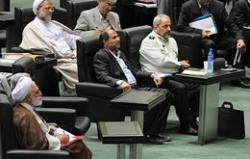
The parliamentary website Khaneh Mellat reports that Parliament today reviewed the subject of "social safety and dealing with criminals" in the presence of the Minister of the Interior, the Minister of Justice, the Prosecutor General and the head of Security Forces.
The session comes after recent weeks saw a significant increase in the reporting of serious crimes such as assault, rape, gang rape and murder.
Esmail Ahmadi Moghaddam, the head of the police force, said: "In our region, the presence of [global] superpowers and their agents who promote crimes such as drug-dealing, sex and violence are factors in the rising crime rates."
He cited the post-election protests of 2009 as another factor.
Following the 2009 presidential elections, numerous mass demonstrations were triggered by allegations that Mahmoud Ahmadinejad’s victory was achieved through vote fraud. The authorities arrested thousands of protesters in order to quell the unrest.
Ahmadi Moghaddam insisted that "weakening the authority of the police leads to insecurity in society."
He said the murder rate has risen in recent years, adding that murders within families have also become more common.
However, he claimed that despite the rise in murder rates, they are still lower than those in most developed countries.
Minister of the Interior Mostafa Mohammad Najjar told the session that while "the U.S. and the enemies of the Revolution are perpetually trying to paint Iran as an unsafe place," Iranian media can inadvertently fall into the same trap.
He also cited economic, social and cultural reasons for the rise in the crime rates and called for more transparent laws to confront them.
Gholamhossein Mohseni Ejei, Iran’s Prosecutor General, said the country’s enemies are trying to propagate an unsafe image of Iran. He called for tough legislation that would enable the judiciary to take action against dangerous crimes.
Mohammadreza Bahonar, the deputy head of Parliament, called on the judiciary to speed up its processing of criminal cases.
However, Minister of Justice Morteza Bakhtiari said speeding up court procedures is not possible, in light of the rights that the constitution gives to suspects, and judges who do so would be breaking the law. He said controls on the media are needed to prevent exaggerated reports about crime.
Alaeddin Boroujerdi, the head of Parliament’s National Security and Foreign Policy Commission, said: "Criminals should be dealt with mercilessly and in public. Prison conditions for them should be very harsh and sentences against them should be issued with greater speed and their cases should be given priority.
Conservative MP Ahmad Tavakoli told the session that the public feels considerably less safe than it used to and he laid part of the blame on the inappropriate media coverage of recent incidents in Iran.
He also acknowledged that poverty and unemployment were additional factors in raising crime rates but he added: "This problem also has a political dimension: when the administration or Parliament and other officials ignore the law or refuse to carry it out, people cannot be expected to act differently."
Tavakoli is a chief critic of Mahmoud Ahmadinejad’s administration and has accused him on several occasions of ignoring Parliament-approved legislation.