

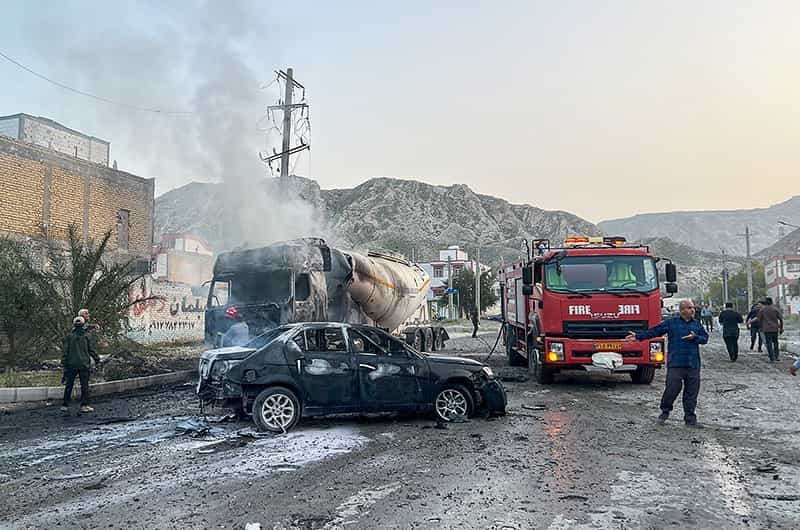
On the first day of the war against Iran, the US military struck a sports complex and residential neighbourhoods in Lamerd with a new generation of ballistic missiles. Independent investigations have found that the Precision Strike Missiles (PrSM) detonated at low altitude, scattering thousands of metal fragments across a wide area and killing at least 21 civilians, including children. The US military denies responsibility for the attack, but a United Nations fact-finding mission has found reasonable grounds to believe that US forces committed a war crime. Eight months later, it remains unclear what the US military intended to target in Lamerd and why it used a weapon with such a wide area of destruction in a residential neighbourhood.
“Is she breathing or not?”
This was the question Sedigheh Sourghali, the mother of Nahal Vaseghi, kept asking at Lamerd Hospital on the afternoon of 28 February 2026.
Her 12-year-old daughter had gone to the Shahid Naimi Sports Complex for volleyball practice. Sedigheh was working in a laboratory a few streets away. When she heard the explosions, she initially thought Nahal must have been frightened. She rushed out of work and repeatedly called her daughter’s phone on her way to the sports complex. No one answered.
By the time she reached the gymnasium, smoke and flames had engulfed the building. She could not find Nahal, who had been taken to hospital along with other casualties. Sedigheh eventually found her lying on the hospital floor as medical staff struggled to help her breathe.
In an interview with the Iranian Women’s Center, Sedigheh recalled the moment she realised her daughter was no longer breathing. Shortly afterwards, she heard Nahal struggling to draw breath. She had survived, but shrapnel had injured her hands and face. A fractured jaw and vascular injuries had caused a blood clot to reach her brain, leaving the right side of her body paralysed.
Before the attack, Nahal played badminton, practised the santur, a traditional Iranian musical instrument, and had won medals in sports competitions. In the months that followed, she underwent extensive physiotherapy, occupational therapy and speech therapy. Her mother said in the same interview that nearly all the activities her daughter once enjoyed had come to an end.
Other girls were brought to the hospital alongside Nahal. Some did not survive. Sedigheh recalled seeing the mother of Seyyedeh Helma Ahmadizadeh sitting beside her daughter. Helma died after a piece of shrapnel struck her heart.
These were among the consequences of the US military attack on Lamerd, a city in southern Iran’s Fars province. Months later, an examination of the damage to buildings and streets, as well as the injuries sustained by victims, helped identify one of the newest weapons in the US military’s arsenal.
28 February: Explosions Over Homes and a Sports Complex
The United States and Israel launched their attacks on Iran on 28 February 2026. That same day, the Shajareh Tayyebeh elementary school in Minab was struck. Several hours later, a series of explosions shook parts of Lamerd.
The governor of Lamerd told the media that the attacks on the first day of the war had struck the sports complex and surrounding residential neighbourhoods. He explained that students were inside the sports facility when the explosions began. Some left the gymnasium after hearing the first blast, only to be caught in subsequent explosions.
An investigation by Airwars, an independent organisation monitoring civilian harm in armed conflicts, published on 31 August 2026, identified three explosion sites along a stretch of approximately 550 metres: the Shahid Naimi Sports Complex, Eisar Township and the Tal-Khandaq neighbourhood.
Using CCTV footage, photographs taken after the attack, satellite imagery and reports from the scene, Airwars reconstructed the locations of the explosions and the extent of the damage. Its researchers also established where some of the civilians had been killed.
In one of the strikes, Avina Barzegar, a two-year-old girl who had been playing in the courtyard of her home, was killed. After locating her house, Airwars calculated that the fragment that killed her had travelled approximately 50 metres from the likely centre of the explosion.
At another location, three teenage volleyball players lost their lives. The sports complex and nearby buildings were struck by a barrage of metal fragments.
In a separate report, Ahmadreza Asadinejad described the death of his sister, Zahra Asadinejad. Zahra, a 33-year-old mother of three, was standing outside her home with her children when the attack occurred. An explosion took place approximately 20 metres away.
Shrapnel struck her chest and side. All three of her children were also injured: 12-year-old Nazanin-Zahra, 10-year-old Fatemeh-Zahra and six-year-old Amirhossein. Zahra died, and her children required prolonged medical treatment. According to her brother, the family concealed their mother’s death from the children for some time.
In another report, the newspaper Iran documented the death of Rabab Dehdashti, a radiology specialist at Lamerd Hospital. Saba Mohseni, the hospital’s public relations officer, explained that Rabab had been in the courtyard of her home with her child when the attack took place.
The victims had been inside the sports complex, in their homes, in residential courtyards and on the streets. What connected them was their presence within the destructive reach of missiles deployed by the US military on the first day of its war against Iran.
A Hospital Overwhelmed by Casualties Within Minutes
An interview conducted by the newspaper Iran with the director of Lamerd’s Haj Mahmoud Haj Heydar Hospital provides important details about the first hours after the attack.
Sajjadi, the hospital director, said a series of explosions was heard at approximately 4:30 p.m. Within five minutes, more than 70 injured people had been brought to the emergency department. In the first half-hour, the number of casualties arriving at the hospital had reached approximately 110.
He explained that shrapnel had struck patients in their knees, feet, lower legs and sides. In some cases, the injuries had severed major arteries, damaged the spinal cord or caused blindness. According to the hospital director’s figures, 118 people were eventually brought to the facility. Of those, 21 died and 97 were injured. He emphasised that the death toll referred to the first day of the attack.
Sajjadi also said that 32 patients required emergency surgery. Doctors continued operating until 2:30 a.m., and five patients were transferred to Shiraz because of the severity of their injuries.
Later reports put the death toll at 23, with 128 injured. The dead included eight women and fifteen men. Four schoolchildren and a two-year-old child were among those killed.
Approximately half of the injured were under the age of 15, and more than half of the injured were still receiving treatment. The United Nations’ Independent International Fact-Finding Mission on Iran, citing information from local authorities in its September 2026 report, recorded 22 deaths.
These figures come from different sources and reflect different stages of casualty reporting. Despite the discrepancies, accounts from the hospital, the Foundation of Martyrs and Veterans Affairs, and victims’ families reveal injuries whose consequences extend far beyond the immediate death toll.
Many survivors continue to live with long-term vascular, neurological and physical injuries.
How Does the New US Weapon Work?
The Precision Strike Missile, or PrSM, was developed by the American defence company Lockheed Martin for the US Army. This surface-to-surface ballistic missile represents a new generation of long-range US military weapons and was designed to replace the older Army Tactical Missile System, known as ATACMS.
According to official information from Lockheed Martin, the PrSM has a range of approximately 499 kilometres and can be launched from HIMARS and M270 systems. Its design allows two missiles to be carried in each launch pod.
On 4 March 2026, the US Army announced that the missile had been used in combat for the first time. Lockheed Martin subsequently confirmed the announcement. What distinguished the missiles identified in Lamerd was the way they detonated.
According to the Airwars investigation, the missiles exploded approximately 15 to 20 metres above the ground. Rather than creating large craters, the explosions dispersed enormous numbers of dense metal pellets at high velocity in multiple directions.
The pellets were reported to be made of tungsten, an extremely dense metal whose small fragments can penetrate human tissue and hard surfaces when travelling at high speeds. Various reports have put the number of pellets carried by each missile at approximately 180,000. Four missiles were fired in the attack on Lamerd.
Airwars reconstructed three explosion sites using visual evidence. By examining the impact marks left by fragments on streets, walls and buildings, the organisation established that damage from one of the strikes extended at least 170 metres from the likely centre of the explosion.
The Associated Press independently reviewed imagery and measured distances, corroborating Airwars’ findings about the extent of the damage. These findings are particularly significant because the PrSM is marketed as a precision-guided missile.
The ability to strike predetermined coordinates accurately says little about the area affected by the warhead. A missile can reach its designated target with precision yet scatter lethal fragments across a much wider area. In Lamerd, this characteristic resulted in the deaths of civilians who were dozens of metres away from the explosions.
A former US Army adviser on the law of war told the Associated Press that it would be extremely difficult to justify using the PrSM in a densely populated area. Six weapons experts interviewed by the Associated Press also warned that militaries should avoid firing this missile at targets near civilian areas.
Evidence of a US Attack and CENTCOM’s Denial
The US military has acknowledged using the PrSM during the war against Iran but has denied responsibility for the attack on Lamerd.
On 31 March 2026, Tim Hawkins, spokesperson for US Central Command (CENTCOM), said in an official statement that US forces had conducted no strikes in Lamerd or within approximately 48 kilometres of the city on the first day of the war. Hawkins also claimed that the missile seen in the published footage did not match the PrSM and instead resembled Iran’s Hoveyzeh cruise missile.
Weapons experts challenged that explanation.
In a report published on 3 April 2026, BBC investigators presented the assessments of six independent experts who had examined footage of the attack. After analysing the missile’s appearance, flight trajectory, detonation pattern and the number of strikes, they rejected CENTCOM’s explanation.
Amaël Kotlarski, a weapons analyst at Janes, explained to the BBC that the Hoveyzeh missile has a turbojet engine mounted beneath its fuselage and wings positioned around the middle of its body. Those features should have been visible in the footage, but they were absent from the videos of the Lamerd attack.
The experts also pointed to the pattern of the explosions. Based on its known specifications, the Hoveyzeh missile could not have produced the same pattern of fragment dispersal.
The BBC confirmed three strike locations through its examination of visual evidence. Satellite imagery reviewed by the broadcaster also indicated that a facility belonging to the Islamic Revolutionary Guard Corps (IRGC), located near the sports complex, appeared to have suffered no damage.
In the Associated Press investigation, six experts, including two former military officials, concluded that the weapon used was most likely the American PrSM. The Israeli military also told the Associated Press that it had not carried out a strike that far south in Iran on the first day of the war.
Independent investigations have found no evidence that military personnel were killed or military facilities destroyed at the strike locations. Despite this body of evidence, CENTCOM has maintained its original denial. The command has yet to release documents identifying the selected targets, missile launch locations or operational details from the day of the attack.
What Was the US Military Targeting?
An IRGC facility is located near the Lamerd sports complex. Its presence has been documented in investigations by the BBC, Airwars and the Associated Press. Yet the existence of a military installation next to a residential area does not, in itself, explain why missiles equipped with fragmentation warheads detonated over a gymnasium and civilian homes.
According to the BBC, satellite imagery dated 9 March 2026 showed no apparent damage to the IRGC compound. The Associated Press reported a similar finding. Under these circumstances, questions about the US military’s responsibility extend beyond identifying the type of missile used.
The commanders who planned and carried out the operation must explain which coordinates were selected for the strike, what information they possessed about the presence of civilians, and how they assessed the weapon’s destructive reach when selecting the munition. US commanders cannot rely on the missile’s accuracy to distance themselves from responsibility for the foreseeable consequences of its warhead.
If the intended target was a military facility next to the sports complex, the decision to use a munition capable of dispersing fragments over a wide area was itself part of the military operation. That decision requires an explanation and has become central to the legal assessment of the attack.
United Nations: Reasonable Grounds to Believe a War Crime Was Committed
The United Nations’ Independent International Fact-Finding Mission on Iran examined the attack on Lamerd alongside the strike on the school in Minab in its September 2026 report, A/HRC/63/61.
On 21 September 2026, Sara Hossain, chair of the mission, told the UN Human Rights Council that the mission had investigated the US attack on a sports complex in a residential area of Lamerd. She said that, according to information provided by local authorities, 22 people had been killed, including ten women and twelve men.
The fact-finding mission concluded that there were reasonable grounds to believe that US forces had committed a war crime in the attack. The effects of using the PrSM could not be confined to a specific military objective, as required under international humanitarian law.
On that basis, the mission found reasonable grounds to believe that the US-commanded attack on Lamerd constituted the war crime of launching an indiscriminate attack that caused civilian deaths and damage. This finding is directly connected to the way the weapon was used.
International humanitarian law requires parties to armed conflicts to distinguish between military objectives and civilians. An attack whose effects cannot be limited to a specific military objective falls under the prohibition of indiscriminate attacks. The principle of proportionality and the obligation to take precautions also require military commanders to consider foreseeable risks to civilians when selecting weapons and targets.
In Lamerd, the warhead’s characteristics and the extensive dispersal of fragments have become central to the legal assessment. A missile that detonates at low altitude and projects large numbers of metal pellets in different directions poses a substantial threat to civilians when used near residential areas. The UN fact-finding mission raised the question of responsibility for the US-commanded attack on the basis of these effects.
Its report does not constitute a final criminal judgment against specific individuals. Nevertheless, its findings provide an important basis for pursuing accountability from the US military and the commanders involved in planning, authorising and carrying out the attack.
New Claims About Materials Used in the Attack
Alongside the identification of the PrSM, Iranian officials have raised questions about other materials that may have been present in the munitions used in Lamerd.
On 8 August 2026, the deputy minister for research and technology at Iran’s Ministry of Health announced that evidence suggested phosphorus had been involved in the bombardment of Lamerd.
Speaking at a press conference, he said studies had been conducted on the effects of the attack in Fars province and that a paper had been prepared for international publication. Akhoundzadeh explained that some of the injured had developed long-lasting wounds after being struck by small fragments.
He also referred to research commissioned by the university and the Ministry of Health and conducted by a researcher from Tehran University of Medical Sciences. These statements form part of the published documentation concerning the medical consequences of the attack.
The full research findings, including information about the materials identified and their effects on the bodies of the injured, could shed further light on the attack. The possibility that phosphorus was used has been raised alongside reports of tungsten fragments.
These claims concern different aspects of the composition and effects of the munitions. Publication of the medical research findings will be important for documenting both more fully.
First Combat Use and Expansion of Missile Production
The PrSM had undergone testing and development before the war against Iran, but the conflict marked its first confirmed use in combat. According to a Lockheed Martin statement issued on 25 March 2026, the US Army confirmed the PrSM’s combat debut on 4 March.
In the same announcement, the manufacturer disclosed a new agreement with the US Department of Defense to quadruple the missile’s production capacity. The expansion builds on an earlier multibillion-dollar contract between the US Army and Lockheed Martin.
The decision to expand production following the missile’s first combat deployment is significant because the PrSM is intended to become one of the principal weapons used in US long-range strike operations.
On 26 October 2026, Lockheed Martin also announced that it had been selected to develop fourth-generation variants of the PrSM. The programme aims to extend the missile’s range to at least 1,000 kilometres and improve its ability to strike moving targets at sea and on land.
Competitive testing of these variants is planned for the period from 2027 to early 2029. The manufacturer’s promotional material emphasises range, precision, operational capability and increased destructive power.
The experience of Lamerd, meanwhile, provides one of the first documented accounts of the human consequences of deploying this weapon in combat. Neither the US military nor the manufacturer has released comprehensive information about the area affected by the warhead used in Lamerd.
Investigations by Airwars and the Associated Press, however, have shown that the destructive effects extended far beyond the area suggested by the manufacturer’s promotional imagery. In evaluating the performance of a new weapon, this information is as important as its range and accuracy.
Responsibility for the Attack and the Lives That Continue
Eight months after the attack on Lamerd, substantial evidence has emerged about what happened.
The US military has yet to provide a clear explanation of the target selected in Lamerd or the decision-making process behind the use of this missile. Documents concerning the strike order, the assessment of risks to civilians and the selection of target coordinates have not been made public.
It remains unclear which commanders participated in the decision and what information was available to them when the attack was authorised. These documents are essential to establishing the responsibility of the US military command.
For the victims, however, the consequences of the attack remain part of their daily lives, regardless of whether those documents are ever released.
In her interview with the Iranian Women’s Center, Sedigheh Sourghali explained that she had opposed the war even before it began and that her greatest concern had been Nahal.
Since the attack, her family’s life has revolved around hospitals, medical treatment and efforts to help her daughter regain her abilities. In Zahra Asadinejad’s family, three injured children have had to begin living without their mother.
The family of Avina Barzegar, the two-year-old girl killed while playing in her courtyard, will never have the chance to watch their daughter grow up. These lives have no place in the technical specifications of the PrSM.
Those specifications record the missile’s range, targeting accuracy, warhead capability and production capacity. In Lamerd, the effects of the same technology remain visible on children’s bodies, the walls of homes and the sports complex.
The published investigations show that precision guidance offers no guarantee of civilian protection. The US military introduced into combat a weapon whose explosive effects spread across a wide area.
The selection of the target, the type of munition used and the acceptance of risks to nearby residents were military decisions. Responsibility for those decisions rests with the US command.
The central question therefore remains: why did the US military, on the first day of the war, use this missile to strike an area where children were playing sports and families were inside their homes?
Answering that question is essential to establishing accountability for the killings in Lamerd and upholding the right of victims’ families to know the truth.