

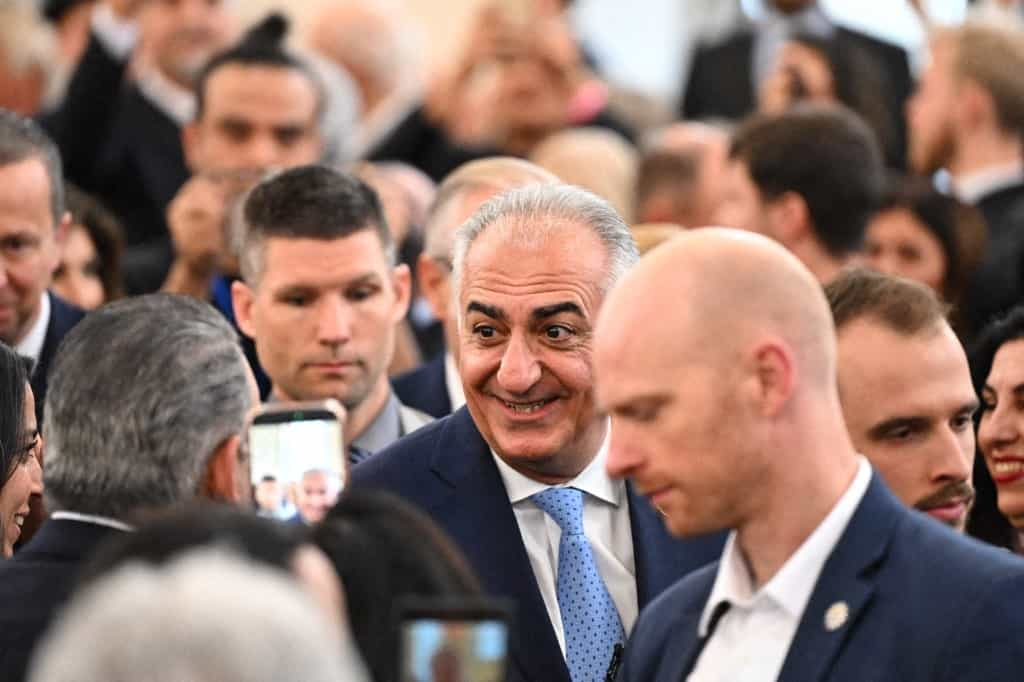
On Saturday, 7 November 2026, Reza Pahlavi attended the Friedrich Naumann Foundation for Freedom’s Freedom Prize ceremony at Frankfurt’s historic St Paul’s Church. The event brought thousands of supporters of the restoration of the Pahlavi monarchy onto Frankfurt’s streets and became one of the most controversial Iran-related political events in Germany in recent months.
The Friedrich Naumann Foundation did not award its 2026 Freedom Prize directly to Reza Pahlavi. Instead, it named the “people of Iran” as the recipients, with Pahlavi entrusted to hold the prize until it can, according to the foundation, be handed over to “freely elected representatives of the Iranian people.”
The foundation says it chose Pahlavi because he is the most widely recognised opposition figure to the Islamic Republic and has emphasised that Iranians should freely determine their future form of government. Yet as Pahlavi delivered his acceptance speech, members of the audience chanted “Long live the Shah.” The contrast was striking between the foundation’s stated rationale and the vision of a future monarchy under Reza Pahlavi that he and his supporters aspire to see established after the Islamic Republic.
At the centre of the controversy is precisely this question: why should a prize awarded in the name of the “people of Iran” be entrusted to a particular politician who aspires to restore a dictatorial monarchy?
A “Freedom” Prize for a Would-Be Ruler
Criticism of Pahlavi’s selection is not limited to the legacy of his father’s monarchy, his own monarchical ambitions, or questions about his political legitimacy. His position on foreign military attacks against Iran has also become one of the central points of contention in recent months.
On Saturday, 7 November, while accepting the prize on behalf of the “people of Iran,” Pahlavi attempted to distinguish between supporting military pressure and opposing war. He declared:
“No Iranian wants bombs to be dropped on their country, and I oppose this binary choice between war and appeasement.”
Yet just minutes later, in the same speech, he explained that his position on the use of military force had changed following the crackdown on the January protests:
“After the massacre of protesters, we were forced, with great pain, to accept that military pressure could weaken the regime and give the Iranian people an opportunity.”
He then described this position as a “third way,” saying:
“Instead of appeasement or war, I have always advocated a third way based on exerting maximum pressure on the Islamic Republic while providing maximum support to the Iranian people.”
Rather than resolving the controversy surrounding his position, these remarks raised another question: what exactly does the “military pressure” Pahlavi supports entail, and how does it differ from the very war he says Iranians do not want?
After all, military attacks, even when their declared targets are the Islamic Republic’s military and security installations, can result in civilian deaths, the destruction of infrastructure, and the escalation of war. One example is the killing of dozens of schoolchildren in Minab during a US bombing, a massacre for which Pahlavi refuses to attribute any responsibility to the United States.
The same contradiction was evident in an interview published the day before the Frankfurt ceremony. In that interview, released on Friday morning, Pahlavi defended attacks on the Islamic Republic’s “repressive capabilities,” while insisting that he opposed the deployment of foreign ground troops to Iran and that regime change should be carried out by Iranians themselves.
In other words, his current position amounts to supporting the bombing of Iran while opposing a US ground invasion, and advocating regime change with the assistance of American and Israeli bombs.
Pahlavi had previously issued a message of condolence and gratitude following the deaths of three American military personnel in the war against the Islamic Republic. While supporting military action against Iran, he has repeatedly stated that he does not want US ground troops deployed to the country and does not believe “American taxpayers” should bear the cost of operations to liberate Iran.
This position is not new. In an interview with Reuters last summer, Pahlavi said that following the January massacre of protesters, he had abandoned his longstanding opposition to foreign intervention and concluded that US military action could save lives.
He has largely remained silent about the bombing of schools, residential homes, medical facilities, and civilian infrastructure, as well as the deaths of Iranians. On the few occasions when he has addressed these issues, he has maintained that the Islamic Republic is to blame.
In an interview with Euronews the previous week, he compared the Islamic Republic to a “wounded animal” seeking revenge and argued that it should not be allowed to survive. He called for increased European pressure and the creation of conditions for a “final uprising” in Iran. In the published excerpts of that interview and the interview released on Friday, Pahlavi did not explicitly oppose a new round of US or Israeli airstrikes against Iran.
This question has become even more pressing amid the possibility of a third round of military confrontation and reports of continued limited US strikes against targets inside Iran.
For Pahlavi’s critics, the gulf between demanding freedom for Iranians and supporting military action whose costs are paid in the blood of those living inside the country represents one of the fundamental contradictions in his political record.
His supporters, by contrast, argue that limited strikes against the Islamic Republic’s military and repressive apparatus could weaken the government’s capacity to kill protesters.
January 8–9: A Call to Protest That Remains Controversial
The controversy over Reza Pahlavi’s political responsibility centres particularly on the protests of 8 and 9 January 2026.
On 6 January, he called on Iranians to chant slogans in the streets or from their homes at precisely 8 p.m. on the evenings of 8 and 9 January. Large gatherings subsequently took place in cities across the country, and from the evening of 8 January, the authorities severely restricted internet access and communications.
On 9 January, as the crackdown intensified, Pahlavi directly appealed to Donald Trump to be “ready to intervene” to help the Iranian people. In the same message, he explained that he had called people into the streets to increase the size of the crowds and put pressure on the security forces. The following day, he urged protesters to prepare to “seize and hold city centres.”
These calls came under criticism after the repression of the protests escalated into mass killings. A few days later, The Guardian reported that Pahlavi’s critics accused him of encouraging people inside Iran to take to the streets without having a realistic plan.
Significantly, Pahlavi’s office now cites those very events of 8 and 9 January as evidence of his political legitimacy. In a response to the German newspaper Frankfurter Rundschau, his office claimed that “millions of people” had answered his call, after which a “massacre” occurred. The newspaper also noted that Pahlavi’s office relied on unspecified opinion polls and slogans documented on social media to substantiate its claims of widespread support.
Pahlavi’s supporters see the turnout on 8 and 9 January as evidence of his influence and leadership. His critics, however, raise a different question: can a political leader’s call for people to take to the streets, where they face armed security forces amid a communications blackout, be presented solely as proof of “legitimacy” when no clear mechanisms have been offered for their protection, withdrawal, or organisation? Or should responsibility for the consequences of such calls also form part of any assessment of that leader’s political record?
The same question has resurfaced in Frankfurt in a different form.
The Naumann Foundation maintains that Pahlavi does not own the prize but is merely holding it in trust for the Iranian people. Critics, however, argue that choosing a particular political figure to stand in St Paul’s Church and receive an award in the name of an entire nation inevitably goes beyond a ceremonial gesture. It confers symbolic political capital on that individual.
And the individual in question is someone who supports war and the bombing of Iran, justifies the deaths of Iranian civilians during the war in the interests of the United States and Israel, and responds to questions about his responsibility for the calls that preceded the massacres of 8 and 9 January with the words: “This is a war and war has casualties.”
German Media and the Question: “Who Represents the Iranian People?”
The German media did not exactly roll out the red carpet for Reza Pahlavi.
On 27 October, Frankfurter Allgemeine Zeitung published an article titled “Controversial Award for the Shah’s Son,” reporting that former political prisoners from the reign of Mohammad Reza Shah, Iranian associations, and a number of German politicians, lawyers, and diplomats had protested the decision.
Critics argued that Pahlavi had never been elected by the Iranian people and therefore had no democratic mandate to represent them. They also questioned his handling of the legacy of SAVAK, the Shah’s secret police, and the history of political repression under his father’s rule, as well as the concentration of power envisaged in his proposed “Transition Handbook.”
Another report published in Frankfurt in recent days also attracted considerable attention. Frankfurter Rundschau framed its investigation around a central question: “Who Is Entitled to Speak on Behalf of the Iranian People?”
The newspaper reported that Pahlavi’s office had failed to provide specific answers to questions about how he addressed human rights violations under the Shah or how he intended to reconcile the different factions opposed to the Islamic Republic. Instead, his office dismissed the questions as reflecting the narratives of the Islamic Republic and the Mojahedin-e Khalq (MEK).
A letter signed by 306 associations also opposed Pahlavi’s selection. Frankfurter Rundschau pointed out, however, that all these organisations supported the National Council of Resistance of Iran, a coalition dominated by the MEK.
Berliner Zeitung also published a critical commentary by Martin Patzelt, a former member of the Bundestag and former rapporteur on Iran for the parliamentary Human Rights Committee. The article was titled “Criticism of the Award for the Shah’s Son Shows No Sign of Ending.”
The controversy extended beyond the media. In Frankfurt, politicians from the Green Party, the Social Democratic Party, and the Left Party opposed the choice of Reza Pahlavi to represent the Iranian people.
The city council rejected the Left Party’s request to cancel the rental agreement for St Paul’s Church. Nevertheless, even some of those who opposed cancelling the ceremony described Pahlavi’s selection as inappropriate.
The Naumann Foundation, for its part, has defended its decision.
Steffen Saebisch, the foundation’s chairman, argues that the prize was deliberately not awarded to an individual. According to him, Pahlavi was chosen because of his widespread public recognition and his stated positions in favour of secular government, the rule of law, and allowing Iranians to determine their future political system through a vote.
The foundation also reported receiving more than 7,000 requests to attend the award ceremony.
Thousands in Frankfurt, but the 30,000 Figure Remains Unconfirmed
Since the previous week, claims had circulated that 30,000 people would attend the demonstration organised by Pahlavi’s supporters. However, this figure represented the organisers’ estimate and the declared number of expected participants, rather than a confirmed attendance figure.
According to live coverage by the German broadcaster Hessenschau, Frankfurt police estimated that slightly more than 3,000 people were present in the city centre at around 11:30 a.m.
By 12:25 p.m., the march had moved from Römerberg towards Ostpark, where approximately 2,500 people had already gathered.
Organisers had registered an expected 24,000 participants for the main march, with a projected total of up to 30,000 for the Ostpark gathering. Smaller demonstrations by opponents of Pahlavi and other Iranian political groups had also been registered for the same day.
Hundreds of police officers were deployed across the city, with heavily armed special units stationed around St Paul’s Church. As of Hessenschau’s midday report on Saturday, police said no major security incidents had occurred.
Yasmine Pahlavi: The Islamic Republic Has Issued Threats
One day before the ceremony, Yasmine Pahlavi, Reza Pahlavi’s wife, claimed in a video message that Frankfurt police had told her and her husband they could neither attend nor speak at the demonstration organised by Pahlavi’s supporters because the Islamic Republic had threatened violence.
According to her account, police warned that Reza Pahlavi’s presence could prompt the Islamic Republic to attack people in the crowd. She questioned why threats from a foreign government should result in restrictions on the very person being targeted.
At the time this report was prepared, the claim had not appeared in any public statements issued by Frankfurt police.
Nevertheless, concerns about threats from the Islamic Republic are not entirely without precedent. On Friday, Belgian Defence Minister Theo Francken announced that Tehran had threatened Belgium with “severe consequences” if Reza Pahlavi were allowed to deliver a speech at the Royal Military Academy in Brussels. The speech ultimately went ahead.
Following Yasmine Pahlavi’s message, Reza Pahlavi’s media office announced that he would still attend the award ceremony and remained “determined” to proceed afterwards to the gathering in Ostpark. His office stated that his team was working with security officials and police to make his attendance possible.
After the award ceremony ended, Pahlavi’s supporters gathered in Frankfurt’s Ostpark, waving the Lion and Sun flag alongside American and Israeli flags. They chanted “Long live the Shah” and “This is our year, Pahlavi is our Shah,” while awaiting the arrival of a man who is undoubtedly the “Shah’s son,” but who, without being a “representative of the Iranian people,” now carries the Iranian people’s Freedom Prize around in his pocket.