

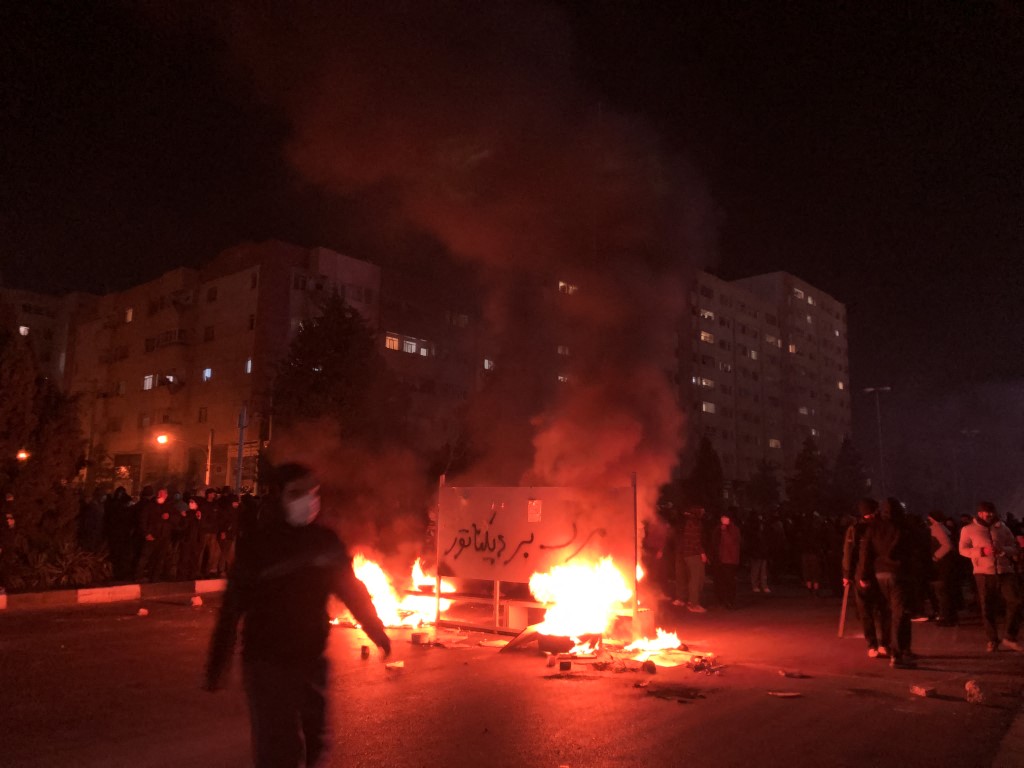
Parviz, a 38-year-old university lecturer and doctoral student at the University of Tehran, was shot twice during the protests in Tehran on the evening of 8 January 2026. When he fell to the ground, he found himself surrounded by the lifeless bodies of young people who, according to his account, had been shot in the head, legs or heart. People trying to reach the wounded from some 50 to 100 metres away came under fire from security forces. Realising that any sign of life could cost him his life, Parviz pretended to be dead. Officers dragged him across the ground, beat him with batons and kicked him. As they talked among themselves, one suggested finishing him off. Another replied that he would be dead in a few minutes anyway. Eventually, they left, and Parviz, badly wounded, struggled to drag himself onto the pavement and towards a hospital entrance. Nurses rushed him inside. He spent two weeks in intensive care, with little hope that he would survive.
This is the testimony of one of those wounded during the bloody night of 8 January in Tehran—a man who has repeatedly taken to the streets, from the Green Movement in 2009 to the protests of January 2018 and November 2019, the Woman, Life, Freedom in 2022, and the 2026 January uprising. Parviz sees his participation in these struggles as links in a chain that is not yet complete, one that, he believes, must eventually lead to the bright day of freedom. In this interview, he recounts a night that could have been the last of his life, when security forces, in his words, wanted “another corpse” to add to the number of those killed.
Parviz has been taking part in street protests for years. His first experience was in 2009, when he was an undergraduate student in Kermanshah. He subsequently joined the protests of December 2017–January 2018 and November 2019. During the November 2019 protests in Isfahan, where he was studying at the time, he was arrested and beaten with batons. But, he says, he managed to escape with the help of other protesters. After the Woman, Life, Freedom movement began in 2022, he moved to Tehran to pursue his doctorate and continued taking part in demonstrations.
Reflecting on the connection between these experiences, he says:
“My participation in the January protests was like another link in a chain whose other links had already been forged. January was another link, an important one that had to be added for the chain to become complete. It started in 2009, when I first joined the protests as an undergraduate student in Kermanshah. Then came the protests of December January 2018 and November 2019, when I took to the streets again. During those protests, I was arrested and beaten with batons, but thanks to the people around me, I managed to escape. I was studying in Isfahan at the time. Then the Woman, Life, Freedom movement began, and I came to Tehran for my doctorate. I continued adding links to that chain until I reached 8 January 2026.”
For Parviz, joining the January 2026 protests was not a decision disconnected from his past. He and his friends, he explains, wanted better living conditions and the possibility of a life worth living. They had been waiting for an opportunity to act collectively and move beyond what he calls a “broken system”.
He says:
“Two friends and I were waiting for the right circumstances to take action together, to stand united and move beyond this broken system. When the call to protest came, we decided to take part together.”
On the evening of 8 January, Parviz left home with two friends, both of whom were also doctoral students. It was around 8 pm. They tried to find a route where they could join a larger crowd, eventually making their way to Sattar Khan Street and then Sadeghiyeh Square.
Parviz recalls that evening:
“We went out at eight. There were already huge numbers of people in the streets. It was incredibly crowded, and the numbers kept growing. People were pouring into Sattar Khan Street in waves, coming out of all the little side streets and alleyways.”
Parviz and his friends remained among the protesters until around 9.30 pm. At that point, his two friends decided to turn back, but he chose to stay.
“When my friends saw the armed security forces, they decided to go back. But I didn’t want to leave. I could see how many people had come out, and I felt that tonight we might light a flame for tomorrow. So I stayed, and the two of them went home. Then we moved further forward.”
By around 10 pm, Parviz was near the front of the crowd. He says he was holding a stone. At that moment, tear gas was fired towards the protesters. He saw a canister fly over his head and land about two metres away. The gas reached his eyes, blurring his vision. He raised his hands to rub them, but within seconds, a bullet struck him and he collapsed.
He recalls:
“The gas got into my eyes, and I couldn’t see anything. I put my hands to my eyes and rubbed them. Then, in a split second, I was hit by a bullet and fell to the ground. I could feel my abdomen swelling more and more, and I was beginning to lose consciousness.”
Parviz says that after about ten minutes, he gradually managed to breathe again and realised that he had to do something to save himself. When he placed his right hand on the ground to try to get up, he was confronted with a scene in which, as he puts it, there was blood as far as the eye could see.
“I saw young women and men lying all around me. One had been shot in the head, another in the leg, another in the heart. Everywhere you looked, there was blood. I felt as though they were all dead.”
Other protesters were standing about 50 to 100 metres away from the wounded and those lying motionless on the ground. According to Parviz, they wanted to reach the injured, but security forces prevented them. He could hear people calling out to one another, urging others to help rescue their brothers and sisters. Yet whenever a group moved towards the wounded, security forces opened fire, and more people fell to the ground.
Despite his injuries, Parviz tried to make his way towards the pavement. As he struggled to move, he was shot again, this time in the leg.
“After the second bullet, I knew for certain that if I gave them any more indication that I was still alive, they would kill me without hesitation. So I pretended to be dead.”
As Parviz lay motionless, trying to appear dead, he heard the footsteps of two officers approaching. Each grabbed one of his legs, and they dragged him across the ground towards the other security forces, pulling him for roughly twenty metres. When they reached the officers’ position, ten more armed men joined them. They beat him with batons, kicked him and shouted abuse: “Bastard, welcome to the black hole!” “Bastard, welcome to hell!” “Bastard, there’s no going back now. You’re finished!” At that moment, Parviz says, two plainclothes officers approached. One warned that the crowd was growing and that they needed to move towards the protesters and disperse them. Then the discussion turned to whether Parviz should be killed.
He recounts:
“One of them said, ‘Let’s finish him off.’ The other said, ‘Let him suffer and die.’ Then they went towards the crowd to kill our brothers and sisters, thinking that by the time they came back, I would be lying dead among the other bodies. They wanted another corpse.”
A few minutes later, when Parviz sensed that the officers had moved away, he began dragging himself across the ground. With enormous difficulty, he managed to crawl from the middle of the street to the pavement, blood pouring from his abdomen and leg. That short distance, he says, “felt like a hundred years”. He was fortunate that two nurses spotted him. At first, they approached cautiously, frightened, but soon several other nurses came to help. According to Parviz, they hurriedly carried him into the hospital, fearing the security forces might return. From that moment onwards, he remembers nothing. He had lost consciousness.
Parviz spent two weeks in intensive care. He says there was little hope that he would survive. When he regained consciousness, he learned that 140 wounded people had reportedly been brought to the hospital that night, of whom only five had survived. He was one of those five. (Radio Zamaneh has not independently verified these figures.) His treatment, he says, began after ten days, but his recovery extended far beyond his hospital stay, bringing enormous medical expenses and months away from normal life. He says the hospital director waived part of his hospital bill. Nevertheless, his total treatment costs reached approximately 200 million tomans.
Discharge from hospital and his return to his hometown in Fars province did not mark the end of his ordeal. The wounds to his abdomen and leg required daily care. He needed sterile gauze, medical tape and other supplies, and his dressings had to be changed twice a day. Weekly appointments with an orthopaedic specialist and repeated X-rays added further expenses. According to Parviz, during the first month or two, his medical costs reached around 50 million tomans per month.
The gunshot injuries also kept him away from work and university for an extended period. He explains:
“For almost three months, I wasn’t allowed to put any weight on my leg. The orthopaedic surgeon told me I couldn’t put pressure on it during that period. I was away from university, and afterwards I had another two months of physiotherapy, exercises and walking according to the doctor’s instructions so that I could learn to walk again. You could say it took five months before I could gradually start walking and returning to normal life. After five months, I decided to go back to university.”
According to Parviz, support from some of his university professors was also important in enabling him to resume his studies. He considers this one of the few strokes of luck he experienced during that period. His professors supported him and, on one or two occasions, intervened on his behalf to prevent further trouble. He says their intervention helped persuade the relevant authorities that he had no malicious intentions and that what had happened had not been deliberate. He stresses that not all wounded protesters received such support, and that his own future remains uncertain.
But Parviz’s difficulties did not end when he returned to university and began walking again. One of his most serious physical complications is a severe hernia that developed after he was shot in the abdomen and underwent several operations. According to Parviz, the surgeries were so extensive, and the damage to his abdominal tissue so severe, that the abdominal wall has been unable to heal. The gap between the damaged tissues is now so large that, according to his doctor, repairing it will require surgical mesh.
Parviz says he needs the largest size of US-made surgical mesh, which is difficult to obtain and costs approximately 250 million tomans on its own. That does not include hospital fees, the surgeon’s charges or other expenses associated with the operation. He estimates that returning to anything resembling his life before the shooting will require a total of around one billion tomans.
Parviz says the financial burden of his treatment, at a time when inflation and economic crises have made everyday life increasingly difficult, has also taken a toll on his mental health. He continues to struggle with pain and the consequences of his injuries. His leg has undergone surgery and contains metal implants, while his abdomen requires another operation, the cost of which has become a major obstacle. Even if he manages to raise the money, he remains anxious about the outcome of the surgery and its possible complications.
Despite everything, Parviz insists that he does not regret taking part in the protests. What has become harder to bear is not simply the physical pain or the cost of treatment, but the gap between what he went into the streets hoping to achieve and what has happened since. He says:
“These expenses and all this pain don’t mean that I regret what I did. No. But when things don’t turn out the way you hoped, the pain and suffering become even harder to bear. Especially these days, when the crackdowns, arrests and executions have only increased.”
For Parviz, who has long regarded successive waves of street protests as part of one continuous struggle, the consequences of that night remain a daily reality. His leg still hurts, his abdomen requires another operation, the medical bills are difficult to meet, and his future, he says, remains uncertain. Yet the question that has stayed with him since that bloody night goes beyond his own fate. It concerns the meaning of everything that happened to him and to the other protesters. As he puts it: “You keep asking yourself: surely all that blood cannot have been shed for nothing.”