

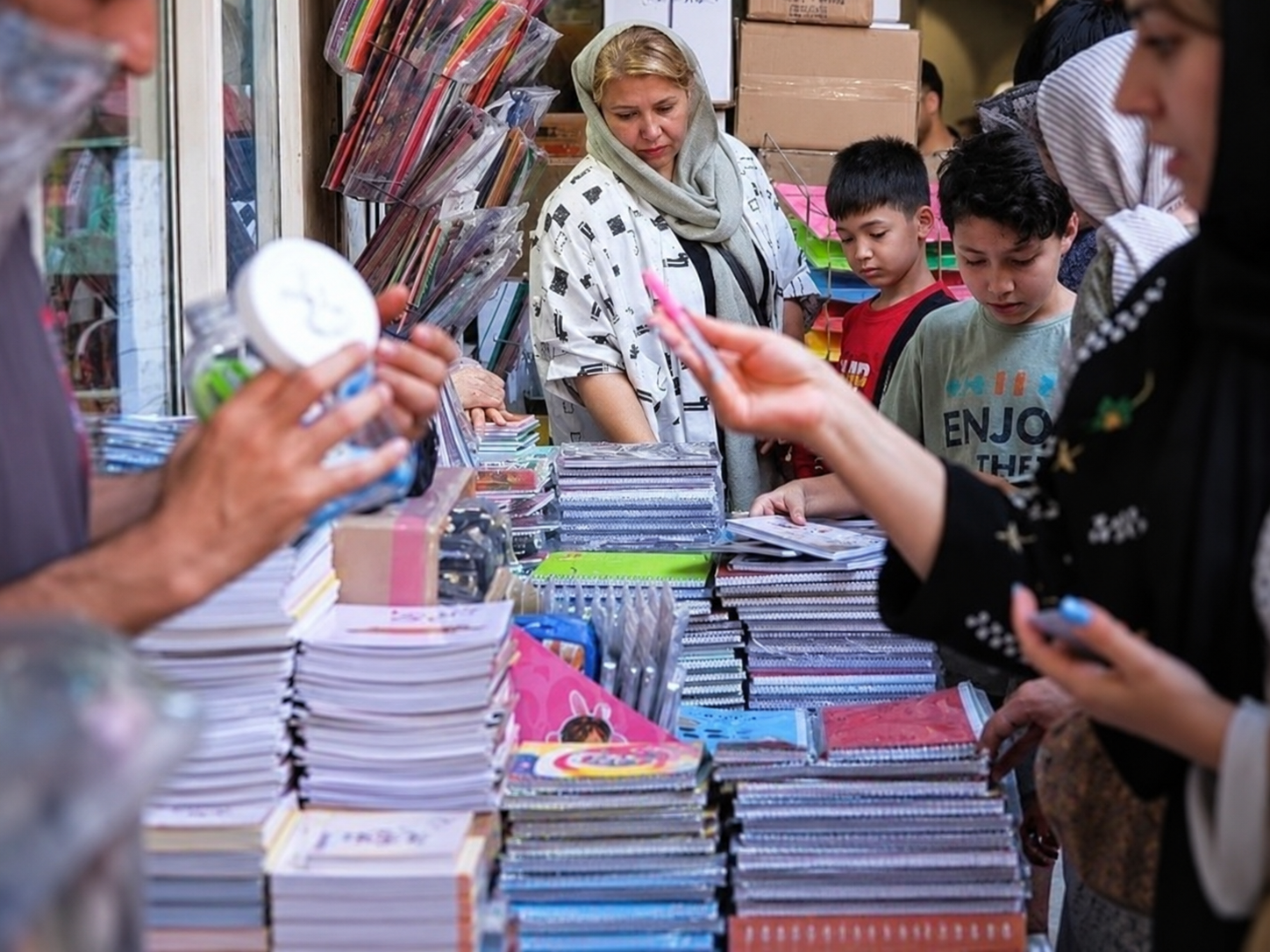
Public education is supposed to be free, but for many families the school year begins with a long list of expenses: uniforms, bags, stationery, contributions to the school, transport, food, student insurance, and even whiteboard markers and erasers.
For households whose incomes have failed to keep pace with the cost of living, this means having to choose between their children’s different needs. Three mothers from Tehran, Lahijan and Garmsar spoke to us about these pressures. One mother washed and ironed her child’s old uniform and told him it was new. Another family was forced to leave Tehran after nearly four decades because of school costs. A third mother had to choose between buying a school uniform and purchasing stationery.
Their accounts offer a glimpse into the financial pressure on families trying to provide their children with decent educational conditions. And that pressure is not confined to private schools. It has also made its way into the public education system.
Tehran: Simin, From Teaching Other People’s Children to Raising Mehran
Simin, 42, is a teacher living in Tehran’s Beryanak neighbourhood. Her son Mehran is in the third grade at a public primary school. Simin herself teaches at a vocational high school.
She describes the financial pressure her family faced at the beginning of the school year:
“I couldn’t buy things for my son because of our financial situation. So I washed and ironed his bag and school uniform from last year and told him they were new. My sister, though, bought a backpack and pencil case for 8.5 million tomans. That’s around the average price. I also spent 2.7 million tomans on notebooks and pencils.”
As a teacher herself, Simin says that even at public schools, families face expenses beyond anything formally described as tuition.
“At the school where I teach, they charge 25 million tomans.”
She says her son’s school also collects money from families for a variety of expenses:
“They charge a set amount for construction and school expenses, usually paid monthly or every few months. There is a separate charge for rubbish bins, another for whiteboard erasers, tissues and storage baskets. They even collect money from the students for whiteboard markers.”
These costs, she says, come on top of the contributions families are asked to make at the beginning of the year.
“I remember they wanted to buy a projector, but they couldn’t collect enough money from all the parents, so the purchase was cancelled.”
Simin stresses that this is a public school. Officially, she says, these payments are voluntary, but in practice the amount a family contributes can affect its relationship with the school.
“As far as I know, it is voluntary. Some people gave 15 million tomans and others gave one million. Maybe the person who gives 15 million has better chances in certain situations, including enrolment. In any case, when you give the school a large amount, it makes a difference compared with someone who gives less.”
She then turns to teachers’ incomes and the difficulty of covering ordinary living expenses.
“Teachers are paid 150,000 tomans for an hour of overtime. That is the price of a bag of puffed corn snacks. Now imagine how I am supposed to support my child.”
Simin emphasises that teachers themselves try to prevent these costs from being passed on to students.
“Teachers really do cooperate and try to keep the costs from falling on the children. But even so, school, including public school, costs money.”
She says the situation is even more severe in vocational schools.
“Especially in vocational schools, the expenses are staggering. They are really high. An ordinary family simply cannot afford to send a child to a vocational school because of the costs of arts programmes such as photography and graphic design.”
Lahijan: Mina and the Struggle to Find the Best School for Her Son Kiarash
Mina, 45, is the mother of Kiarash. She had lived in Tehran her entire life, but rising living and education costs forced the family to leave the capital this year and move to Lahijan in northern Iran.
She describes the fees at her son’s private school in Tehran:
“When he was in first grade, the annual tuition was 110 million tomans. Last year it was 160 million. This year it went up to 260 million, and we simply couldn’t afford it. That 260 million was for one year. The school uniform was extra.”
Mina says the cost ultimately forced the family to leave Tehran after nearly four decades.
“This year we just couldn’t manage it anymore, so we came north. Our only source of happiness in this country, where every day feels bleak, is this one child. We want him to study in a good school and succeed. But after three years, we could no longer afford even that and were forced to move north. After four decades of living in Tehran.”
Her son is now enrolled in a private school in Lahijan, but Mina is still struggling to adjust to her new life. One of her main concerns is maintaining the standard of her son’s education.
“My son had been in a good school in Tehran and had three very good years there. I couldn’t suddenly put him in a regular school and let him fall behind.”
She visited two schools in Lahijan that she considered suitable.
“There were two good schools I looked at. The tuition here was 62 million tomans. The uniform was another 1.5 million. One supplementary workbook cost one million, another educational booklet cost 600,000. Every school event or celebration means another separate payment, anything from 800,000 to one million tomans.”
Mina also describes the experience of a friend who has one child. Her friend raises a broader question about the gulf between public and private education:
“When all the government and state officials send their own children to private schools, how can they possibly know what conditions are like in public schools?”
To illustrate the disparity, she points to what happened during the war:
“During the war, children in public schools studied for one hour a day, while children in private schools studied for five hours. That is just one example of the disparity. Later, you see the consequences in the university entrance exam and university admissions, where, she says, more than 70 percent of successful applicants come from private schools.”
Alongside her own difficulties, Mina is also involved in charitable work. Every year, together with other parents, she helps provide school supplies for a number of children in Sistan and Baluchistan.
“This year, because of the move, I wasn’t doing well emotionally. Financially, well, everyone is in the same situation now. The fact that I left Tehran after four decades says enough about why.”
But letters from two children persuaded her to continue.
“When letters arrived from two of the children we used to give school backpacks to every year, saying that we had helped them stay in school and attend language classes, I shared the letters.”
To her surprise, donations increased.
“Even though I could see that everyone’s financial situation had deteriorated, there are still people who step in at moments like this. Contrary to what I expected, this year we raised three times as much money as last year.”
Mina spent almost three weekends preparing the school bags.
“I chose each one separately so they wouldn’t all look the same. I wanted each child to have their own backpack in their own colour and style, so they would not feel singled out as objects of pity. I did the same with the notebooks, pencils and pencil cases.”
Garmsar: Sahar, a Widowed Mother, and Her Daughter Hana in an Unfamiliar City
Sahar, 38, is a widowed mother and the head of her household. Her daughter Hana is in the sixth grade at a public school.
Like Simin, financial difficulties have made it impossible for her to enrol her daughter in a private school. Even buying a new school uniform has become a major expense.
After five years of living in Tehran and following the death of her husband, Sahar made the decision, against both her own wishes and those of her daughter, to leave Tehran for Garmsar.
Garmsar is in Semnan Province. Originally from Khuzestan, Sahar describes living there as being in a place where she feels like a stranger. But she says she had no alternative.
“For someone like me, who is both the head of the household and a mother, if you cannot afford the rent, naturally you cannot afford a school uniform that costs close to two million tomans either. If I had bought the uniform, I would have had trouble buying stationery. Even buying the cheapest school supplies came to five million tomans. That was without buying a school bag, because even an ordinary backpack costs at least three million.”
For that reason, Hana is wearing last year’s uniform again.
But the costs do not end with uniforms and stationery. Sahar says families are also asked to contribute money when enrolling their children.
“As usual, you have to pay money as a contribution to the school. We paid two million tomans. If you don’t pay, they make things difficult when it is time to collect the report card.”
She lists other expenses families face throughout the school year.
“There is also student insurance, daily expenses, and food. Feeding a child costs around 200,000 tomans a day. Then you have to add school transport, which varies from city to city.”
Even in a relatively small city such as Garmsar, she says, transport has become much more expensive.
“Maybe school transport used to be cheap in a small city like ours. But with the increase in petrol prices, the blockade, inflation and sanctions, it has become expensive here too.”
Sahar’s story, like those of Simin and Mina, reveals an accumulation of large and small expenses that together place a considerable burden on families. They begin with uniforms, notebooks and pencils, and extend to food, transport and financial contributions to schools.
These three accounts from Tehran, Lahijan and Garmsar are individual experiences, but they share one fundamental point: for these families, attending a public school does not necessarily mean receiving an education free of charge.
For Simin, the problem begins with a backpack and uniform she cannot afford to replace. For Mina, the cost of education became so high that it drove her family from Tehran to Lahijan after four decades. For Sahar, choosing between a school uniform and stationery has become a real economic calculation.
For these three families, and perhaps for many others across Iran, the beginning of the school year is not simply the start of another year of education. It marks the beginning of another round of calculations over costs that continue to rise, especially amid war, accelerating inflation, sanctions and economic blockade.