

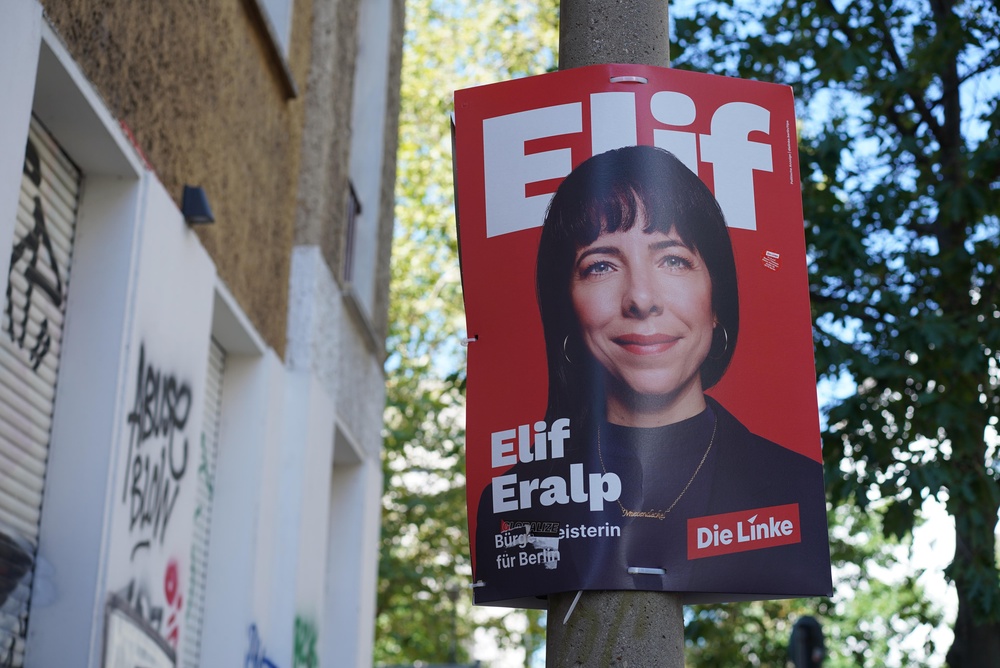
Germany’s recent state elections produced two sharply contrasting political pictures. While the far-right Alternative for Germany, or AfD, recorded major victories elsewhere in the country, Berlin moved in the opposite direction: for the first time since the fall of the Berlin Wall, Die Linke emerged as the leading force in the capital.
The result has made a coalition of Die Linke, the Social Democrats and the Greens a plausible governing option and placed Elif Eralp, Die Linke’s lead candidate for Berlin, at the centre of the city’s politics. Eralp is the daughter of parents who fled Turkey for Germany in 1988. Her party campaigned heavily on housing and rent controls, including bringing major private housing holdings into public ownership, alongside migrant rights, opposition to police violence and combating both antisemitism and anti-Muslim racism.
But the response to Die Linke’s victory has revealed another political divide — one that extends beyond Germany’s traditional left-right conflict. Among some Iranians living in Germany, including journalists themselves from migrant backgrounds, the result has produced anger strikingly similar to that expressed by sections of Germany’s conservative and right-wing media.
Two Germanies at the Ballot Box
Two weeks before the Berlin election, the AfD won around 44 per cent of the vote in the state election in Saxony-Anhalt, becoming the largest party there for the first time. It then secured close to 38 per cent in the state election in Mecklenburg-Western Pomerania. In the latter, the Social Democrats came second, while the Christian Democrats failed to clear the five-per-cent threshold required to enter the state parliament.
Berlin, however, delivered a very different result. Die Linke, which had lost support in the previous election, came first in the election to Berlin’s House of Representatives. Because Berlin is one of Germany’s city-states, this is the equivalent of a state parliamentary election.
Housing was central to the party’s campaign. Berlin has experienced years of rapidly rising rents, particularly in neighbourhoods such as Neukölln and Friedrichshain-Kreuzberg, areas with large migrant populations and a long history of left-wing and autonomous political organising.
Die Linke has promised stronger rent protections, more social housing, lower heating costs and implementation of the 2021 Berlin referendum calling for the expropriation of major private housing companies. More than 51 per cent of voters backed that proposal in 2021, but the demand was never turned into law.
Many of Die Linke’s strongest results came precisely from districts routinely portrayed by sections of the German media as migrant, Muslim, unemployed or “crime-ridden.” Its candidates in these areas also reflected Berlin’s migrant population. Among them was Rouzbeh Taheri, an Iranian housing-rights activist and one of the founders of the campaign to expropriate large private housing companies, alongside candidates from Turkish refugee and migrant-worker families.
Eralp herself comes from a Turkish family whose parents sought refuge in Germany.
From Housing Policy to a Culture War
The response from Germany’s right has focused on more than Die Linke’s economic programme. Right-wing media, particularly outlets close to Israel such as the Axel Springer group, have highlighted party candidates’ support for protests against Israel’s war in Gaza and their proximity to anti-war activists, presenting Die Linke’s victory as a danger to “Jewish life in Berlin.”
Some commentators have pointed to the party’s failure to foreground “Islamism” as a major threat in its election programme as evidence that Islamists are gaining political power in Berlin. In more openly racist versions of the argument, the election result has even been portrayed as a kind of Ottoman or Turkish conquest of the German capital.
The accusation of antisemitism against Berlin’s Die Linke has intensified since October 7, 2023. Germany’s treatment of criticism of Israel and pro-Palestinian activism as potential forms of antisemitism has itself been criticised by human-rights organisations, while anti-war activists — including Jewish activists — have faced prosecution and other legal measures. Following Die Linke’s victory, the Israeli embassy in Berlin went so far as to claim that Jewish people could no longer feel safe in the city.
Housing has produced another front of confrontation. Die Linke made affordable housing the centrepiece of its state-election campaign and has sought to revive both rent controls and the demand to expropriate major private housing companies. The AfD has presented this agenda as an attack on wealth and private property, while Chancellor Friedrich Merz has moved to prevent states from expropriating large private housing companies. The Social Democrats, property owners and banks have also opposed such measures, warning of their effects on housing and financial markets.
The political objective of these attacks, Saber argues, is clear: to make a coalition led by Die Linke impossible and prevent its Berlin victory from spreading to other German states and, eventually, to federal politics.
When Iranian Migrants Join the German Right
More striking, however, has been the reaction of some Iranians living in Berlin and working in Persian- or German-language media.
An Iranian journalist at the right-wing German newspaper Bild, a supporter of both Israel and Iran’s Pahlavi opposition, posted footage of Die Linke’s victory celebration and drew attention to Palestinian scarves, Arabic music and a migrant family. In another post, he used an image of Eralp at a gathering to associate her political milieu with hostility towards Israel and Jews.
He was not alone. An Iran International journalist in Berlin described the city as having been ruined by left-wing government, calling it disorganised, impoverished and comparable to “villages in a Third World country.” He characterised Die Linke as a party devoted to cultivating people who live on welfare and suggested that its electoral success was partly the product of mysterious foreign intervention and voter passivity.
Journalist Arash Sarkouhi challenged these claims, pointing out that Die Linke had participated in Berlin coalition governments for only 12 of the previous 20 years, had never been the largest governing party and had never held the mayoralty. He also noted that turnout had actually increased compared with the previous election, undermining the claim that voter “passivity” explained the result.
Another striking example came from an Iranian doctor whose video circulated on social media after the election. He described Die Linke as radical, fascist and Islamist, said its citizenship policies would turn Berlin into a city for Islamists and announced that he intended to leave. He warned Germans that within ten years Berlin would become an “Islamic city.”
These responses closely echo themes already used by the German right: hostility towards welfare recipients, fear of Muslims and migrants, opposition to redistribution and the portrayal of pro-Palestinian politics as an Islamist threat.
The Politics of “We Are Different”
The contradiction becomes particularly striking when anti-migrant politics are embraced by migrants themselves.
Saber points to Iranian supporters of Germany’s right who appear to assume that measures against migrants will not apply to them. Some have even openly acknowledged voting for the AfD because of its deportation policies, apparently reassured by statements suggesting that Iranians are somehow different from other migrants.
Yet the AfD’s policies do not necessarily sustain that distinction. In Saxony-Anhalt, for example, the party has also included non-German doctors in proposals concerning the removal of foreign nationals.
A similar contradiction appears around social protections. Iranian commentators who condemn welfare payments, public housing and redistributive policies in Germany may themselves live in a country where migrant rights and protections were secured through political struggles in which the left played an important role. Saber argues that some of the very people attacking these policies have benefited from the conditions they helped create.
Palestine and the Iranian Right
Palestine has intensified these divisions. For sections of the Iranian right, hostility to the Islamic Republic has increasingly become intertwined with support for Israel. In Germany, that alignment overlaps with a political environment in which pro-Palestinian activism has repeatedly been accused of antisemitism and subjected to legal and police restrictions.
Some Iranian reactions to Die Linke’s victory reproduce the same language: the party is portrayed as antisemitic, Islamist, dangerously close to Palestinian organisations or compromised by its support among Muslim voters.
Saber compares these attacks with the response to Zohran Mamdani in New York. Eralp herself had previously pointed to Mamdani’s success as evidence that the left could win in Berlin. In both cases, opponents have relied on a similar vocabulary: “antisemitic,” “Islamist,” “socialist” and hostile to the free market.
The comparison also extends to sections of the Iranian diaspora. In the United States, prominent Iranian opposition figures such as Masih Alinejad campaigned against Mamdani; in Berlin, right-wing Iranians have become prominent participants in attacks on Die Linke.
More Than an Iranian Contradiction
For Saber, this is not simply a curious contradiction within exile politics. The language used by sections of the Iranian right in Germany reveals a deeper political orientation.
Some Iranian nationalists have reacted angrily not only to Die Linke’s position on Palestine and migration but also to proposals for stronger social welfare, free education and greater control over the housing market. Yet media aligned with the same political currents routinely describe rising rents, healthcare costs and educational expenses inside Iran as forms of oppression produced by the Islamic Republic.
The contradiction, in Saber’s view, is revealing: social suffering in Iran becomes evidence for regime change, while attempts to expand social protection in Germany are denounced as threats to democracy or incentives for idleness.
He argues that the reactions of parts of the Iranian diaspora therefore deserve closer political and sociological attention. Just as the support of some Cuban migrants in Miami for Donald Trump has become an object of analysis, the attraction of some Iranian migrants towards right-wing and even far-right politics in Europe may warrant similar scrutiny.
The issue also matters beyond Germany. Saber warns that political currents promoting slogans against leftists, defending the legacy of the Shah’s security apparatus and embracing increasingly exclusionary forms of nationalism are relevant to debates about Iran’s own future.
Berlin’s election therefore reveals more than a German electoral divide. At a moment when the far right is gaining ground, Die Linke’s victory has also exposed competing political tendencies among Iranians in exile: between support for redistribution, migrant rights and social protections on one side, and an increasingly explicit identification with the politics of the European right on the other.