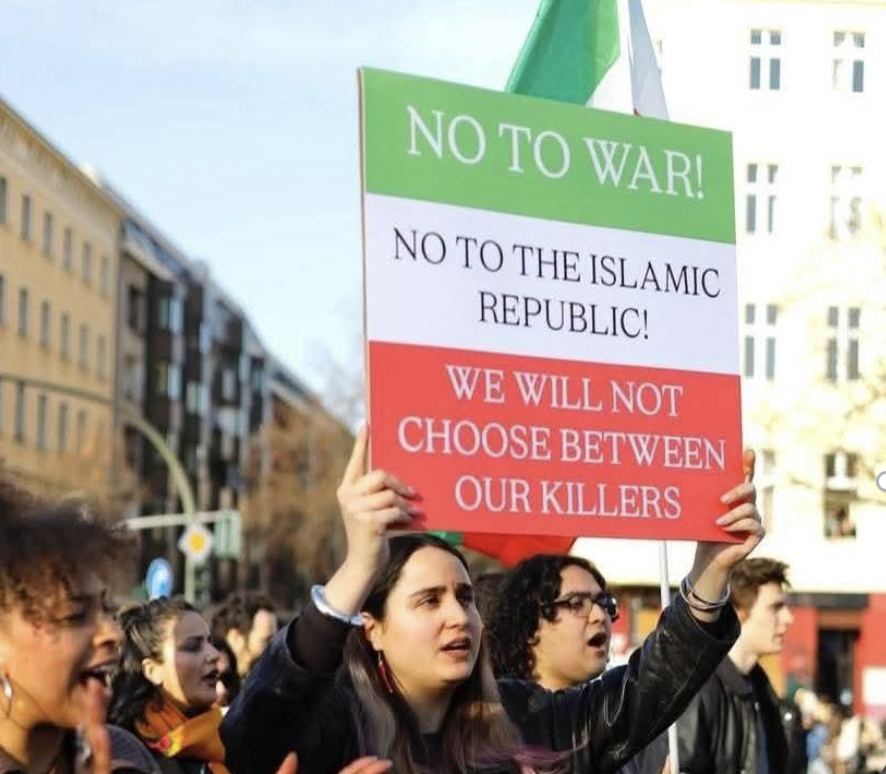
More than 100 Iranians reject the choice between foreign aggression and state repression, demanding an end to executions, political imprisonment, war and collective punishment.
More than 100 former political prisoners, human rights defenders, writers, journalists, academics, trade-union activists and civil society figures inside Iran and in exile have issued a joint statement in support of the open letter published in The Guardian on 20 August 2026 in solidarity with Iran’s political prisoners. Read the Guardian open letter
The Guardian letter, titled To Iran’s Political Prisoners, Trapped ‘Between Two Blades of a Scissors’, was signed by prominent intellectuals, activists and former and current political prisoners including Angela Davis, Judith Butler, Mumia Abu-Jamal, Michael Löwy and Alberto Toscano. Addressed directly to prisoners of conscience across Iran, it condemned both the Islamic Republic’s machinery of imprisonment, torture and execution and the US-Israeli war, military attacks and sanctions against Iran. Its central argument was that Iranian political prisoners are caught between two distinct sources of violence and domination and should not be forced to choose between them.
The new statement, published in response both to the letter and to the controversy that followed it, endorses that position. Its signatories insist that the people of Iran must not be forced to choose between external military and economic aggression and state repression. They call for an immediate halt to executions, the release of all political prisoners, and an end to war and the collective punishment of the Iranian people. Read the full statement
The statement reads:
“We echo its call to immediately halt executions, release all political prisoners, end the war, and end the collective punishment of the Iranian people. We commend the signatories’ historic act to build solidarity with the Iranian people by foregrounding the struggle of political prisoners directly subjected to state repression.”
Addressing the metaphor of the “two blades of a scissors,” the statement stresses that using it to describe Iranians simultaneously confronted with war and state repression does not imply a moral or political equivalence between the two. Recognising and condemning different forms and sources of violence does not mean erasing their distinct origins or conflating their intentions. Rather, the metaphor centres the lived experience of those caught between irreconcilable forms of pressure.
The statement rejects the binary logic that demands exclusive allegiance either to the Islamic Republic or to imperialist powers. A state, it argues, can simultaneously be the target of foreign aggression and the agent of domestic repression, and these two realities must be held together rather than allowing one to excuse the other.
The signatories point to a history of foreign intervention in Iran, including the bombardment of Iran’s parliament following the Constitutional Revolution, the 1953 coup, and more recent sanctions and the current US-Israeli war against Iran. Alongside this history, they recall forms of state repression before and after the 1979 revolution, including political imprisonment and executions, compulsory hijab, censorship, the suppression of civil society and minority communities, and the persecution of political and social movements.
Recognising both realities, they argue, means refusing the idea that the rights of political prisoners can be made contingent on geopolitics. The fact that the Islamic Republic itself faces foreign aggression does not diminish the suffering of those it imprisons, nor can justice, freedom and democracy be postponed in the name of its purported “anti-imperialist resistance.”
The statement also challenges the idea that the Islamic Republic represents the sole or authentic tradition of solidarity with Palestine in Iran. It points instead to the Iranian left’s much longer history of solidarity with Palestinians, a history predating the establishment of the Islamic Republic.
It states:
“Long before the Islamic Republic, the Iranian left played a central role in building networks of solidarity with progressive Palestinians, a legacy rooted in anti-colonial struggle and internationalism that did not start with the establishment of the Islamic Republic. This same leftist movement was the first victim of severe repression after the 1979 Revolution.”
That repression culminated, among other atrocities, in the mass execution of political prisoners in the summer of 1988, a massacre extensively documented by former prisoners, researchers and human rights organisations and described as a crime against humanity.
The signatories go on to reject the instrumentalisation of Iranian suffering, whether it is used to justify military intervention from abroad or repression at home. Iranian lives, they argue, cannot be reduced to propaganda material for competing ideological camps.
The statement says:
“We reject the instrumentalization of Iranian suffering, whether as justification for foreign military intervention or as an excuse for domestic repression. Iranian lives must not be manipulated for propaganda by any ideological camp.”
It adds that laws criminalising protest and dissent, facilitating coerced confessions and sham trials, and enabling the summary execution of prisoners without evidence do not demonstrate the legitimacy of a sovereign state’s legal system. They testify instead to its injustice and must be opposed.
The statement concludes with a direct challenge to forms of anti-imperialist politics that disregard repression inside Iran: “‘Resistance’ that turns a blind eye to the struggle of political prisoners is not worthy of that name.” Its signatories express solidarity with all those resisting domination, oppression and imperialist wars.
Among the signatories are Janet Afary, Touraj Atabaki, Nayereh Tohidi, Mohammad Habibi, Reza Khandan, Atena Daemi, Fatemeh Shams, Parastou Forouhar, Saeed Madani, Mohammad-Reza Nikfar, Mehrdad Vahabi, Frieda Afary, Monireh Baradaran, Ali Banuazizi, Alireza Behtoui, Mansoureh Behkish, Saeed Paivandi, Mehrdad Darvishpour, Faraj Sarkohi and Mansoureh Shojaee, alongside many other former political prisoners, writers, academics, trade-unionists and civil society activists. The published statement carries 102 signatures.
The 20 August Guardian letter had framed the same position in explicitly internationalist terms. Addressing Iran’s political prisoners, it declared: “We stand with you, and we reject the false binary of imperialism and hollow anti-imperialism.” It called on global civil society and anti-imperialist organisations to build sustained solidarity with political prisoners in Iran, amplify their voices and pressure the Islamic Republic to stop executions and release political prisoners, while also demanding an end to US-Israeli war and sanctions.