

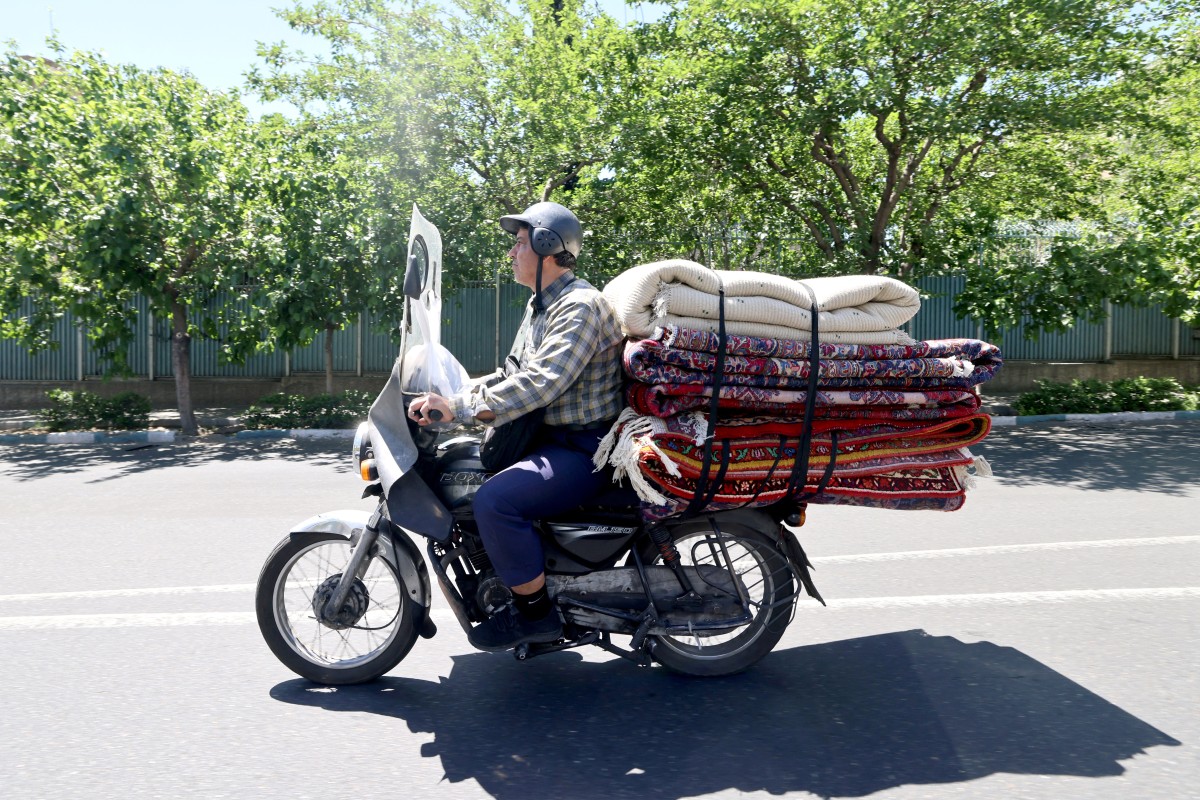
A field report from Iran follows Tehran’s motorbike couriers, who keep the city moving at the cost of crashes, exhaustion, sleeplessness and relentless pressure to work faster.
Tehran has become a hub for motorbike couriers. The need to move quickly through the capital’s traffic has turned this job into an option for many young men. From a distance, it may look like relatively easy work. But the wounds on couriers’ bodies and legs, and their exhausted minds, tell another story.
Density and the Demand for Speed
Motorbike couriers have become increasingly important to Tehran’s urban economy amid the city’s rapid and poorly planned expansion. They transport all kinds of parcels, goods and passengers across the city.
In traffic-clogged Tehran, almost every journey by car is disrupted. Few appointments or deliveries happen on time unless they have been planned hours in advance. Even then, a single accident along the route can render all that planning useless.
This is the contradiction of a city that demands ever greater speed while placing dozens of obstacles in its way.
An Escape Route
The metro is one of the systems designed to move large numbers of people and workers quickly through major cities. But transporting packages, goods and some passengers to a specific destination within a short period of time remains a problem.
Motorbike couriers have become the solution. They cut through traffic and meet an essential need in an overcrowded city.
Their work falls broadly into three categories.
The first group works in Tehran’s Grand Bazaar. Some transport passengers through the bazaar’s extreme congestion, while others carry wholesalers’ goods out of its crowded streets to quieter locations where they can be loaded onto vehicles. Their sheer numbers in Tehran’s bazaar can evoke the crowded streets of India or Bangladesh.
One-way streets, no-entry signs and conventional traffic routes mean little to them. They find a way through from every corner and keep moving. There are so many of them that traffic police have, in practice, learned to tolerate their presence and largely leave them alone. This accommodation is a price the city’s regulatory order pays for its dependence on their labour.
A second group works through delivery platforms such as Snapp, Tapsi, Miare and a growing number of newer apps. They transport almost anything: ordinary supermarket shopping, spare parts, passengers, online purchases, letters, and packages large and small.
Typically, between 10 and 20 percent of their earnings is deducted as commission by the apps. These companies effectively act as employers, profiting from the labour of the couriers who work for them.
A third, very large group works specifically in food delivery and for restaurants. Speed is even more important in this sector. Ordered food is expected to reach the customer in less than 40 minutes.
Some couriers work directly for a particular restaurant, while others pick up orders according to which courier is closest. Because of this pressure for rapid delivery, restaurant couriers suffer some of the greatest occupational harm.
The Toll of the Job
Ordered food must reach the customer hot and in good condition. On the SnappFood app, for example, once a restaurant accepts an order, it generally has around 40 minutes to deliver it.
Roughly 25 to 30 minutes of that period may be spent preparing the food in the restaurant kitchen. This leaves the courier somewhere between 10 and 20 minutes to make the delivery. If the food does not arrive within that time, both the restaurant and the courier are penalised. The customer may also refuse the order and send it back.
Restaurant owners have shifted the consequences of failed deliveries onto the couriers. Once food has been dispatched, it effectively cannot be returned without cost to the courier. If a customer sends an order back, its price may be charged to the courier and deducted from his wages.
Sometimes a family places an order worth nearly five million tomans. If the courier fails to deliver it on time, he may be expected to reimburse the restaurant for the entire five million tomans—an amount equivalent to several days of his earnings.
Putting couriers under this kind of pressure forces them to race towards their destinations at maximum speed and with little room for caution. Few motorbike couriers in Tehran stop at every red light. They risk fatal accidents in order to avoid being penalised.
This is not their choice. It is a condition imposed on them by the exploitative relationship between worker and employer.
Stories from the Road
Milad is one of these SnappFood couriers. I have known him for some time. I ask him about his job and the restaurant where he works:
“I’m never working for these bastards again. A while ago, one of my friends was working here. He had an accident and broke his leg badly. His motorbike was wrecked too. I went to take him to hospital. These bastards from the restaurant call me and say, ‘Come back, we’ve got orders.’
“I tell them, ‘He works for you. He’s had an accident. I brought him to hospital.’ And the guy says, ‘He had the accident. You’re fine!’
“They didn’t even want me taking the poor guy to hospital. Can you believe it? They didn’t even call him afterwards to see how he was doing.”
Minor accidents—and sometimes fatal ones—have become an entirely ordinary and accepted part of restaurant couriers’ working lives.
Employers accept no responsibility for the physical or financial consequences of these crashes. To them, couriers are not human beings with needs of their own. They are treated simply as machines for meeting the demands of the business.
Another courier says:
“I have two children. If it weren’t for them, I wouldn’t have to destroy myself like this. Most nights they keep me working until two in the morning. By the time I get home, it’s three. I eat something and get to sleep around four. Then I have to be back at work at eleven in the morning.
“Sometimes I go an entire week without seeing my children.”
Long working hours are a permanent feature of food-delivery work. As long as orders keep coming in, restaurants keep couriers and other workers on the job.
Serving the Needs of the Upper Classes
Ready-made food and fast food largely serve the middle and upper classes. Poorer people have far less ability to afford prepared food, and most regular customers come from higher-income groups.
In effect, a whole layer of low-paid workers must labour around the clock to provide the affluent with hot, ready-to-eat food.
The prepared-food industry is profitable for restaurant owners in large cities. For motorbike couriers, however, it brings little but injury, sleeplessness, exhaustion and physical and psychological wear.
One of Milad’s friends recalls:
“Last winter it snowed, and they sent me up to Tehran Roof. Everything had turned to ice. I fell my motorbike broke and I hurt my leg.
“I told them, ‘At least stop accepting orders from up there until the snow is over.’ And the guy turns around and says to me, ‘A courier can’t expect everything to be roses and sunshine. That’s the job.’”
Their position in the labour market leaves motorbike couriers exposed to exploitation by restaurants while requiring them to deliver hot meals to social classes considerably more affluent than their own.
This does not mean that working-class people never order prepared food. Rather, the dominant pattern is that couriers’ labour is organised primarily around satisfying the needs of social classes above their own.
Much of a food courier’s life is spent at work: on the streets, in stairwells and in the lifts of affluent residential towers.
If they work fewer hours, their earnings are not enough to sustain even a basic life in Tehran. Those supporting a family generally have fewer than seven hours left each day for sleep and rest.