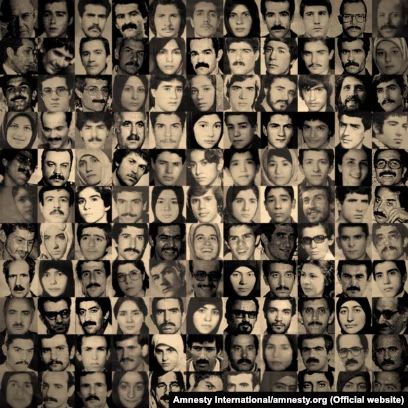
For four decades, Khavaran’s families have turned unmarked graves into an archive of state violence, preserving names, evidence, and an unfinished demand for justice.
In the closing days of the Iranian year, in March 2026, families who return to Khavaran each year for the same long-standing gathering found the gate closed. It was neither new nor exceptional. For nearly four decades, simply going to that patch of land, laying flowers on its soil, and standing beside it has itself been a source of conflict.
Khavaran is a plot of land in southeastern Tehran where the bodies of a number of executed political prisoners, particularly left-wing political prisoners, were buried in unmarked and mass graves. But if we see it only as the best-known burial ground of victims of the 1988 massacre of political prisoners, we miss the most important part of its history. From the beginning, Khavaran has been the site of a struggle over another question: who has the right to record the past, to decide where the dead are buried, and to determine what remains of them?
The seizure of the bodies of those executed, the refusal to return them to their families, and the prohibition of mourning were all part of a mechanism that extended power from the prisoner’s living body to the prisoner’s dead one. The state had not only decided their fate in life; it also sought to claim ownership over them after death.
When Families Became the Documentarians
In the summer of 1988, thousands of political prisoners were cut off from the outside world for weeks. Families went to the prisons and came back again. Visits had been suspended, and no one would tell them anything. News of the executions came later, piece by piece. Many bodies were never returned, nor were families told where they had been buried. Testimonies recorded later described shallow graves and bodies buried without any marker.
Normally, a state execution leaves behind a paper trail: the sentence, the time of execution, the cause of death, the place of burial, a record of the body being handed over. At Khavaran, all of these were absent. That void forced families, unintentionally, into the role of archivists and documentarians of the crime.
They collected names. They preserved photographs. Released prisoners gave testimony. Mothers pointed to corners of the land and said: perhaps it is here. They placed flowers and photographs in the soil and, year after year, returned to the same place where they were not even permitted to put up a simple gravestone.
A large part of Khavaran’s archive was created directly against the state’s wishes. The soil became evidence because the families refused to allow the link between the earth and the names of the dead to be severed.
From Mourning to the Pursuit of Justice
The Khavaran families were not initially an organisation, nor did they have a common programme. Their relationship began with loss: one was searching for her son, another for her husband, another for her sister. But when all of their searches ended at the same network of prisons, prosecutors’ offices, and unmarked graves, private grief became a collective experience. The pursuit of justice here is not simply a demand that an individual perpetrator be punished. It means preserving names, reconstructing what happened, and refusing to allow violence to remain private.
Seen from this perspective, it becomes clear why the gates of Khavaran are still being closed. The obstruction repeated in March 2026 is not a relic of the first years after the massacre; it is a policy that has spanned several generations. Thirty-seven years have passed, and there is still a struggle over the right to lay a single flower on the ground. Nothing could make it clearer that the issue is not simply where the dead are buried. The issue is control over the narrative of their deaths.
But memory is not, by itself, justice. A society may know the truth about a crime while those responsible never stand trial. A few years ago, one case related to the 1988 massacre reached a verdict in a European court. What made that case possible was not a state archive, but the testimony of people who had preserved their memories for thirty years. Yet that same case also showed that justice has no guaranteed happy ending: a verdict was issued, and later, amid bargaining between governments, its enforcement was set aside.
An archive does not guarantee that justice will be done. But without an archive, even the possibility of raising the question of justice again disappears.
Law as Stagecraft
This history becomes even more consequential when we look at recent months. Since February–March 2026, at least 56 people in Iran have been executed on charges related to national security, while more than one hundred others are awaiting execution. This is a chain in which street protest and self-organisation are criminalised.
The next step is to shift the accusation out of the register of protest and into the vocabulary of war: moharebeh, or “enmity against God”; “corruption on earth”; armed rebellion; collaboration with a hostile state. Someone who was in the street becomes, on paper, an agent of a foreign power. The script of foreign intervention is written before the arrest; what happens afterwards merely fills in the blanks.
Arrests are arbitrary and often undocumented. People are taken from the street, from their homes, or from hospital beds, then kept incommunicado for weeks. It is during these days and weeks of disappearance that the “confession” is produced: a text that will later become the central pillar of the case, while almost no one in court asks how it was obtained.
Then comes the trial, and here the gap is widest of all. Iran’s Constitution requires political offences to be tried publicly and in the presence of a jury, but these cases are not classified as political offences at all. They are sent to Revolutionary Courts, where there is neither a jury nor public scrutiny. In national-security cases, defendants are not free to choose their own lawyer during the preliminary investigation and must select one from a judiciary-approved list. An independent lawyer, if allowed into the case at all, has often not seen the file until the final hours.
And the judge does not adjudicate. The judge’s task is to endorse the security agency’s report. The sentence has been written before the hearing, and the hearing is merely the ceremony through which it is issued: sometimes lasting a few hours, sometimes dealing with several defendants at once, always behind closed doors.
It is a performance—a performance conducted in the language of law so that killing can assume the form of a judicial sentence. Justice is not its purpose. Intimidation is, and law is merely the costume that makes it presentable.
A Script Written Before Death
This is also what gives the speed with which sentences are carried out a different meaning. With a punishment that can never be reversed, time itself is part of due process: time is needed for a lawyer to read the case file, for allegations of torture to be investigated, for an appeal to be lodged. When the distance between arrest and the gallows is reduced to a few months or even a few weeks, that compression is not a malfunction of the system. It confirms that nothing was ever meant to be verified in the first place. Where the sentence has been written before the hearing, taking time over the process has no purpose.
And once again, the story does not end with the execution. This year, the bodies of a number of executed political prisoners had still not been returned to their families weeks after their sentences were carried out, and no one knew where they had been buried. Human rights reports have described the concealment of their bodies as a continuation of enforced disappearance.
At this point, Khavaran is no longer a historical metaphor. The same question has returned: after death, who owns the body? When a family is not told when the execution will take place, has no opportunity to say goodbye, and does not know where the grave is, power has not ended with the carrying out of the sentence.
There is, however, one difference. In 1988, the massacre first took place in darkness, and its archive had to be extracted from beneath years of silence. Today, in many cases, the archive is assembled before death. The prisoner’s name is known. Their lawyer has spoken. Their family has written letters. The court branch and charges have been recorded. Human rights organisations have issued warnings. In other words, the problem is not always discovering something that has been hidden. Sometimes everyone knows, and the sentence is carried out anyway.
What Remains
An execution removes a person, but it does not necessarily erase their memory. Mothers who went to Khavaran simply looking for the graves of their children ultimately created one of the most enduring networks for the pursuit of justice in contemporary Iranian history.
But to describe what they did merely as “preserving memory” is to underestimate it. The question “Who was responsible?” is no longer really a question; we know the answer. The name of the court branch, the name of the judge, the name of the security agency, and the signature at the bottom of the sentence are all there in the archive. These four decades have demonstrated that knowing, by itself, stops nothing.
What the Khavaran families did was not simply an act of discovery. They did not merely gather evidence and testimony; they became complainants themselves. And that is no small distinction. In the Revolutionary Court, the state turns a protester into a defendant. But the rest of the apparatus—the body it refuses to return, the grave it refuses to identify, the gate it closes every March—is pursuing something else: ensuring that no one becomes a complainant. Turning the protester into a defendant is one half of the project; ensuring that the crime has no complainant is the other.
Seen from this perspective, the Khavaran archive is not simply evidence waiting for a trial. It is the record of proceedings for a court that has yet to convene. Without ever naming their work in these terms, the families have kept the case alive for adjudication for forty years, even in the absence of any tribunal.
The day the gates to Khavaran are finally opened, what stands behind them will not be a plea to be heard. It will be a completed case file, waiting only for the court that will finally hear it.