

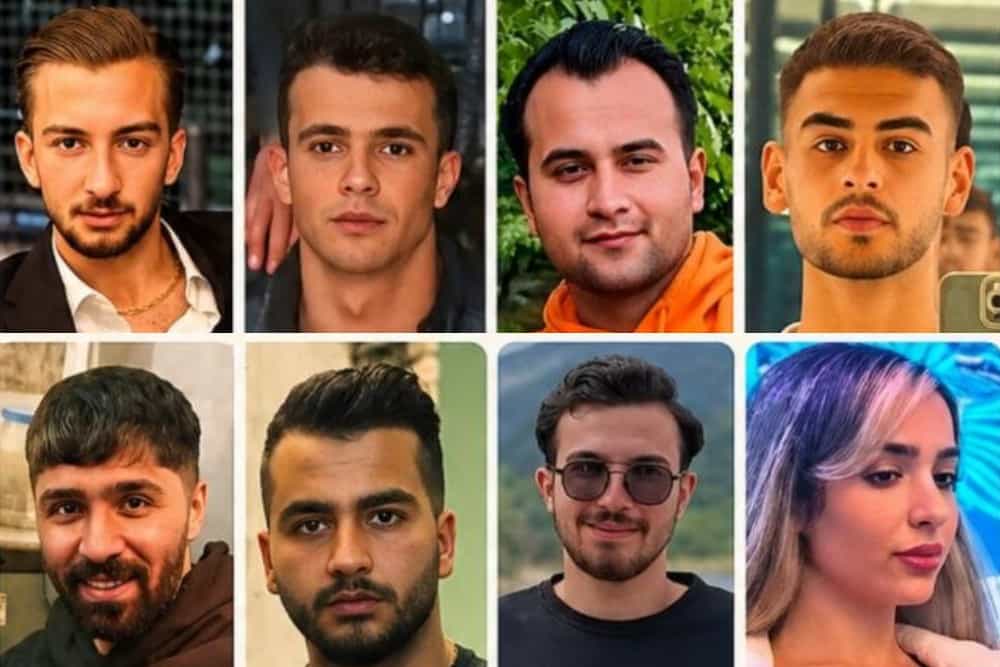
Eight protesters face possible death sentences after being denied independent legal representation linked to the January uprising, during which Mashhad witnessed one of the largest protests of the uprising.
The case involves 25 people detained during the January protests at the Shandiz prayer grounds in Mashhad. It has now entered a critical stage, with reports indicating that eight defendants may receive death sentences or face execution.
The eight detainees at risk are Ilya Akbari, Ali Zaghi, Farshad Hosseinpour, Sajjad Cherani, Hossein Rasouli-Nasab, Matin Shabani, Mehdi Zarif and Najmeh Amini.
Published reports indicate that they have been denied access to lawyers of their own choosing throughout their detention, intensifying concerns over their right to legal representation and the observance of fair-trial standards.
The authorities have reportedly accused them of involvement in the destruction of public property, setting fire to religious sites, and “assembly and collusion against national security.”
No further information has been released about the individual judicial status of the eight defendants or the precise stage their cases have reached.
Was Mashhad Briefly Outside Government Control?
The case has drawn increasing attention amid conflicting accounts of the scale of the January protests in Mashhad and the extent of the authorities’ control over the city at the height of the unrest.
Javad Mogouei, a state-aligned presenter and documentary filmmaker, recently appeared on the program The Story of War 2 alongside Abbas Araghchi, the Islamic Republic’s foreign minister. Mogouei said that, after investigating the events himself, he had concluded that some of US President Donald Trump’s claims about the situation in Mashhad had been accurate.
He said the city had slipped beyond government control for several hours.
Mogouei was referring to statements Trump posted on Truth Social during the protests. Sharing images of demonstrations, Trump claimed that more than one million people had gathered in Mashhad, that “Iran’s second-largest city was under the control of protesters,” and that government forces had abandoned the city.
Responding to the events during the same interview, Araghchi said: “We must, after all, acknowledge that we had weaknesses.”
After these remarks received widespread attention, Iran’s Interior Ministry spokesperson rejected the claim that Mashhad had “fallen.” Referring to the ministry’s continuous contact with the governor of Razavi Khorasan Province, he said that although the clashes in Mashhad had been intense, “our communication with Mashhad was not interrupted even for a single moment.”
The January Protests in Mashhad
According to published reports, the protests in Mashhad began on December 29, 2025, in the city’s Reza Bazaar, following a widespread strike by bazaar merchants in Tehran.
Eyewitnesses said several areas of Mashhad, including the vicinity of Mellat Park and Shandiz, witnessed severe confrontations between security forces and protesters.
From around January 10, 2026, a heavy security presence reportedly descended on the city. Checkpoints were established in several locations, while motorcycle units and security patrols became increasingly visible.
Widely differing figures have been published regarding the number of people killed. Islamic Republic officials have put the death toll at approximately 400, while some unofficial sources estimate that thousands were killed.
Executions Following the Protests
The Mashhad case has emerged amid growing concern among human rights organizations over the accelerating use of the death penalty in Iran.
In recent months, these organizations have repeatedly warned of an increase in both the issuance and implementation of death sentences, particularly in cases connected to the protests. They have also raised concerns over violations of the right to life and the failure to observe fair-trial standards.
According to a recent report by the Iran Human Rights Center, the Islamic Republic executed at least 58 prisoners across the country over a 16-day period in July 2026—an average of between three and four executions each day.
Should the reported threat of death sentences or execution against the eight Mashhad detainees be confirmed, their case could become one of the most significant death-penalty cases arising from the January protests.